Why do mice like to chew on jumper cables? How does stainless steel armor make mice’s teeth hurt?
This is a classic and interesting cross-disciplinary problem involving physics and biomechanics. In fiber optic communication networks and sensor engineering, rodent resistance (anti-rodent) is an extremely important physical protection indicator.
We can scientifically explain why “mice love to gnaw on patch cords” and “how stainless steel jacketing blocks this behavior and gives them a ‘toothache’” from the perspectives of biological characteristics, material mechanics, and acoustic emission feedback.
I. Why Do Mice Love to Gnaw on Standard Fiber Optic Patch Cords?
Many engineers mistakenly believe that mice gnaw on patch cords because “they have a smell” or “mice want to eat them.” In reality, this is entirely determined by the rodent’s physiological structure:
- The Incisors’ Continuous Growth Trait:
Mice’s incisors lack roots and are continuously growing throughout their lives. Their incisors grow approximately 1.4\text{ mm} to 2.8\text{ mm} per week. If they don’t wear down their teeth by gnawing on hard, resilient objects, their incisors will grow too long, curve into their brain or jaw, preventing them from eating and leading to starvation. Therefore, “gnawing” is an instinctive physical activity for mice to survive. - The Ideal Gnawing Sensation of Polymer Sheathing:
The outer sheathing of conventional fiber optic patch cords is typically made of Polyvinyl Chloride (PVC), Low Smoke Zero Halogen (LSZH), and internally filled with Aramid (Kevlar fiber). These polymer materials have a very low Mohs hardness and possess a certain degree of elasticity and toughness. When mice gnaw, their teeth cut into the material, providing an excellent sense of frictional damping, which is very similar to the texture of plant roots and twigs in nature. This makes them very fond of choosing patch cords as targets for gnawing. - Overlap with the Installation Environment:
Fiber optic patch cords are usually laid in dark, dry, and narrow areas such as conduits, cable trays, underfloors, and weak current shafts. These locations happen to be the main pathways and nesting sites for mice, increasing the probability of contact and gnawing behavior.
II. How Does Stainless Steel Jacketing Give Mice a “Toothache”?
When stainless steel jacketing (seamless stainless steel tubes or stranded steel wire structures) is introduced into patch cords, the rodent-proofing mechanism shifts entirely from “chemical deterrence” (spraying toxic or spicy agents) to physical obstruction. This design, through the following physical mechanisms, causes severe pain to mice when they attempt to gnaw, leading them to abandon the act:
- Absolute Suppression by Mohs and Vickers Hardness:
The surface of a mouse’s teeth is composed of enamel (primarily hydroxyapatite), which has a Mohs hardness of approximately 5.5.
Standard PVC or LSZH sheathing has a very low Mohs hardness (below 2).
High-performance stainless steel (e.g., SUS304) used in OFSCN® armored patch cords has an extremely high elastic modulus (Young’s modulus E \approx 190\text{ GPa} - 200\text{ GPa}) and Vickers hardness. Mouse teeth are incapable of causing any plastic deformation or cutting to stainless steel. - Acute Neuralgia Caused by Reaction Force and Vibration:
When a mouse attempts to bite down forcefully on the stainless steel jacket tube, due to the material’s extremely high compressive strength (e.g., OFSCN® rodent-resistant patch cords can withstand lateral pressure greater than 150\text{ MPa} to 240\text{ MPa}), the biting force exerted by the mouse is instantly converted into an elastic reaction force of equal magnitude.
This rigid compression, which cannot be relieved, generates high-frequency micro-vibrations that are directly transmitted to the base of the mouse’s teeth. The high pressure and micro-vibrations stimulate the nociceptors in the dental pulp and periodontal ligament, causing severe acute toothache. - Chipping and Physical Damage Risk:
If a mouse forcibly increases its biting force (rodent bite pressure can reach tens of thousands of pounds per square inch), the hard enamel of its incisors will chip or fracture against the high-rigidity stainless steel surface. Once they experience this, the intense nerve pain and discomfort feedback will form a long-term conditioned reflex, prompting the mouse to immediately abandon gnawing on the cable.
III. OFSCN® Official Rodent-Resistant Stainless Steel Armored Patch Cord Solution
To address these harsh industrial and multi-rodent environments, OFSCN® has launched several ultra-strong armored fiber optic patch cords utilizing all-metal stainless steel structures. These patch cords not only possess extremely high tensile and compressive strength but also completely physically block all rodent gnawing damage:
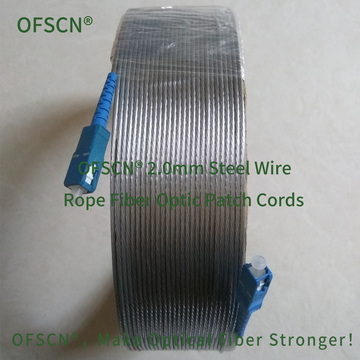
1. OFSCN® 2.0mm Steel Wire Rope Fiber Optic Patch Cord
This patch cord features a bare metal design without sheathing, with an outer layer constructed from a steel wire rope structure, offering unparalleled mechanical strength and resistance to rodents and cutting.
- Physical Structure: Consists of fiber optic connectors, a 0.6\text{ mm} galvanized steel wire stranded structure, a 1.0\text{ mm} seamless stainless steel tube, and optical fiber (all-metal structure).
- Key Specifications: Default diameter 2.0\text{ mm}; tensile strength \gt 1500\text{ N}, compressive strength \gt 150\text{ MPa}. Operating temperature range is -40\text{℃} to 85\text{℃}.
- Product Images:

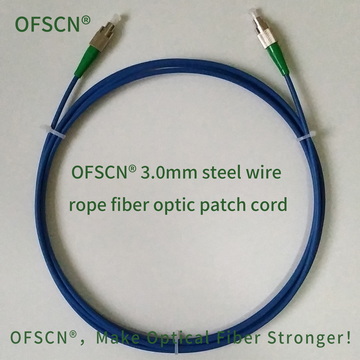
2. OFSCN® 3.0mm Steel Wire Rope Fiber Optic Patch Cord
A multi-layer steel wire rope protected patch cord with a PE outer sheath, suitable for outdoor, buried, or humid environments.
- Physical Structure: Consists of fiber optic connectors, PE sheath, a 0.45\text{ mm} stainless steel wire stranded structure, a 0.9\text{ mm} seamless stainless steel tube, and optical fiber.
- Key Specifications: Default diameter 3.0\text{ mm}; tensile strength \gt 1200\text{ N}, compressive strength \gt 200\text{ MPa}. Operating temperature range is -40\text{℃} to 75\text{℃}.
- Product Images:

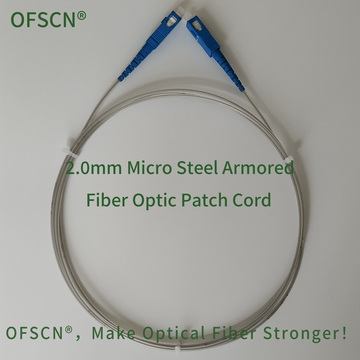
3. OFSCN® 2.0mm Micro Steel Armored Fiber Optic Patch Cord
While maintaining a small diameter and flexibility, the built-in seamless stainless steel tube provides extremely high pressure protection.
- Physical Structure: Consists of fiber optic connectors, PVC sheath, a 0.6\text{ mm} seamless stainless steel tube, and optical fiber.
- Key Specifications: Default diameter 2.0\text{ mm}; tensile strength \gt 150\text{ N}, compressive strength \gt 240\text{ MPa}. Operating temperature range is -40\text{℃} to 75\text{℃}.
- Product Images:
Conclusion
Rodent-resistant patch cords do not “deter” mice through chemical toxicity or smell. Instead, they protect the delicate internal optical fiber from physical damage by utilizing a rigid protective layer of high-modulus stainless steel that, under strong pressure, generates intense physical counter-force and high-frequency vibration stimulation on the mouse’s teeth, directly causing pulp nerve pain and fundamentally safeguarding the optical fiber from breakage.