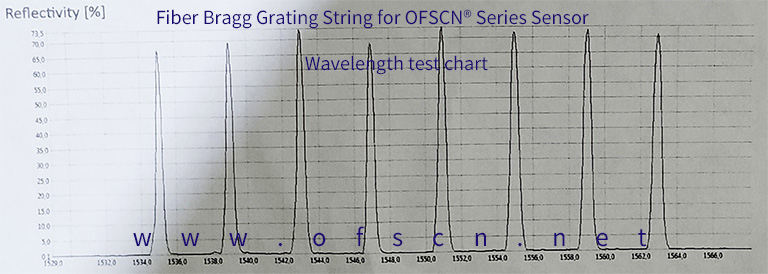
What does the spectral plot look like when multiple gratings of different wavelengths are inscribed on a single fiber?
When multiple Fiber Bragg Gratings (FBGs) with different center wavelengths are inscribed sequentially on a single optical fiber, the spectral plot exhibits a “comb spectrum.” This means that instead of a single reflection peak, you will observe multiple distinct reflection peaks, each corresponding to a specific FBG and its unique Bragg wavelength. Each peak’s position represents the center wavelength of that particular FBG, while its amplitude and bandwidth are determined by the FBG’s design parameters (e.g., reflectivity, grating length).
This configuration allows for multipoint sensing along a single fiber, as each FBG can measure a different parameter (e.g., temperature, strain) at its respective location, with the interrogator distinguishing them by their unique wavelengths.
OFSCN offers various types of bare Fiber Bragg Gratings that can be configured as strings (multiple gratings on a single fiber) for such applications:
- OFSCN® Polyacrylate Fiber Bragg Gratings / Fiber Bragg Grating Strings (bare)
- OFSCN® Polyimide Fiber Bragg Gratings / Fiber Bragg Grating Strings (bare)
- OFSCN® Standard Femtosecond Fiber Bragg Gratings / Fiber Bragg Grating Strings (Bare)
Here are some visual representations of how multiple FBGs can be arranged on a single fiber:



1 Like