Is it equivalent to the “brain” of a fiber optic sensing system? How does it convert light into digital signals?
In a Fiber Bragg Grating (FBG) sensing system, the FBG Interrogator is indeed equivalent to the “information hub” or “brain” of the entire system.
Fiber Bragg Grating sensors themselves are passive devices that only cause a slight drift in the central wavelength of their reflected light when subjected to changes in physical quantities such as temperature and strain. The interrogator undertakes all core tasks of “light emission,” “light signal reception,” “spectral analysis,” “photoelectric conversion,” and “data calculation and quantization.”
I. How Does an FBG Interrogator “Turn Light into Digital”?
The physical and data processing stages by which the interrogator converts optical wavelength signals into digital signals mainly include the following four phases:
[Built-in Broadband Light Source/Swept Laser]
       │ (Injects broadband light)
       ▼
[Fiber Bragg Grating Sensor (FBG)] ────(Reflects characteristic narrow-band light λ_B)────► [Spectral Spectrometer / Wavelength Selection System]
                                                             │
                                                             ▼
                                                    [Photodetector (PD/CCD)]
                                                             │ (Photocurrent analog signal)
                                                             ▼
                                                    [ADC Analog-to-Digital Converter]
                                                             │ (Digital array sequence)
                                                             ▼
                                                    [Digital Signal Processor (DSP/FPGA)]
                                                             │ (Extracts wavelength using spectral peak algorithm)
                                                             ▼
                                                    [Physical Quantity Calculation and Communication Output]
1. Optical Excitation and Reflection
The interrogator’s internal light source (such as a broadband ASE light source or a tunable laser) injects measurement light into the optical fiber. When the light signal reaches the Fiber Bragg Grating, the light wave satisfying the Bragg condition is reflected:
\lambda_B = 2 n_{\text{eff}} \Lambda
Where n_{\text{eff}} is the effective refractive index of the fiber core, and \Lambda is the grating period. External physical changes (such as temperature fluctuations or tensile/compressive strain) alter n_{\text{eff}} and \Lambda, causing a slight drift in the central reflected wavelength \lambda_B.
2. Spectral Spectrometry and Wavelength-to-Space Mapping
The reflected light returns to the interrogator’s optical front-end via an optical circulator. The interrogator typically uses one of the following mainstream technologies for wavelength analysis:
- Tunable Filter Method (e.g., F-P Cavity) / Swept Laser Method: Utilizes a high-precision piezoelectric ceramic to drive an optical cavity or a swept laser source to scan a specific wavelength range in a known time sequence, mapping “wavelength information” to a “time sequence.”
- Dispersion Element Combined with Linear Array Detector (CCD/CMOS) Method: Employs dispersion elements like diffraction gratings to spatially expand light of different wavelengths, projecting it onto a multi-pixel linear array photodetector, thus mapping “wavelength information” to “spatial pixel positions.”
3. Photoelectric Conversion and ADC Digitization
- Photodiodes (PD) / Array Detectors convert incoming photons into a photocurrent analog signal (Volt-ampere level signal) corresponding to their intensity.
- After conditioning by a pre-amplifier, a high-speed ADC (Analog-to-Digital Converter) samples and quantizes the continuous voltage signal, outputting a discrete array sequence of spectral intensities.
4. Digital Signal Processing and Physical Quantity Conversion
- Peak-Detection Algorithm: The embedded DSP or FPGA chip performs Gaussian Fitting, Centroid Calculation, or Polynomial Fitting on the digital spectral curve to calculate the central wavelength value \lambda_B (typically in \text{nm} or \text{pm}) of the current reflection peak with sub-picometer precision.
- Calibration Calculation: The system converts the wavelength drift \Delta \lambda into actual engineering physical quantities such as temperature (^\circ\text{C}), micro-strain (\mu\varepsilon), stress (\text{MPa}), or displacement (\text{mm}) based on the factory calibration formula, and outputs them through industrial buses like TCP/IP or Modbus.
II. Related Official Products and Specifications
In the Beijing Dacheng Yongsheng Technology Co., Ltd. (OFSCN®) product line, the Fiber Bragg Grating Interrogator provides high-precision multi-channel wavelength acquisition and networked data transmission capabilities.
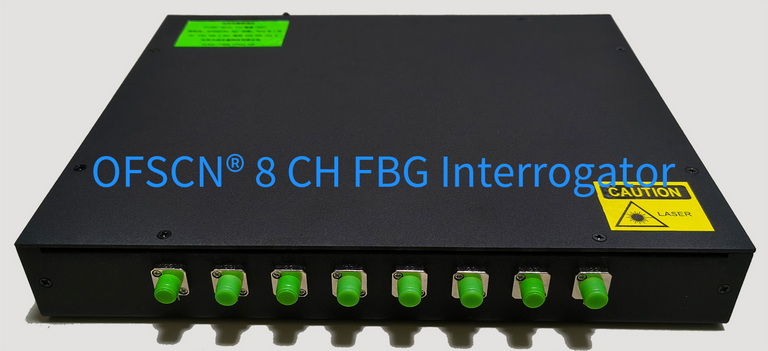
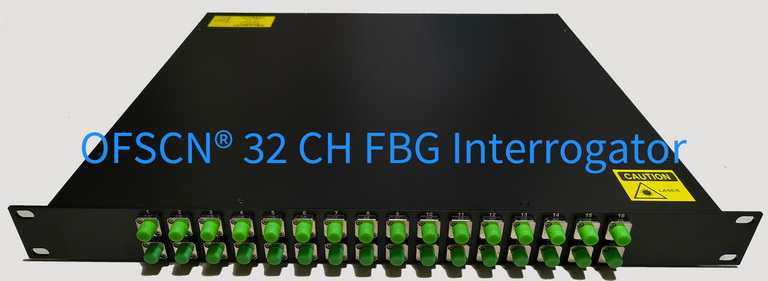
- Product Name: OFSCN® Fiber Bragg Grating Interrogator
- Core Parameter Specifications:
- Wavelength Range: Default 1525 \sim 1565\text{ nm} or 1528 \sim 1568\text{ nm} (custom expansion supported);
- Channel Configuration: 4, 8, 16, or 32 channels available;
- Sampling Frequency: 10\text{ Hz}, 50\text{ Hz}, 100\text{ Hz} selectable (software supports down-sampling to a minimum of 1\text{ Hz});
- Wavelength Resolution: Default 1\text{ pm} (optional 0.1\text{ pm} customization);
- Software and Interface Architecture: Supports B/S and C/S architectures, seamless integration with third-party measurement and control systems via communication protocols such as TCP, UDP, and Modbus.