How does its bayonet-style coupling perform in high-vibration environments, and which industrial scenarios is it best suited for?
The ST (Straight Tip) fiber connector is a classic optical fiber connector developed by AT&T. Its design is characterized by a 2.5mm ceramic or metal ferrule and a “Bayonet-style” coupling mechanism.
Regarding your specific questions on performance and industrial application:
1. Performance in High-Vibration Environments
The bayonet-style coupling of the ST connector uses a spring-loaded twist-lock mechanism. While it provides a secure connection that is resistant to accidental pull-outs, it has certain limitations in high-vibration environments compared to threaded connectors (like FC):
- Spring Resilience: The internal spring maintains contact between ferrules, which helps absorb minor axial vibrations.
- Potential for Rotational Play: Because it relies on a bayonet lug, extreme or continuous multi-axis vibration can occasionally lead to microscopic “chatter” or rotational movement if the coupling is not perfectly seated. This can result in transient increases in insertion loss or signal instability.
- Comparison: In environments with severe mechanical shock or constant heavy vibration, threaded connectors like the OFSCN® Fiber Optic Connector (specifically the FC/APC or FC/PC types) are often preferred because the threaded nut provides a more rigid, non-moving mechanical lock.
2. Best Suited Industrial Scenarios
ST connectors remain popular in specific industrial sectors due to their ease of manual installation and robust 2.5mm ferrule:
- Campus and Building Backbones: Still widely used in legacy local area networks (LANs) and horizontal cabling.
- Industrial Control Systems: Often found in manufacturing plants where quick “plug-and-twist” connectivity is needed for sensors and controllers.
- Power Utilities: Used in substations and power monitoring systems where electromagnetic interference (EMI) immunity is required and physical space for large connectors is available.
- Security and Surveillance: Frequently used in older fiber-optic video transmission equipment for CCTV systems.
OFSCN® Technical Implementation
If your application involves harsh environments or specialized sensing, we provide ST connectors with enhanced specifications. For example:
- Standard Industrial Use: OFSCN® Standard Fiber Patch Cord (Available with ST/PC or ST/APC connectors).
- High-Temperature Environments: For scenarios where temperatures exceed 60°C, we offer the OFSCN® 120℃ Fiber Optic Connector or OFSCN® 200℃ Fiber Optic Connector in ST configurations to ensure the adhesive and housing do not degrade.
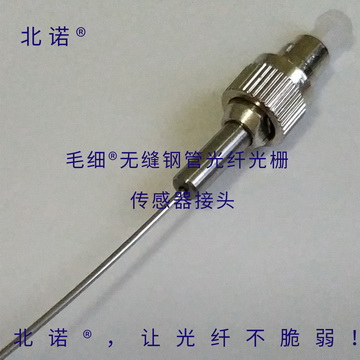
Standard Product Image:
If you are designing a system for a specific high-vibration environment, could you specify the vibration frequency or the type of machinery involved? This will help in determining if an ST connector is sufficient or if a threaded FC connector is required.