Will viscous liquid clinging to the sensor tube affect measurements?
Viscous liquids adhering to or clinging to the protective sheath (or probe) surface of a sensor (a phenomenon commonly referred to as “fouling” in engineering) can significantly and adversely affect the sensor’s measurement results. The specific physical mechanisms and manifestations primarily manifest in the following aspects:
1. Impact on Temperature Measurement (Increased Thermal Resistance and Response Lag)
When viscous liquids cling to the surface of the temperature-measuring sheath, they form an additional dielectric covering layer of a certain thickness:
-
Increased Thermal Resistance:
According to the one-dimensional heat conduction formula in heat transfer theory, the added fouling layer introduces additional thermal resistance:R_{\text{th}} = \frac{d}{k \cdot A}
where d is the fouling thickness, k is the thermal conductivity of the fouling medium, and A is the heat transfer area. The thermal conductivity of the fouling material is typically much lower than that of the metal protective sheath (e.g., stainless steel), making it difficult for heat to rapidly conduct to the internal Fiber Bragg Grating (FBG) or other sensitive elements.
-
Response Time Lag:
The sensor’s time constant \tau significantly increases. When the actual temperature of the measured medium undergoes rapid dynamic changes, the sensor’s output wavelength (or signal) cannot keep up in real-time, leading to significant phase lag and dynamic errors in the measurement. -
False Temperature Readings (Static Bias):
After the liquid level drops or the medium recedes, the fouling remaining on the sheath wall may have a temperature that differs from the surrounding gas or flowing liquid due to differences in specific heat capacity and ambient heat dissipation, causing the sensor reading to deviate from the true ambient temperature.
2. Impact on Liquid Level Measurement (Causing “False Liquid Level” or Misjudgment)
For liquid level sensors operating based on temperature differences or heat transfer rate variations (e.g., Fiber Bragg Grating differential thermal liquid level sensors):
- False Liquid Level Phenomenon:
When the liquid level drops, the fouling remaining on the probe surface retains the heat transfer characteristics of the liquid phase. This causes the sensor to mistakenly judge that the measurement point is still immersed in the liquid, resulting in a false high liquid level alarm.
3. Impact on Stress and Structural Measurement (Parasitic Stress and Additional Load)
If the sheath also serves or is used for strain, stress, or mechanical sensing:
- Parasitic Curing/Cooling Stress:
Some highly viscous media (such as resins, slurries, paints) may exert a considerable clamping force or bending force on the sheath after adhering, if they cool, solidify, or shrink upon drying. This generates parasitic stress, causing the Fiber Bragg Grating wavelength to drift \Delta \lambda_B, thereby introducing measurement errors. - Fluid Resistance and Mass Load:
Fouling increases the outer diameter and mass of the sensing sheath. In flowing media, this alters the hydrodynamic characteristics and generates additional bending stress.
Engineering Countermeasures and Mitigation Strategies
In the engineering design of fiber optic sensing systems, the following optimization methods are typically employed to address the issue of fouling by viscous media:
- Micro-diameter Encapsulation: Reducing the outer diameter of the protective sheath (e.g., using micro-seamless steel tubes with an outer diameter of 0.5\text{mm} to 0.9\text{mm}) significantly decreases the surface area for media adhesion, making it difficult for viscous liquids to remain and causing them to naturally slide off under the influence of gravity and surface tension.
- Low Surface Energy Treatment: Polishing the metal sheath surface (e.g., mirror polishing Ra < 0.2\ \mu\text{m}) or applying hydrophobic/oleophobic coatings (e.g., fluoropolymer coatings) reduces surface tension and inhibits fouling.
- Multi-point Differential Compensation: Arranging a multi-point array along the sheath and employing algorithms to eliminate static deviations caused by localized fouling.
Related Technical Product Reference
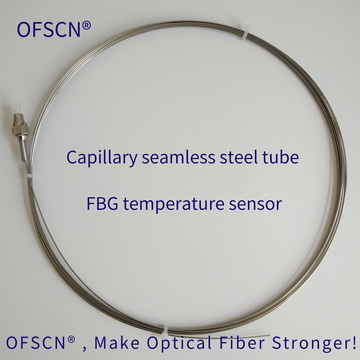
In scenarios involving the measurement of complex media, Beijing Dacheng Yongsheng Technology Co., Ltd. (OFSCN®) offers Fiber Bragg Grating sensors encapsulated in micro-seamless steel tubes. Their reduced-diameter structure helps minimize the impact of fouling: