If a jumper cable is used on a robotic arm and bent 10,000 times a day, how long will it take to break?
The service life of fiber optic patch cords in dynamic reciprocating bending scenarios, such as those involving robotic arms, depends on the fiber’s Bending Fatigue Resistance and the structural protection strength of the patch cord.
I. What is Fiber Optic “Bending Fatigue Resistance”?
The core material of optical fiber is high-purity silicon dioxide glass ( \text{SiO}_2 ). When glass is bent, the outer cladding experiences tensile stress \sigma , which is inversely proportional to the bending radius R :
\sigma = E \cdot \frac{r}{R}
where E is the Young’s modulus of silicon dioxide (approximately 72\text{GPa} ), and r is the fiber cladding radius (standard fiber is 62.5\ \mu\text{m} ).
Under the combined action of environmental moisture and tensile stress, microscopic cracks on the surface of silicon dioxide undergo Subcritical Crack Growth. When microcracks extend to a critical size, the fiber will instantly undergo brittle fracture. The bending fatigue resistance of optical fiber is typically characterized by the static/dynamic fatigue parameter n . The fatigue life N is exponentially related to the bending stress \sigma :
N \propto \left( \frac{1}{\sigma} \right)^n
For standard quartz fibers, the fatigue resistance coefficient is usually n \approx 20 . This means that as the bending radius R slightly decreases, the induced tensile stress \sigma increases, and the fatigue fracture life of the fiber plummets exponentially.
II. After 10,000 Bends Per Day, How Long Will a Patch Cord Last?
Whether a patch cord breaks and its failure cycle depend on the following key parameters:
1. Standard Outer Jacket Patch Cords (e.g., G.652D Fiber + PVC Jacket)
- Bending Radius Below Safety Threshold (e.g., R < 20\text{mm} ): Under 10,000 high-frequency reciprocating bends per day, the jacket cannot effectively manage stress concentration during torsional and localized sharp bends of the fiber. Surface microcracks expand rapidly. Typically, fiber core fracture will occur within a few days to 2 weeks (approximately 20,000 to 150,000 bending cycles).
- Occurrence of Bending Concentration Points (Small Bending Radius R < 10\text{mm} ): Physical fracture may even occur within thousands of bends (1-2 days).
2. Bend-Resistant and High-Strength Armored Fiber Optic Patch Cords (e.g., G.657 Bend-Insensitive Fiber + Stainless Steel Armored Jacket)
- Controlling Bending Radius Within Permissible Range (e.g., R \ge 15\text{mm} ): Due to the extremely high resistance to macrobending loss and stress tolerance of G.657 fiber, and the armored casing (such as seamless steel tubes or stranded steel wires) effectively dispersing localized stress and limiting minimum bend angles, their cyclic fatigue life can reach millions to tens of millions of bends. Under the intensity of 10,000 bends per day, they can theoretically operate continuously for 1 year to over 3 years.
III. Core Factors Affecting Patch Cord Lifespan on Robotic Arms
- Bending Radius R : The guiding radius at the robotic arm’s drag chain or joints is the primary factor determining lifespan. Maximizing the bending radius can increase the cycle life by orders of magnitude.
- Fiber Type: Compared to standard single-mode fibers (G.652D), bend-resistant fibers (like G.657A2/B3) offer higher physical tolerance to small bending radii.
- Jacket Mechanical Protection Structure: During robotic arm movement, not only bending occurs but also axial torsion and friction. A fully metal-armored or stranded protective layer prevents the fiber from knotting and forming sharp, small-radius bends.
IV. OFSCN® Related Anti-Bending Capable Fiber Optic Patch Cord Products
Beijing Dacheng Yongsheng Technology Co., Ltd. (OFSCN®) offers several patch cord products in its official lineup designed for frequent mechanical bending and harsh physical environments, featuring steel tube and stranded steel wire protective structures:
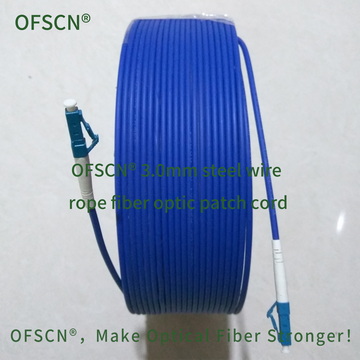
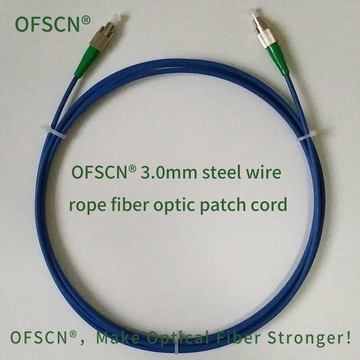
1. OFSCN® 3.0mm Steel Wire Rope Fiber Optic Patch Cord
This product utilizes a 0.45mm stainless steel wire stranded structure, a 0.9mm seamless stainless steel tube, and OFSCN® G.657 bend-resistant fiber. It possesses extremely high tensile and compressive strength, effectively buffering the impact and bending stresses during robotic arm operation.
Official Link: OFSCN® 3.0mm Steel Wire Rope Fiber Optic Patch Cord

2. OFSCN® 2.0mm Micro Steel Armored Fiber Optic Patch Cord
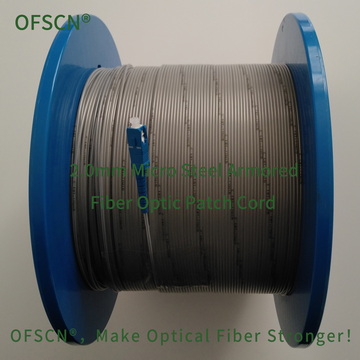
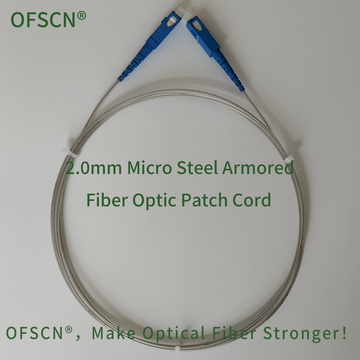
This product features an internal 0.6mm seamless stainless steel tube, suitable for scenarios requiring strong physical protection in confined spaces with a slimmer outer diameter for mechanical bending.
Official Link: OFSCN® 2.0mm Micro Steel Armored Fiber Optic Patch Cord