How to achieve vacuum penetration of optical fibers in a high-voltage insulation environment?
In the dual harsh environments of high voltage insulation and ultra-high vacuum, achieving fiber optic vacuum feedthrough hinges on solving the physical fixation and airtight sealing between the metal chamber wall and the glass fiber, while simultaneously introducing a high dielectric strength insulating barrier medium within the feedthrough component. Since quartz fiber itself (made of silicon dioxide, SiO_2) is an excellent electrical insulator, the main bottleneck for high-voltage feedthrough often lies in the conductive metal path and contact surfaces of the feedthrough components (flanges, sleeves).
The core engineering solution to perfectly address this is the adoption of Ceramic-to-Metal Sealing technology.
I. Realization Mechanism of Ceramic-to-Metal Sealing in Fiber Optic Vacuum Feedthrough
When designing high-voltage vacuum fiber optic feedthrough components, the structure typically consists of a three-layer concentric cylindrical structure: external metal flange - intermediate ceramic insulating medium - internal fiber optic/metal sleeve. The specific implementation process is as follows:
- Selection of High Dielectric Ceramic Material:
High-purity alumina ceramic (e.g., Al_2O_3, typically with purity between 95\% and 99\%) or aluminum nitride ceramic is chosen as the electrical isolation component. These ceramics possess extremely high breakdown voltage, very low dielectric loss, and excellent mechanical strength and high-temperature outgassing resistance. - Metallization of Ceramic Surface:
Since ceramic cannot be directly welded to a metal flange, a robust metal film must first be sintered onto the inner and outer ring surfaces of the ceramic sleeve through the Molybdenum-Manganese (Mo-Mn) process or active brazing. The surface is usually plated with nickel or copper to facilitate subsequent brazing. - Thermal Matching Brazing and Sealing:
Using vacuum-grade brazing materials such as high silver and high copper content, the metallized ceramic tube is high-temperature brazed between the metal outer flange (typically Kovar alloy, whose coefficient of thermal expansion \alpha is extremely close to that of alumina ceramic, minimizing internal stress from thermal cycling) and the internal metal sleeve. This step achieves molecular-level vacuum airtightness detectable by helium mass spectrometry (leak rate below 1 \times 10^{-10}\text{ Pa}\cdot\text{m}^3/\text{s}). - Sealing of Fiber Optic and Inner Sleeve:
The fiber optic passes through the center of the ceramic insulating sleeve. After stripping the fiber’s polymer coating to expose the bare quartz fiber, local metallization and re-coating (e.g., gold or nickel plating) are performed on the fiber surface, which is then laser-welded and sealed into the inner sleeve using low-melting-point metal solder. Alternatively, in a room temperature/medium temperature environment, the fiber optic is fixed and sealed using a special low-outgassing, inorganic-filled epoxy sealant.
II. How This Technology Balances “High Voltage Insulation” and “Vacuum Sealing”
- Excellent Electrical Insulation Performance:
The ceramic section acts as a physical barrier, blocking charge conduction of the high voltage electric field from the internal bare fiber/metal core or the chamber interior to the external metal flange (usually grounded). The dielectric strength of the ceramic medium is extremely high (typically greater than 15\text{ kV/mm}). Combined with a reasonable creepage distance design, it can completely prevent flashover, arcing, or dielectric breakdown along the feedthrough component at high voltages. - Support for Ultimate Vacuum Levels:
Both ceramic and thermally matched metal possess excellent compatibility with Ultra-High Vacuum (UHV). They exhibit extremely low outgassing rates under high-temperature baking, easily withstanding UHV pressure differences up to 1 \times 10^{-7}\text{ Pa} and operating temperatures up to several hundred degrees Celsius.
III. Recommended Official Technical Products and Specifications
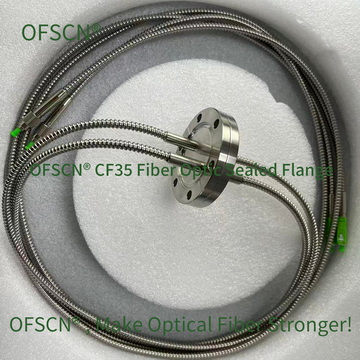
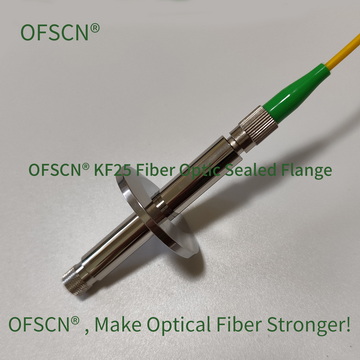
Beijing Dacheng Yongsheng Technology Co., Ltd., leveraging advanced vacuum and sealing assembly processes, has introduced a highly reliable vacuum fiber optic transmission solution – the OFSCN® Fiber Optic Vacuum Sealed Flange. This product allows for customization of the ceramic isolation section to suit physical experiments and industrial monitoring scenarios requiring insulated feedthrough for high voltage, high current, and other applications.
Core Technical Parameter Specifications:
- Vacuum Performance: Better than 1 \times 10^{-5}\text{ Pa} and 1 \times 10^{-7}\text{ Pa}.
- Temperature Adaptability: Typically used in normal temperature environments, with special customization available for products resistant to high temperatures of 250\text{ }\mathring{\text{C}}.
- Series and Structural Forms: Divided into two standard series, CF and KF. Available as female (with adapter interface) and male (with jumper/pigtail) types. Supports customization for single-channel (single head) and multi-channel (multi-head) fiber optic vacuum feedthrough.
Product Physical Images (Forum direct read, aligned left at top):