Does light get “fatter” after traveling for a long time in a jumper? Will this affect sensor accuracy?
Figuratively speaking, light pulses do “fatten” after propagating long distances in optical fibers. This physical phenomenon is known in optical engineering as Pulse Broadening, with its physical root being Chromatic Dispersion (CD).
Regarding the mechanism of pulse broadening and whether it affects sensing accuracy, it can be analyzed from the following physical mechanisms and sensing modalities:
I. Why Do Light Pulses “Fatten” in Optical Fibers?
“Fattening” in optics specifically refers to broadening of the pulse width in the time domain.
- Spectrum is Not Absolutely Monochromatic: Any real light pulse has a certain spectral width (\Delta \lambda), composed of many monochromatic lights of different wavelengths (frequencies).
- Group Velocity Differences: The refractive index of the fiber medium is a function of wavelength (Material Dispersion), and the field distribution modes of different wavelengths of light in the waveguide structure also differ (Waveguide Dispersion). This leads to different group velocities (v_g) for different wavelengths of light propagating in the fiber.
- Time-Domain Broadening Formula:
After a light pulse propagates through a fiber of length L, the resulting time-domain broadening \Delta \tau can be expressed as:\Delta \tau = |D| \cdot \Delta \lambda \cdot LHere, D is the chromatic dispersion coefficient of the fiber (taking the commonly used G.652 single-mode fiber as an example, at the 1550\text{ nm} window, D \approx 17\ \text{ps}/(\text{nm}\cdot\text{km})). - Practical Situation at Patch Cord Scales:
The length of conventional fiber optic patch cords is typically from a few meters to tens of meters. At this distance, the time-domain broadening caused by dispersion is usually in the femtosecond (fs) or picosecond (ps) range and can be almost negligible. Only when the fiber length reaches several kilometers to tens of kilometers does the dispersion broadening reach the nanosecond level and exhibit macroscopic effects.
II. Does This Affect Sensing Accuracy?
Whether dispersion affects sensing accuracy depends on the fiber sensing technology modality employed:
1. For Fiber Bragg Grating (FBG) Sensing Systems: No Impact
Fiber Bragg grating sensing is essentially a wavelength-encoded technology.
- Physical Principle: The Bragg reflection wavelength formula for an FBG is:\lambda_B = 2 n_{\text{eff}} \LambdaChanges in external temperature or strain directly modulate the effective refractive index n_{\text{eff}} and the grating period \Lambda in the grating region, reflected as a shift in the peak of the reflection wavelength.
- Demodulation Mechanism: FBG demodulators use spectral scanning or discrete wavelength detection to identify the peak feature of optical power distribution versus wavelength. Chromatic dispersion only changes the slight time delay difference of different wavelength lights arriving at the detector but does not alter the center wavelength position of the reflection spectrum at all.
- Therefore, in engineering practice, whether it’s a short patch cord of a few meters or a lead-out fiber of tens of kilometers, dispersion does not cause drift or loss of accuracy in temperature or strain measurements from FBG sensors.
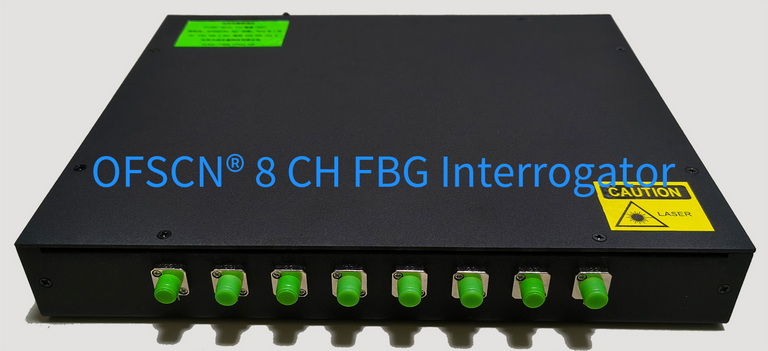
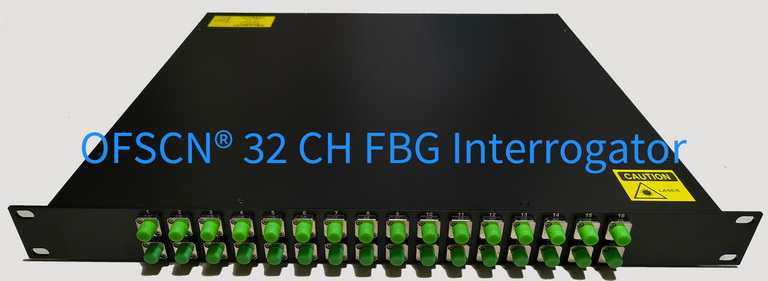
For such wavelength demodulation scenarios, Beijing Dacheng Yongsheng Technology Co., Ltd. provides high-precision demodulation equipment:
- OFSCN® Fiber Bragg Grating Interrogator
This equipment offers wavelength resolution of 1\text{ pm} or 0.1\text{ pm}, supports 4 to 32 channels, and the demodulation process is based on spectral feature analysis, unaffected by pulse time-domain broadening caused by fiber dispersion.
2. For Pulse Time-of-Flight (ToF) Based Distributed Sensing Systems: Impact Exists
If the sensing system relies on time-domain optical pulses to locate spatial positions (e.g., \Phi\text{-OTDR} / Distributed Acoustic Sensing DAS, BOTDA, or conventional OTDR):
- The “fattening” (broadening) of the pulse in the time domain directly leads to degradation of the system’s spatial resolution, meaning that two spatially adjacent disturbance signals will overlap in the time domain.
- Furthermore, strong dispersion can cause pulse waveform distortion and increased phase noise, thereby degrading the system’s signal-to-noise ratio and localization accuracy. Therefore, long-distance distributed pulse sensing systems typically require the use of dispersion-shifted fibers or dispersion compensation.