Why is the optical fiber jacket on some special patch cords difficult to strip? What are the construction requirements for this?
In the field of fiber optics engineering and fiber optic sensing, the phenomenon where special fiber optic patch cords and their cable cores exhibit significant resistance during stripping is primarily due to the physicochemical properties of the materials and the structural design for preventing mechanical damage/stress transfer.
I. Physical Mechanism Behind Difficult-to-Strip Special Patch Cords and Fiber Optic Jacketing
-
Curing Method and Mechanical Strength of Coating Materials
- Standard Communication Optical Fiber:
Typically employs a dual-layer UV-curable Acrylate coating, with an outer diameter generally ranging from 245\ \mu\text{m} to 250\ \mu\text{m}. The stripping force for such materials is relatively low (usually between 1.0\ \text{N} and 3.0\ \text{N}), allowing for easy removal with standard Miller pliers. - Special High-Temperature/High-Strain Optical Fiber:
Often utilizes materials like Polyimide (PI) or carbon coatings. Taking Polyimide as an example, it is tightly bonded to the silica cladding (outer diameter 125\ \mu\text{m}) surface through thermal curing, with a coating outer diameter of only about 155\ \mu\text{m}. Polyimide possesses extremely high tensile strength and adhesion. Its stripping force is significantly higher than that of traditional acrylate, making it very difficult to strip with conventional mechanical blades.
- Standard Communication Optical Fiber:
-
Tight-Buffer Structure and Stress Transfer Requirements
- Ordinary fiber optic patch cords commonly use a loose tube structure, which retains gaps internally.
- Special patch cords (e.g., high-tensile or high-strain transmission patch cords) often employ a tight buffer encapsulation (such as fluoropolymers ETFE, PFA, PEEK, or a polymer tight buffer layer). The tight buffer structure requires the jacket and the optical fiber’s glass cladding to be tightly engaged to ensure no relative displacement occurs during stretching, bending, or environmental temperature changes. This extremely high mechanical interface adhesion directly leads to a substantial increase in stripping resistance.
-
Micro-Armor Protection
- Some special patch cords contain micro seamless stainless steel tubes or stranded wire layers (e.g., metal tubes with an outer diameter of 0.6\ \text{mm} to 0.9\ \text{mm}) inside, intended for protection against crushing and rodent damage. These armor structures cannot be processed with conventional fiber optic strippers.
II. Specific Requirements for Field Construction and Processing
For high-strength/special patch cords with high stripping forces or complex structures, the following standard engineering requirements must be followed during construction and splicing termination:
-
Use of Dedicated Stripping Tools
- Thermal Stripper:
For optical fibers with Polyimide (PI) coatings, heating stripping equipment is usually required to soften the coating before precise blade stripping, or chemical stripping methods using concentrated sulfuric acid at high temperatures may be employed (in laboratory/factory production environments). - Micro Tube Cutter and Precision Rotary Stripper:
For special patch cords with stainless steel seamless steel tube jacketing, a micro-pipe cutting tool must be used to circumferentially cut the tube wall when removing the outer metal layer. Direct use of shearing tools to break it is strictly prohibited to avoid damaging the internal optical fiber due to compression.
- Thermal Stripper:
-
Strict Control of Blade Precision and Stress Concentration
- Jacketing materials with high stripping forces can easily cause micro-cracks on the surface of the silica cladding during forceful mechanical stripping. Micro-cracks can drastically reduce the tensile strength of the optical fiber (down to 10\%\sim20\% of its original strength). Therefore, specialized strippers with matching aperture sizes and unworn blades must be used.
-
Cleaning and Residue Handling
- After stripping Polyimide or tight buffer materials, trace amounts of polymer particles may remain on the cladding surface. Before splicing or connectorization, repeated unidirectional wiping with high-purity anhydrous ethanol (purity \ge 99.5\% ) and lint-free wipes is essential to ensure zero residue on the glass surface.
III. Relevant Official Product Specifications
In Beijing Dacheng Yongsheng Technology Co., Ltd.'s (OFSCN®) product line, products designed for harsh environments such as high temperatures and strong tensile forces incorporate the aforementioned high-stripping-force materials and seamless stainless steel tube structures:
1. High-Temperature Polyimide Optical Fiber
OFSCN® 300℃ SM Polyimide Optical Fiber

- Features a Polyimide coating (outer diameter 155\ \mu\text{m} ), with an operating temperature range of -200^\circ\text{C} to 350^\circ\text{C}. The thermally cured coating offers extremely high mechanical adhesion and thermal stability.
2. High-Temperature Special Patch Cord
OFSCN® 300℃ Fiber Optic Patch Cord

- Internally utilizes a 0.9\ \text{mm} stainless steel seamless steel tube along with high-temperature Polyimide optical fiber. Requires micro metal tube cutting tools for end stripping and termination.
3. Micro-Armored Tensile-Resistant Patch Cord
OFSCN® 2.0mm Micro Steel Armored Fiber Optic Patch Cord
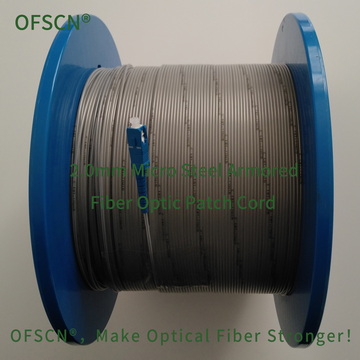
- Employs a structure with a PVC outer jacket embedding a 0.6\ \text{mm} stainless steel seamless steel tube, balancing physical flexibility with high compressive strength.