Can pressure from the side of the sensor, when embedded in fill, disguise itself as a temperature change?
In geotechnical engineering and earthwork backfill scenarios, whether lateral extrusion pressure will “disguise” itself as temperature variation hinges entirely on whether the sensor’s internal physical packaging structure achieves “Stress Isolation”.
I. Physical Mechanism: How Lateral Extrusion Pressure Affects Fiber Bragg Gratings
The reflection center wavelength \lambda_B of a Fiber Bragg Grating (FBG) is determined by the effective refractive index of the fiber core n_{\text{eff}} and the grating period \Lambda :
\lambda_B = 2 n_{\text{eff}} \Lambda
When a sensor is directly embedded in earthen or rocky media, significant lateral pressure (Lateral Pressure / Crush) is exerted by the self-weight of the soil, pore pressure, and local contact points of rocks. If this lateral pressure is transmitted to the fiber core, it induces the following two physical responses:
- Isotropic Radial Pressure (Uniform Lateral Pressure): Disguised as Wavelength Drift
When the fiber is subjected to uniform radial compression, the photoelastic effect alters the refractive index of the medium, while Poisson’s Ratio causes axial deformation. This effect results in an overall shift of the reflection wavelength (wavelength drift). The demodulator can only detect the absolute movement of the center wavelength \Delta \lambda_B . Without decoupling, the system cannot distinguish whether this wavelength shift originates from ambient temperature increase or lateral extrusion pressure, thus generating false temperature readings. - Non-uniform Local Lateral Pressure (Contact Point Extrusion): Inducing Birefringence and Spectral Peak Distortion
Lateral pressure from soil and rock particles is typically non-uniform, occurring at localized point contacts. When the fiber cross-section is subjected to asymmetric transverse lateral pressure, the original circular symmetry of the core is disrupted, inducing a photoelastic birefringence effect, causing a refractive index difference between the two polarization states ( n_x \neq n_y ) that were originally degenerate. In the reflection spectrum, a single reflection peak will broaden or even split into two peaks (Peak Splitting), making it impossible for the demodulation algorithm to accurately lock onto the peak, leading to drastic jumps or failure in the output data.
II. Response Differences to Lateral Pressure Based on Packaging Structure
In practical engineering applications, bare fiber gratings or those with simple flexible polymer coatings must never be directly embedded in earthworks as thermometers.
- Un-stress-isolated Flexible/Bare Fiber Gratings: Directly subjected to external soil pressure and shear forces. Lateral pressure is misread as temperature change, and the fiber is easily broken under shear from rocks.
- Rigid Stress-Isolated FBG Temperature Sensors: Qualified industrial-grade FBG temperature sensors must employ a “stress/mechanical isolation” structure. The fiber grating is suspended or freely placed within a rigid protective tube. External loads (including vertical and lateral extrusion pressures from earthworks) are entirely borne by the external rigid tube.
III. Official Related Products and Protection Solutions
In the Beijing Dacheng Yongsheng Technology Co., Ltd. (OFSCN®) manufacturing series, fiber Bragg grating temperature sensors utilize a specialized seamless stainless steel tube packaging structure. The housing possesses extremely high resistance to lateral and extrusion pressures, ensuring the grating measurement point is in a stress-free state, completely isolated from axial and radial forces. This completely blocks the interference of external earthwork lateral pressure on temperature measurement:
1. OFSCN® 100°C Fiber Bragg Grating Temperature Sensor
Features a standard single-layer seamless stainless steel tube packaging technology with an outer diameter typically of 0.9 mm (minimum down to 0.6 mm). It achieves pure ambient temperature sensing while withstanding external harsh media contact and lateral soil pressure.
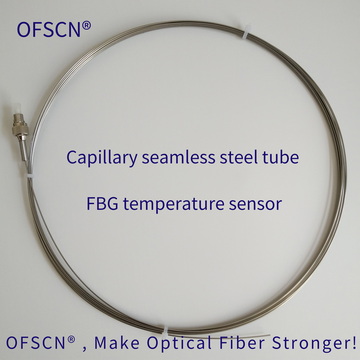

2. OFSCN® 300°C Fiber Bragg Grating Temperature Sensor
Employs a seamless steel pipe mechanical protection structure suitable for higher temperature ranges. The internal grating is completely isolated from external radial lateral pressure and axial mechanical stretching. Factory calibration ensures no lateral pressure strain error is introduced under embedded, pressurized conditions.