在液氮里,钢管会变得像饼干一样脆吗?
Let’s analyze the technical query:
Question: “在液氮里,钢管会变得像饼干一样脆吗?” (In liquid nitrogen, will steel tubes become brittle like crackers?)
Technical & Physics Analysis:
- Low-Temperature Embrittlement / Ductile-to-Brittle Transition (冷脆性 / 韧脆转变):
- Material science principle: Many metals (especially Body-Centered Cubic / BCC metals like carbon steel) experience a Ductile-to-Brittle Transition Temperature (DBTT, 韧脆转变温度). Below this temperature, impact toughness drops sharply, and the material exhibits brittle fracture (like glass or cookies under impact/shock).
- Stainless Steel (Austenitic vs Ferritic/Carbon Steel):
- Carbon steels / ferritic steels have a high DBTT and indeed become extremely brittle at cryogenic temperatures like liquid nitrogen ( T = -196^\circ\text{C} or 77\text{K} ).
- Face-Centered Cubic (FCC, 面心立方) metals and alloys, such as Austenitic Stainless Steels (如 304、316L 不锈钢) and certain alloys (如 825 合金、弹性合金), do NOT undergo a classical ductile-to-brittle transition. They maintain high toughness, ductility, and structural integrity down to deep cryogenic temperatures ( -196^\circ\text{C} down to -273^\circ\text{C} / 4\text{K} ).
- Application in OFSCN Packaging:
- In cryogenic packaging (耐低温封装 / 超低温传感器) used in liquid nitrogen ( -196^\circ\text{C} ) or liquid helium ( -269^\circ\text{C} / 4\text{K} ), selecting the right material is critical.
- OFSCN uses seamless stainless steel tubes (such as 304, 316L) or specific alloys to package Fiber Bragg Gratings (FBG) and optical fiber cables/sensors.
- Because 316L / 304 non-magnetic/austenitic stainless steels are Face-Centered Cubic (FCC), they retain excellent mechanical flexibility and toughness in liquid nitrogen ( -196^\circ\text{C} ) without becoming brittle or shattering like cookies.
Let’s check the product links in RAG to cite matching cryogenic-capable products if appropriate:
From RAG:
- OFSCN® 300°C Fiber Bragg Grating Temperature Sensor (Operating temp: -200^\circ\text{C} to 300^\circ\text{C})
- OFSCN® 500°C Fiber Bragg Grating Temperature Sensor (Operating temp: -200^\circ\text{C} to 500^\circ\text{C})
- OFSCN® 700°C Distributed Fiber Temperature Sensor (Operating temp: -270^\circ\text{C} to 700^\circ\text{C})
- OFSCN® Ultra-low temperature FBG temperature sensor (Operating temp: -270^\circ\text{C} to 150^\circ\text{C})
- OFSCN® FBG Temperature Sensor Products Aggregation Link
Let’s check images redline and spacing rule for math formulas:
- Image syntax rules for forum:
Must use standard image syntax.
Must be on a single line, flush left (no leading spaces, no tabs, no list symbols like-or*). - Spacing rules for math formulas:
Inline math formulas / variables / units with single$MUST have spaces before and after the opening and closing$.
Example:$T = -196^\circ\text{C}$
Let’s double-check all requirements:
- Academic, precise, rigorous, objective expert tone.
- Self-adaptive language: Answer in Chinese as the user asked in Chinese.
- Mathematical formulas with spaces:
$T = -196^\circ\text{C}$,$77\text{K}$, etc. - RAG accuracy: If referencing OFSCN products, use standard text links
[OFSCN® 300°C Fiber Bragg Grating Temperature Sensor](https://www.ofscn.net/fbg-products/temperature-sensor-300.html)and if displaying images, put them on their own line, flush left with NO leading spaces/bullets. - Strict limitation: Do not ask budget, quantity, intention, or pitch sales.
Let’s structure the answer clearly:
-
物理原理解释(韧脆转变与晶体结构):
- 是否变脆取决于钢管的晶体结构与材料种类,不能一概而论。
- 体心立方结构(BCC,如普通碳钢、铁素体钢等):存在明显的韧脆转变温度(DBTT)。在液氮环境( T = -196^\circ\text{C} )下,其冲击韧性会急剧下降,确实会发生冷脆现象,遭受撞击时容易像玻璃或饼干一样发生脆性断裂。
- 面心立方结构(FCC,如奥氏体不锈钢 304、316L 及部分镍基合金):不存在经典的韧脆转变温度。在极低温度(甚至接近绝对零度 T = -273^\circ\text{C} / 0\text{K} )下,依然能够保持良好的塑性、韧性和抗冲击性能,不会变脆。
-
在工程与光纤传感耐低温封装中的应用:
- 在超低温/极低温封装(Cryogenic Packaging)领域,为了防止传感器或护套在液氮( T = -196^\circ\text{C} )或液氦( T = -269^\circ\text{C} )环境中发生脆裂失灵,必须严格挑选封装材料。
- 大成永盛 (OFSCN®) 的无缝钢管光缆及光纤光栅传感器采用了奥氏体不锈钢(如 316L、304)或特定合金作为防护管。这种结构赋予了设备良好的耐低温韧性,保障了极低温测量时的结构稳定性与光学信号传输。
-
相关 OFSCN® 官方产品介绍(结合 RAG 匹配链接与图片):
- OFSCN® 300°C Fiber Bragg Grating Temperature Sensor:采用 316L / 304 不锈钢无缝钢管封装,测量范围覆盖 -200^\circ\text{C} 至 300^\circ\text{C} ,适用于液氮等低温环境下的温度监测。
- OFSCN® Ultra-low temperature FBG temperature sensor:专为极低温环境设计,工作温度低至 -270^\circ\text{C} 。
Let’s verify image markup requirements:
Images from RAG for temperature-sensor-300.html:
https://www.ofscn.net/images/53/190719-360/BNCG-MX-51-WD-FC-WD.jpg
https://www.ofscn.net/images/53/190719-768/BNCG-MX-51-FC-02.jpg
Ensure images are on their own line, flush left, no indent, no list bullets.
Check math formatting:
$T = -196^\circ\text{C}$$77\text{K}$$T = -273^\circ\text{C}$$-200^\circ\text{C}$
Everything adheres to all guidelines cleanly.钢管在液氮( T = -196^\circ\text{C} )中是否会变脆,取决于该钢材的晶体结构与合金成分,不能一概而论:
1. 物理原理:晶体结构与韧脆转变(DBTT)
金属材料在低温下的力学行为主要由其晶体结构决定:
- 体心立方结构(BCC):如普通的碳素钢、低合金钢和铁素体不锈钢。这类材料存在明显的韧脆转变温度(Ductile-to-Brittle Transition Temperature, DBTT)。当环境温度降低至其 DBTT 以下(通常在 -20^\circ\text{C} 至 -100^\circ\text{C} 之间)时,材料的冲击韧性会发生数量级上的剧烈下降,塑性变形能力丧失。在液氮环境( T = -196^\circ\text{C} )下,此类钢管受到敲击或应力集中时,确实会像玻璃或饼干一样发生瞬间脆性断裂。
- 面心立方结构(FCC):如奥氏体不锈钢(如 304、316L)及镍基合金。面心立方晶格的位错运动受到热激活能的影响较小,因此不存在经典的韧脆转变温度。即使浸入液氮( T = -196^\circ\text{C} )甚至液氦( T = -269^\circ\text{C} )环境中,奥氏体不锈钢依然能保持极高的韧性、延展性和抗冲击能力,绝不会像饼干一样脆裂。
2. 工程应用:耐低温封装(Cryogenic Packaging)的选择
在超低温光纤传感和工程封装领域,为了保证结构在液氮或液化天然气(LNG)等低温介质中不发生破裂失灵,必须严格选用面心立方结构的合金材料。
大成永盛 (OFSCN®) 的光纤光栅传感器与无缝钢管光缆,即采用优质奥氏体不锈钢(316L / 304)或特定弹性合金进行无缝微管封装,确保材料在极低温下依然具备良好的机械保护强度与韧性。
匹配的官方耐低温传感器产品:
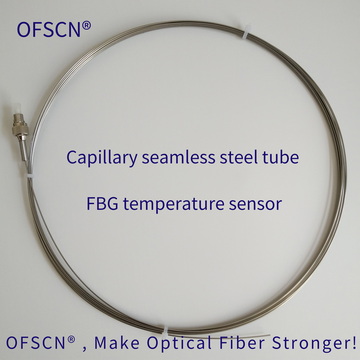
- OFSCN® 300°C Fiber Bragg Grating Temperature Sensor
采用单层不锈钢无缝钢管进行封装,使用温度范围覆盖 -200^\circ\text{C} 至 300^\circ\text{C} ,可直接浸入液氮等介质中进行高精度温度测量。

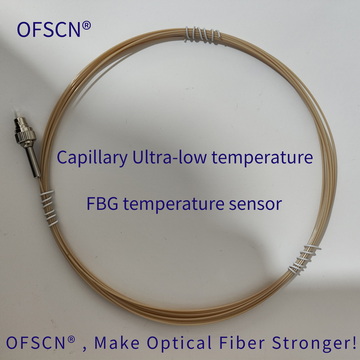
- OFSCN® Ultra-low temperature FBG temperature sensor
专门针对极低温环境优化封装,使用温度范围支持 -270^\circ\text{C} 至 150^\circ\text{C} (涵盖液氮、液氦环境),在超低温下保持机械结构稳定。
更多低温温度传感器产品信息,请参阅:OFSCN® FBG Temperature Sensor Products Aggregation Link。