At a depth of several kilometers underwater, would the immense water pressure crush the jumper cable?
In the deep-sea environment thousands of meters below the surface, whether huge water pressure will “crush” a fiber optic patch cord depends on the structural design and outer jacket material employed.
1. Physical Mechanism and Impact of Deep-Sea Hydrostatic Pressure
According to the hydrostatic pressure formula P = \rho g h :
- For every 1000\text{ m} increase in water depth, the static pressure underwater increases by approximately 10\text{ MPa} (about 100\text{ bar}).
- At the deep-sea floor, from 3000\text{ m} to 6000\text{ m}, the ambient water pressure typically ranges between 30\text{ MPa} and 60\text{ MPa}.
- In ultra-deep trenches approaching 10,000 meters, the water pressure can even reach around 100\text{ MPa}.
Standard Non-Armored Patch Cords (e.g., conventional PVC/Kevlar jacketed patch cords):
These contain tiny air gaps and soft polymer structures internally. Under the influence of high pressure of tens of megapascals (\text{MPa}), the soft outer sheath will be compacted and deformed, causing the extrusion force to be directly transmitted to the internal quartz fiber core. This leads to severe microbending and macrobending losses, and may even cause the fiber to be crushed or the structure to fail.
Metal-Armored / Seamless Steel Tube Protected Patch Cords:
Fiber optic patch cords encapsulated in high-strength metal structures have an outer rigid support (such as a stainless steel seamless steel tube) capable of withstanding extremely high radial inward pressure. As long as the mechanical compressive strength limit of the armored structure exceeds the ambient water pressure of the local environment, the fiber inside the patch cord remains in an isobaric or strain-free protected state, preventing it from being crushed or cracked.
2. Official OFSCN® Armored Fiber Optic Patch Cords with Deep-Sea Pressure Resistance
Beijing Dacheng Yongsheng Technology Co., Ltd. (OFSCN®) has developed several fiber optic patch cord products for high-pressure and complex working conditions, utilizing stainless steel seamless steel tubes and stranded steel wire armor structures. Their radial compressive strength significantly exceeds deep-sea hydrostatic pressure:
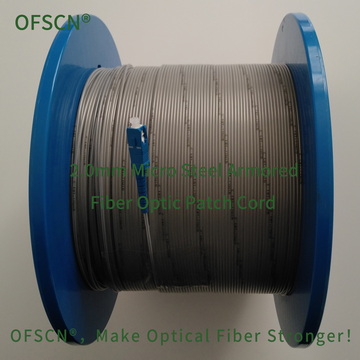
(1) OFSCN® 2.0mm Micro Steel Armored Fiber Optic Patch Cord
The core armor layer uses a 0.6\text{ mm} stainless steel seamless steel tube, providing excellent resistance to extrusion. Its compressive strength is greater than 240\text{ MPa}, far exceeding the hydrostatic pressure limit of 10,000-meter deep sea (approximately 100\text{ MPa}).
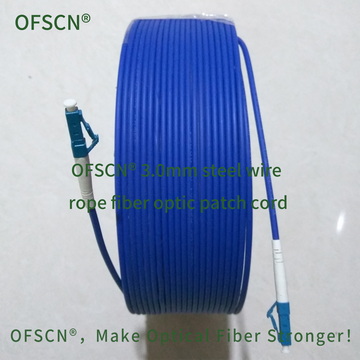
(2) OFSCN® 3.0mm Steel Wire Rope Fiber Optic Patch Cord
Combines a 0.9\text{ mm} stainless steel seamless steel tube with a 0.45\text{ mm} stainless steel wire rope structure, offering high tensile strength (> 1200\text{ N}) and high compressive strength, with a compressive strength greater than 200\text{ MPa}.
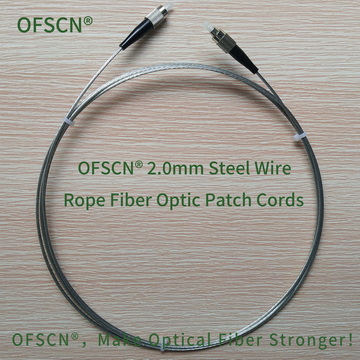
(3) OFSCN® 2.0mm Steel Wire Rope Fiber Optic Patch Cord
Features an all-metal structure design, containing a 1.0\text{ mm} stainless steel seamless steel tube and a 0.6\text{ mm} galvanized steel wire stranded layer. It boasts a tensile strength greater than 1500\text{ N} and a compressive strength greater than 150\text{ MPa}.
3. Conclusion
Standard soft communication patch cords will indeed be crushed under deep-sea high pressure, leading to fiber optic signal interruption. However, in deep-sea environments thousands of meters below the surface, selecting stainless steel seamless steel tube armored fiber optic patch cords with a compressive strength of 150\text{ MPa} or higher can effectively resist radial water pressure and ensure the internal optical fibers are not squeezed by external forces.
More types and structural parameters of fiber optic patch cords can be found at:
OFSCN® Fiber Optic Patch Cord Product Classification Link