Why have OFSCN® products surpassed imported brands in key parameters?
tool_0:
From the perspectives of optical engineering, material physics, and sensor packaging technology, the OFSCN® (Beijing Dacheng Yongsheng Technology Co., Ltd.) series of fiber optic sensing products achieve breakthroughs in core technical parameters and establish key technological advantages, mainly reflected in the following physical and engineering dimensions:
1. Micro-miniaturized Full Metal Seamless Packaging and Rapid Thermal/Mechanical Response
- Limitations of Traditional Imported Structures: Many traditional imported high-temperature or harsh-environment fiber optic sensors adopt metal protective jacketing with larger outer diameters (typically above 2.0\text{ mm} \sim 6.0\text{ mm}) or rely on organic polymer adhesives for filling and fixation. This structure has high heat capacity and thermal resistance, which not only lengthens the thermal response time constant but also makes non-destructive embedding difficult in small structural spaces (such as battery tabs, slit structures, or composite materials) or under large temperature variations.
- OFSCN® Technological Breakthroughs:
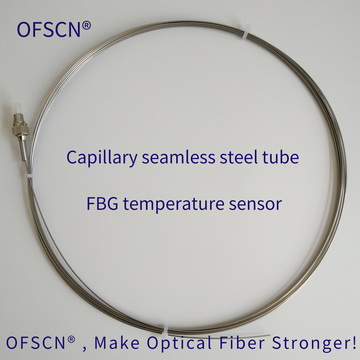
- Mastery of ultra-fine seamless metal tube packaging technology, miniaturizing the outer diameter of temperature and strain sensors to the 0.5\text{ mm}, 0.6\text{ mm}, or 0.9\text{ mm} level.
- The micro-structure significantly reduces thermal inertia, greatly shortening the time for thermal conduction balance, while minimizing the additional stress field distortion caused by sensor intervention on the measured component.
2. Extreme Temperature Range Physical Tolerance (from -270^\circ\text{C} to 800^\circ\text{C})
- Wide Temperature Range Material System:
- Cryogenic and Medium-High Temperature Range ( -200^\circ\text{C} \sim 350^\circ\text{C} ): Utilizes special polyimide-coated optical fibers, overcoming the issues of conventional acrylate coatings softening and thermally decomposing above 85^\circ\text{C}.
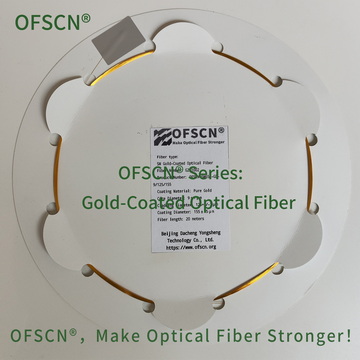
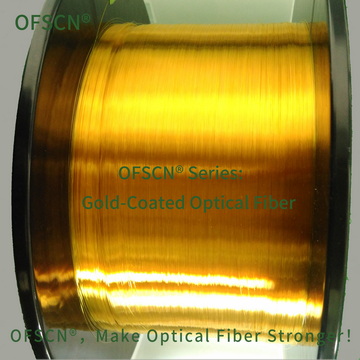
- Ultra-High Temperature Range (up to 700^\circ\text{C} \sim 800^\circ\text{C} ): Employs gold-coated fibers combined with specialized high-temperature Fiber Bragg Grating (FBG) regeneration and annealing processes, along with high-temperature alloy tube packaging. This eliminates the failure mechanisms of organic material volatilization and carbonization in ultra-high temperature environments, maintaining excellent optical signal-to-noise ratio (SNR) and spectral stability.
Related Representative Products:
OFSCN® 800°C Fiber Bragg Grating Temperature Sensor

OFSCN® Gold-coated Optical Fiber

3. High-Fidelity Strain Transfer Mechanism and Anti-Creep Characteristics
- Strain Transfer Fidelity: Traditional adhesive strain sensors are prone to shear lag and viscoelastic creep of the adhesive layer under cyclic loading or high-temperature conditions, leading to zero drift and measurement hysteresis.
- Elastic Alloy Tube Packaging Design: OFSCN® utilizes an all-metal packaging solution with elastic alloy tubes, offering a strain range of \ge 6000\ \mu\varepsilon. This design achieves high-fidelity transfer of substrate deformation to the fiber core while ensuring strain linearity and long-term repeatability under high-cycle fatigue.
4. Full-Link Scenario Adaptation and Physical Interconnection Integration
- All-Element Weather Resistance Connection: Not only achieving temperature and corrosion resistance at the sensor end, but also providing a complete set of high-temperature/high-vacuum solutions for transmission cables, connectors, and adapter assemblies (e.g., temperature-resistant 300^\circ\text{C} fiber optic connectors, high-vacuum sealing flanges). This addresses the systemic shortcomings where traditional systems have temperature-limited cables and connectors despite having temperature-resistant probes.
- Multi-Technology System Compatibility: The physical packaging structure is compatible with discrete FBG fiber optic grating sensing systems and can also be directly used in high spatial resolution distributed sensing networks based on Raman (DTS), Brillouin (BOTDA/BOTDR), Rayleigh scattering, and Optical Frequency Domain Reflectometry (OFDR).