If the fiber is installed on a vibrating engine, would this back-and-forth movement shorten its lifespan?
Yes, continuous vibration and rocking from equipment like engines can shorten the lifespan of bare optical fibers. This phenomenon, known in fiber optics physics and material reliability engineering, is known as Dynamic Fatigue.
I. Physical Principles: What is “Dynamic Fatigue” of Optical Fibers?
While silica (\text{SiO}_2) quartz fibers possess extremely high tensile strength, their surfaces inevitably contain microscopic defects and cracks.
When fibers are installed on vibrating engines, the rocking motion induces alternating tensile stress (\sigma) and bending stress on the fiber. Under the combined action of dynamic stress and environmental moisture (\text{H}_2\text{O}), the fiber undergoes Stress Corrosion:
- Chemical Bond Rupture: Water molecules, under stress concentration, attack and break the \text{Si-O-Si} siloxane bonds at the crack tips.
- Crack Propagation: Under the alternating stress of vibration (dynamic loading), cracks gradually extend from microscopic dimensions until they reach a critical fracture size, ultimately leading to fiber fracture.
- Dynamic Fatigue Parameter n_d: Materials science commonly uses the dynamic fatigue stress corrosion exponent n_d to assess a fiber’s resistance to dynamic stress failure. The crack propagation rate is closely related to the applied dynamic strain rate.
Therefore, the greater the engine vibration amplitude, the higher the frequency, and the smaller the installation bend radius, the more pronounced the dynamic stress concentration within the fiber becomes, and the faster its fatigue life degrades.
II. Key Factors Affecting Fiber Lifespan in Engine Vibration Environments
- Alternating Strain Amplitude (\\varepsilon): A smaller dynamic bending radius (R) induced by vibration leads to greater tensile stress on the outer core of the fiber, accelerating fatigue failure.
- Environmental Temperature and Humidity: Engine compartments are typically associated with high temperatures and humidity. Rising temperatures accelerate the chemical reaction rates of stress corrosion.
- Coating Layer and Structural Protection: The acrylate coating layer of ordinary optical fibers can easily age and peel off in high-temperature, vibrating environments, losing its protective function for microcracks.
III. Protective Measures and Product Solutions in Industrial Engineering
To prevent dynamic fatigue failure caused by engine vibrations, bare optical fibers are typically not used directly. Instead, seamless steel pipe armoring or metal/alloy tube encapsulation techniques are employed to isolate external mechanical vibrations and enhance temperature resistance.
Within Beijing Dacheng Yongsheng Technology Co., Ltd.'s (OFSCN®) product line, the following standardized structures and sensors are offered for high-vibration, dynamic stress, and high-temperature environments:
1. Vibration and Dynamic Stress Measurement
For dynamic stress/strain monitoring of vibrating structural components like engines, alloy tube encapsulation significantly isolates alternating stress concentration and protects the fiber core:

2. High-Temperature Vibration-Resistant Armored Fiber Optic Cable
For signal transmission or distributed sensing, seamless stainless steel pipe (FIMT) encapsulation completely isolates external alternating physical wear and protects against moisture:
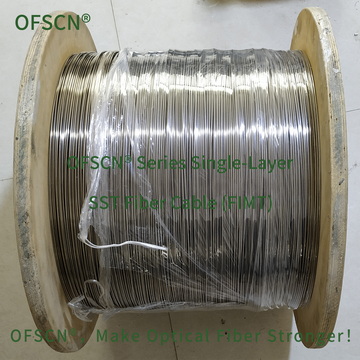
3. High-Temperature Resistant Special Optical Fiber with High Adhesion
At the fiber level, polyimide coating offers higher temperature resistance and tighter bonding with the quartz cladding compared to traditional coatings, effectively slowing down dynamic fatigue propagation:
