Why can a demodulator clearly see both very strong and very weak signals simultaneously?
In Fiber Bragg Grating (FBG) sensing and optical measurement, the ability of a demodulator to “simultaneously see strong and weak signals” fundamentally depends on the instrument’s Optical Dynamic Range and the signal processing capabilities of its front-end receiver.
I. What is “Dynamic Range”?
The dynamic range refers to the ratio of maximum optical power to minimum optical power that a demodulator can reliably resolve simultaneously (or within a single scan) while maintaining measurement accuracy and linearity, typically expressed in logarithmic decibels (dB):
\text{Dynamic Range (dB)} = 10 \lg\left(\frac{P_{\max}}{P_{\min}}\right)
- Signal Upper Limit (P_{\max}): Determined by the saturation limit of the photodetector and front-end transimpedance amplifier. Once light intensity exceeds this limit, the signal will experience clipping distortion, leading to distorted reflection peak waveforms and failure of peak-finding algorithms.
- Signal Lower Limit (P_{\min}): Determined by the system’s Noise Floor, which includes thermal noise, shot noise, stray light background, and quantization noise from the photodetector. Signals below this threshold will be submerged in noise and become unidentifiable.
The larger the ratio (range) between these two values, the stronger the demodulator’s observational capability across varying signal strengths.
II. Why Can Demodulators See Strong and Weak Signals Simultaneously?
In practical engineering topologies (e.g., multiple FBGs in series on a single fiber), measurement points near the input or those with high reflectivity return strong signals. Conversely, measurement points at the far end, after significant attenuation from tens of kilometers of fiber, losses from multiple splices, or low reflectivity, return extremely weak signals. The core hardware and algorithmic architecture that enable demodulators to accommodate both scenarios include:
-
High-Resolution ADC (High-Bit-Depth Analog-to-Digital Converter)
Demodulator acquisition systems typically employ high-speed ADCs with 16-bit or even 24-bit resolution. High bit depth provides an extremely wide instantaneous quantization span, preventing faint reflection peaks from being obscured by coarse quantization steps, while also preventing strong reflection peaks from easily triggering full-scale quantization overflow. -
Wide Linear Range and Low Equivalent Noise Power (Low NEP) Detection Front-End
High-quality Avalanche Photodiodes (APD) or InGaAs PIN detectors possess an excellent linear response range and very low Noise Equivalent Power (NEP). This suppresses the system’s noise floor to very low light levels (e.g., -40 dBm to -60 dBm) while maintaining milliwatt (mW) level unsaturated performance. -
Excellent Optical Signal-to-Noise Ratio and Side Mode Suppression Ratio (High SMSR)
For swept-laser type demodulators, narrow linewidth lasers offer high SMSR and a very low Amplified Spontaneous Emission (ASE) background. For filter-based demodulation systems, the dispersive elements have very high out-of-band rejection capabilities. This prevents strong reflection peaks from causing optical crosstalk and scattering side light that would raise the noise floor in adjacent areas, thereby protecting adjacent weak reflection peaks. -
Adaptive Dynamic Thresholding and Peak-Finding Algorithms
Peak-finding algorithms at the software level (e.g., Gaussian fitting, centroid method) do not use a single fixed amplitude threshold. Instead, they dynamically calculate adaptive Signal-to-Noise Ratio (SNR) thresholds based on the local background noise. This allows for accurate extraction of the center wavelength for both strong and weak peaks, even when their optical powers differ by thousands of times (over 30 dB).
III. Related Products and System Configuration
Beijing Dacheng Yongsheng Technology Co., Ltd.'s series of FBG demodulators feature excellent optical signal-to-noise ratio and wide dynamic range, enabling reliable demodulation of strong and weak reflection signals transmitted over long distances or in complex series topologies:
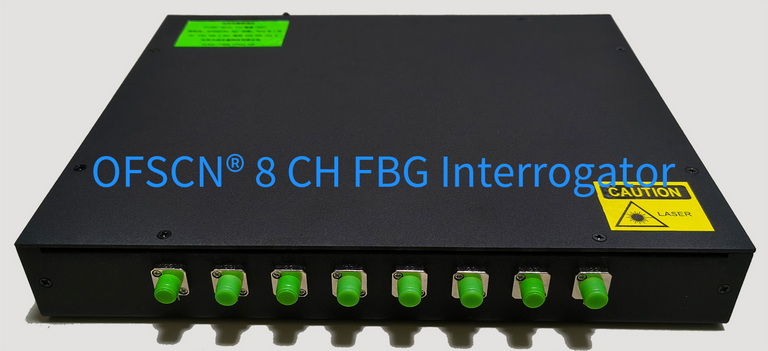
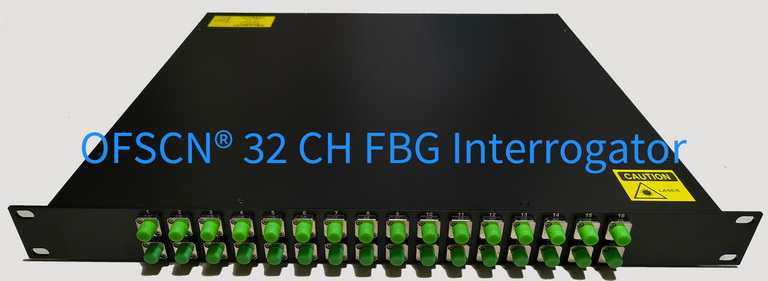
- OFSCN® Fiber Bragg Grating Interrogator: Standard wavelength range is 1525~1565 nm (or 1528~1568 nm, customization supported), available in 4, 8, 16, or 32 channels. Default wavelength resolution can reach 1 pm or 0.1 pm, offering a large dynamic range and high wavelength stability to accommodate various loss conditions.