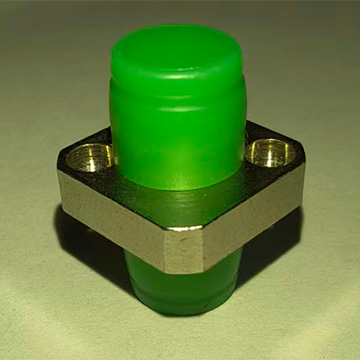
Under high-power lasers, if the end face is oily, will the connector actually “smoke” and burn off?
Yes, under high-power laser systems, if the fiber optic end face is contaminated with oil, the connector will indeed “smoke” and be completely destroyed.
In optical engineering and fiber optic communications, this is known as “End-Face Burn” or “Optical Damage / Connector Burnout”.
I. Analysis of Physical and Engineering Principles
Why can an extremely small amount of oil cause such severe physical damage? We can quantify this scientifically from three perspectives:
1. Extremely High Energy Density
The core diameter of a single-mode fiber is very small (e.g., the nominal mode field diameter is approximately 9\ \mu\text{m}), with a core cross-sectional area of about:
A = \pi \times (4.5 \times 10^{-4}\ \text{cm})^2 \approx 6.36 \times 10^{-7}\ \text{cm}^2
When just 1\ \text{W} of laser power is transmitted, the power density (light intensity) at the fiber core reaches:
I = \frac{1\ \text{W}}{6.36 \times 10^{-7}\ \text{cm}^2} \approx 1.57 \times 10^6\ \text{W/cm}^2 = 1.57\ \text{MW/cm}^2
With such immense energy density (megawatt level) concentrated on such a tiny area, any slight additional absorption of light energy will be converted into destructive thermal energy.
2. High Absorption Rate of Oil and Contaminants
High-purity silica (fused silica) has a very low absorption coefficient at conventional communication wavelengths (e.g., 1550\ \text{nm}) or common laser wavelengths (e.g., 1064\ \text{nm}). Therefore, in a clean state, high-power lasers can pass through the end face safely without significant temperature rise.
However, oily contaminants (such as skin oils, fingerprints, rust inhibitors, mineral oils, and other organic substances) and dust particles typically exhibit extremely high and non-uniform absorption rates at these wavelengths.
3. Positive Feedback Thermal Runaway and “Smoking” Burnout
When a high-power beam passes through a contaminated end face, the entire destruction process occurs within milliseconds or even microseconds:
- Stage 1 (Light Energy Absorption): The oil instantly absorbs a large amount of light energy. Due to the low thermal conductivity of glass and ceramics, heat cannot dissipate quickly, causing a rapid rise in local temperature.
- Stage 2 (Cracking and Smoking): The organic oil reaches its boiling and ignition points, undergoing vigorous thermal cracking, vaporization, and even combustion, which manifests macroscopically as “smoking”.
- Stage 3 (Carbonization and Thermal Runaway): After cracking, the organic material leaves behind charred “carbonized spots” on the end face. Carbon has an extremely high absorption rate for light (close to 100\ \text{%}), thus creating a positive feedback loop (Thermal Runaway). The local temperature rapidly soars above 1700\ ^\circ\text{C}.
- Stage 4 (Melting): As the temperature exceeds the melting point of silica (approximately 1700\ ^\circ\text{C}), the fiber core end face begins to melt and collapse. Simultaneously, the adhesive used to secure the fiber core in the connector undergoes thermal decomposition and burning, leading to the fracture of the ferrule and complete failure of the connector.
II. Prevention and Protection Measures
- Strict End-Face Inspection and Cleaning:
Before connecting high-power devices, it is essential to perform proper cleaning using lint-free wipes, anhydrous ethanol, or dry fiber optic cleaners, and to confirm the absence of any contaminants or scratches using a fiber optic end-face inspection scope. - Selection of Special Optical Connectors with High Temperature and Pressure Resistance:
Standard fiber optic patch cord connectors (which typically have a maximum operating temperature of only 65\ ^\circ\text{C}) use ordinary adhesives and plastic components. In high-power or high-temperature environments, they are prone to aging and adhesive failure due to temperature rise. Therefore, for high-power and harsh environments, industrial-grade, special high-temperature resistant optical connectors and patch cords are recommended.
III. OFSCN® Official Product Support
Beijing Dacheng Yongsheng Technology Co., Ltd. (OFSCN®) has developed a series of specialized optical connection products for high-temperature and demanding industrial environments, which can effectively enhance the system’s tolerance limits in complex conditions:
1. OFSCN® 300℃ Fiber Optic Connector
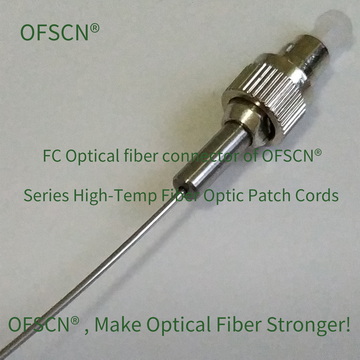
This product is a high-temperature resistant (300\ ^\circ\text{C}) connector for single-mode and multi-mode fibers, supporting various interface types such as FC/PC, FC/APC, ST/PC, ST/APC, SMA905, etc. It utilizes high-temperature resistant materials and special curing processes to ensure physical structural stability in extreme temperature rise environments.
2. OFSCN® 300℃ Fiber Optic Patch Cord
Designed for extreme temperatures and harsh industrial environments, this fiber optic patch cord has an operating temperature range of -270\ ^\circ\text{C} to 300\ ^\circ\text{C}. It consists of the aforementioned high-temperature resistant connectors, seamless stainless steel tubing with an outer diameter of 0.9\ \text{mm}, and polyimide-coated fiber.


3. OFSCN® High Temperature Resistant Fiber Optic Adapter
A high-temperature resistant (300\ ^\circ\text{C}) high-temperature fiber optic adapter (flange) that supports high-reliability mating of precision interfaces such as FC/APC-FC/APC.