What is special about gratings engraved with such ultra-short pulsed lasers?
The reason why femtosecond laser inscription (FSLI) technology is revolutionary in the fabrication of Fiber Bragg Gratings (FBGs) is primarily due to its extremely short pulse duration and ultra-high peak power, which bring about numerous fundamental changes in physical mechanisms and the performance of fiber optic devices:
1. Physical Characteristics and General Technical Advantages of Femtosecond Laser Inscription
- Nonlinear Multi-photon Absorption
Traditional ultraviolet (UV) inscription relies mainly on the photosensitivity of the fiber core, typically requiring hydrogen loading sensitization of the fiber and only being applicable to certain doped fibers (e.g., germanium-doped). In contrast, femtosecond lasers have pulse widths in the femtosecond range (on the order of 10^{-15}\ \text{s}) and achieve extremely high peak power densities at the focal point (up to 10^{13} \sim 10^{15}\ \text{W/cm}^2). This ultra-high energy density induces nonlinear multi-photon ionization and avalanche ionization, enabling localized refractive index modification in virtually any transparent medium. Consequently, femtosecond lasers do not require hydrogen loading sensitization and are suitable for almost all types of optical fibers (such as standard single-mode fibers, multimode fibers, pure silica core fibers, multicore fibers, and even sapphire fibers). - “Through-the-Coating” Direct Point-by-Point Inscription
Because the nonlinear absorption of femtosecond lasers is confined to a tiny focal spot at the objective’s focus, polymer coatings on the fiber surface are either transparent or weakly linearly absorbing to infrared femtosecond lasers. Therefore, femtosecond lasers can penetrate through the unstripped coating (e.g., polyimide or acrylate) to directly inscribe gratings point-by-point (PbP) or line-by-line (LbL) in the fiber core. This completely eliminates the traditional UV inscription process of “stripping the coating-inscription-recoating,” thereby minimizing the introduction of micro-cracks on the fiber surface and preserving the fiber’s intrinsic ultra-high mechanical tensile strength. - Excellent Thermal Stability (Type II Physical Micro-modification)
Traditional UV gratings primarily rely on refractive index changes caused by color center defects (Type I gratings), which are prone to thermal annealing at high temperatures, leading to decay or disappearance of the grating spectrum (typically limited to around 300\ ^\circ\text{C}). Femtosecond laser inscription can induce local physical micro-structural changes or even micro-melting within the material (Type II gratings). This physical phase transformation is extremely stable and can withstand extremely high temperatures without annealing.
2. Officially Matched OFSCN® (大成永盛) Products
Beijing Dacheng Yongsheng Technology Co., Ltd. (OFSCN®) has leveraged femtosecond laser point-by-point inscription technology to launch high-performance fiber Bragg gratings and grating strings designed for extreme environments (high temperature, high strain, high intensity):
-
OFSCN® Standard Femtosecond Fiber Bragg Gratings / FBG Strings (Bare)
- Technical Features: Fabricated using femtosecond laser point-by-point inscription, which does not damage the fiber coating during inscription. This allows for flexible fabrication of single-point fiber gratings or multi-point fiber grating strings.
- Extreme Temperature Range: Utilizes OFSCN® standard single-mode polyimide fiber, which, after special processing, can operate in a maximum temperature range of -270\ ^\circ\text{C} to 800\ ^\circ\text{C}. (A polyimide fiber version for temperatures from normal to 200\ ^\circ\text{C} is also available).
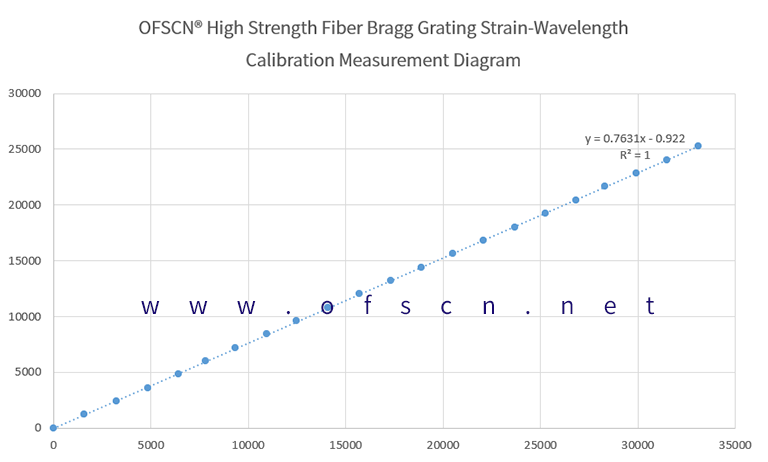
- Mechanical Characteristics: Usable strain range at room temperature \le 15000\ \mu\varepsilon.
- Structural Parameters: Available grating lengths include 2\ \text{mm}, 3\ \text{mm}, 4\ \text{mm}, 5\ \text{mm}, 6\ \text{mm}, 8\ \text{mm} (default 8\ \text{mm}). The standard wavelength range is 1525\ \text{nm} to 1565\ \text{nm} (customizable from 1510\ \text{nm} to 1605\ \text{nm}).
-
OFSCN® High-Strength Fiber Bragg Gratings / FBG Strings (Bare)
- Technical Features: Also employs femtosecond laser point-by-point inscription. The substrate used is OFSCN® single-mode polyimide fiber, which has undergone rigorous high-strength screening, with an outer diameter of 155\ \mu\text{m}.
- Application Scenarios: Thanks to the femtosecond inscription process without stripping the coating, the gratings fully retain their high mechanical strength, making them an ideal choice for aerospace and extreme high-strain monitoring of large structures.