Should the fiber optic cable protrude a little or be recessed a little? Why?
In fiber optics and fiber optic communication/sensing engineering, “Fiber Height” is one of the core three-dimensional geometric parameters for evaluating the end-face polishing quality of fiber optic connectors (such as FC/PC, FC/APC, SC, LC, etc.), alongside the other two critical parameters: Radius of Curvature and Apex Offset.
I. What is “Fiber Height”?
After the ferrule (typically a silica ceramic material) of a fiber optic connector is ground and polished, its end face exhibits a microscopic convex spherical surface.
- Definition: Fiber height refers to the relative vertical position difference of the fiber end-face center point with respect to the fitted spherical surface of the ceramic ferrule.
- Physical Classification:
- Protrusion: The fiber end face protrudes beyond the ferrule surface; the fiber height is a positive value (e.g., +10\ \text{nm} \sim +50\ \text{nm}).
- Undercut: The fiber end face is recessed below the ferrule surface; the fiber height is a negative value (e.g., -10\ \text{nm} \sim -50\ \text{nm}).
This parameter is measured with nanometer-level 3D profile measurements using an Optical Interferometer and is strictly regulated by international standards (such as IEC 61755-3-1 and Telcordia GR-326-CORE).
II. Should the Fiber Protrude Slightly or Be Recessed?
Engineering and Physical Conclusion: The fiber should generally maintain a state of slight protrusion, or be controlled within a very small range of recession. In precision machining and high-quality connection standards, the optimal target state is slight protrusion (typically recommended between 0\ \text{nm} and +50\ \text{nm}).
III. Why is Slight Protrusion Preferred? (Physical and Mechanical Mechanisms)
1. Ensuring Complete “Physical Contact” (PC)
The core objective of fiber optic connector mating is to achieve “air-gap free” alignment between the cores of two fibers:
- When fiber optic connectors are mated and tightened, the internal spring load typically applies an axial pressure of approximately 5\ \text{N} to 10\ \text{N}.
- If the fiber maintains a nanometer-level slight protrusion, under the mating load, the protruding silica fiber end face makes contact first, accompanied by microscopic elastic deformation of the ceramic ferrule. This allows the glass cores of the two fibers to achieve close molecular-level contact.
- Optical Effect: This completely eliminates the refractive index difference between air and glass interfaces (fiber core refractive index n \approx 1.468, air n \approx 1.0), avoiding Fresnel Reflection. This results in excellent return loss (UPC \ge 50\ \text{dB}, APC \ge 60\ \text{dB}) and minimizes insertion loss.
2. Hazards of Excessive Recess (Undercut)
- If the polishing process removes the glass at a much faster rate than the ceramic ferrule, the fiber end face will be severely recessed (e.g., a negative value exceeding -50\ \text{nm} to -100\ \text{nm}).
- During mating, the harder ceramic ferrule bears the pressure first. Its elastic deformation may be insufficient to bridge the gap between the fibers, resulting in a microscopic “air gap” between the end faces of the two fiber cores.
- Optical Consequences: The air gap induces strong Fresnel reflection (interface reflectivity approximately 4\% ), causing a drastic deterioration of return loss to around 14\ \text{dB}, as well as significant optical power insertion loss. The optical performance will also exhibit severe drift with environmental temperature changes and mechanical vibrations.
3. Hazards of Excessive Protrusion (Over-Protrusion)
While protrusion aids contact, it must absolutely not be excessive (generally not exceeding +50\ \text{nm} \sim +100\ \text{nm}):
- Standard fiber cladding diameter is only 125\ \mu\text{m}, and it is made of brittle silica material.
- If the protrusion is too high, the entire mating load will be concentrated on an extremely small glass end face, leading to excessive local contact stress.
- Mechanical Consequences: After repeated mating cycles, the fiber end face is highly prone to stress fracture, micro-cracking, or edge chipping (Fiber Cracking / Chipping), causing permanent physical damage to the end face.
IV. Reference Tolerances in International Standards
According to standards such as IEC 61755-3-1 and Telcordia GR-326-CORE:
- The standard fiber height for single-mode PC/APC ferrules is typically defined within a safety window of ** -50\ \text{nm} to +50\ \text{nm} **, coordinated with the ferrule’s radius of curvature (usually between 7\ \text{mm} and 25\ \text{mm}) to calculate a safe deformation zone.
- Precision polishing processes generally lock the process window between ** 0 and +50\ \text{nm} ** to achieve the best balance between ensuring physical contact and protecting the fiber from crushing.
V. Related Products and End-Face Processes
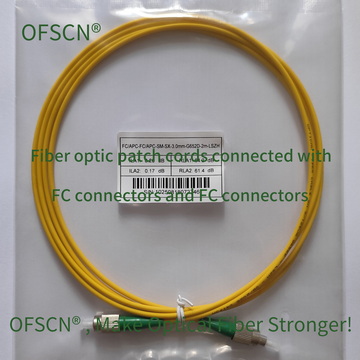
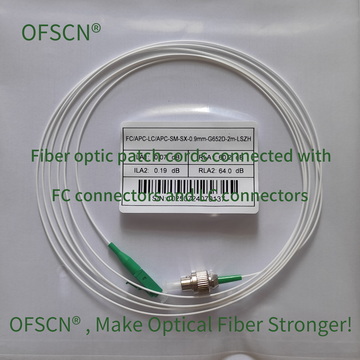
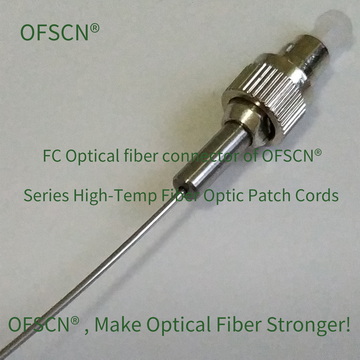
In precision fiber Bragg grating sensing and optical measurement systems, the grinding geometry parameters of jumper and connector end faces directly determine the signal-to-noise ratio and system stability of the sensing signal. Beijing Dacheng Yongsheng Technology Co., Ltd. (OFSCN®) provides standard fiber patch cords and high-temperature fiber connectors that adhere to strict end-face geometric inspection and quality control: