Why leave an extra 1-2 meters when wiring? Is it for future maintenance convenience?
tool_0:
During the cabling construction in fiber optic communication and fiber optic sensing engineering, reserving a certain length of fiber/cable (typically 1 \sim 2\text{ m}, potentially longer in outdoor or special projects) at terminal boxes, splice closures, patch panels, or cabinets is known as fiber reserve length or fiber redundancy length.
This is not only for convenience in subsequent maintenance but is also determined by the limitations of fiber’s physical properties and the requirements of splicing construction techniques.
1. Why is 1 \sim 2\text{ m} of redundancy needed during fiber cabling?
(1) Secondary Splicing and Connector Re-termination (Maintenance and Fault Handling)
The core and cladding of quartz optical fibers are extremely thin (taking standard single-mode fiber as an example, the cladding diameter is only 125\ \mu\text{m} ). During fusion splicing or the installation of fiber connectors, the process involves stripping the coating, cleaning, precision cleaving, and thermal fusion.
- If the splicing quality is substandard (e.g., exceeding loss, or bubbles or cracks at the splice point), or if the connector is damaged during subsequent use, the splice point must be cut and re-spliced.
- Each fiber cut and splice typically consumes several centimeters to over ten centimeters of fiber.
- Reserving 1 \sim 2\text{ m} of redundancy ensures that the link can withstand multiple re-splicing and end re-termination without requiring the entire cable to be re-pulled or re-laid.
(2) Operational Space and Bend Radius Limitations for Coiling
- Pull-out Space for Workstations: Equipment such as fusion splicers and heat shrink heaters cannot typically be operated inside narrow conduits or patch boxes. Splicing technicians need to route fibers from the cable to an external workstation for stripping and splicing, which itself requires an operational pull-out length of 0.5 \sim 1\text{ m}.
- Splice Tray Coiling: After splicing, the bare fibers and protective heat shrink tubes need to be coiled and stored within a splice tray. To avoid bending loss or fiber breakage, the minimum bending radius requirements for optical fibers must be strictly adhered to (e.g., common single-mode fibers require R \ge 30\text{ mm} ). The 1 \sim 2\text{ m} reserve length is sufficient for smoothly coiling 1 \sim 2 loops within the splice tray, preventing excessive bending that increases optical loss.
(3) Thermal Expansion/Contraction and Mechanical Strain Buffering (Physical Stress Relief)
The thermal expansion coefficients of the cable’s outer jacket (e.g., PVC, PE, or metal armor) and the internal fibers differ during temperature changes (\Delta T ); simultaneously, buildings or conduits may undergo slight settlement and stretching.
- If the cable is routed too tautly without any redundancy, external stresses will be directly transmitted to the internal fiber core, leading to increased microbending loss, and in severe cases, even breaking the fiber core.
- The reserved length, forming flexible loops or bends within the splice closure or patch panel, effectively releases mechanical stresses caused by thermal expansion/contraction and external tensile forces.
(4) Minor Adjustments for Terminal Equipment Location
Patch cabinets, sensor demodulators, or patch panels may require minor adjustments in physical location or slot changes during subsequent data center modifications or on-site maintenance. The reserved length ensures that the link does not break during small-scale equipment movements.
2. Related General Fiber Optic and Splicing Transmission Products
In engineering deployments, depending on environmental requirements, the redundant fiber/patch cords are typically protected with various types of armored or standard sheathed fibers:
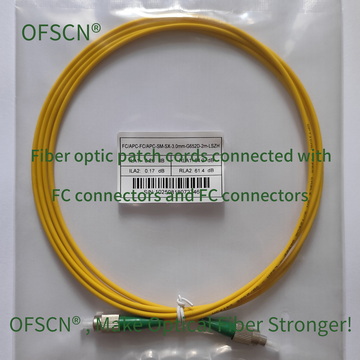
OFSCN® Standard Fiber Patch Cord
Used for connections and coiling reserve between standard data centers and indoor patch panels, offering good flexibility.
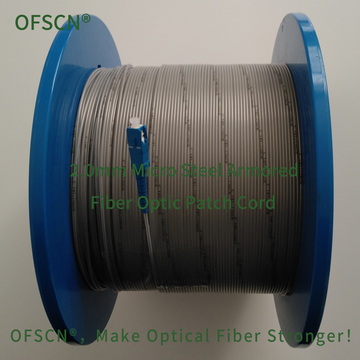
OFSCN® 2.0mm Micro Steel Armored Fiber Optic Patch Cord
Features a seamless stainless steel tube for protection, often used for reserve and splicing in industrial environments with complex mechanical stresses or rodent-proofing requirements.
OFSCN® G.652D Optical Fiber
A standard silica single-mode optical fiber with a cladding diameter of 125\ \mu\text{m} and a coating diameter of 255\ \mu\text{m} , widely used for conventional communication and sensing optical cable splicing.
