I heard that hydrogen can penetrate glass and turn optical fibers black. What is going on?
In the fields of fiber optic communication and fiber optic sensing, the phenomenon you mentioned, “hydrogen drilling into glass causing the fiber to turn black,” is known in physics and engineering as “hydrogen aging” (or hydrogen-induced attenuation, in English Hydrogen Aging or Hydrogen Darkening). This is a very classic cross-phenomenon between solid-state physics and optics.
Here are the scientific principles, mechanisms, and corresponding engineering solutions for this phenomenon:
I. What is “Hydrogen Aging / Darkening”?
The main component of optical fiber is high-purity silicon dioxide (SiO_2) glass. Although glass appears very dense to us, at the molecular level, the amorphous network structure of silicon dioxide contains a large number of microscopic lattice voids.
When optical fibers are in a hydrogen-rich environment, due to the extremely small molecular radius of hydrogen molecules (H_2) (dynamic diameter of only about 0.289\ \text{nm}), they can penetrate the interior of quartz glass through physical diffusion, much like passing through a sieve. Hydrogen that enters the fiber primarily causes a sharp increase in fiber transmission loss (the so-called “darkening”) through the following two mechanisms:
1. Physical Absorption Loss (Reversible Process)
Free H_2 molecules dissolved in the gaps of the quartz glass absorb specific wavelengths of light. They produce characteristic absorption peaks in the infrared band (e.g., around 1240\ \text{nm}, and at positions like 1383\ \text{nm} and 1430\ \text{nm} near the optical communication bands). This absorption loss is physical in nature. If the fiber is removed from the hydrogen environment and subjected to dehydrogenation treatment, the free hydrogen molecules will slowly diffuse out of the fiber, and the loss can be partially or fully recovered.
2. Chemical Defect Absorption Loss (Irreversible Process)
Under high temperature or high pressure conditions, the diffused hydrogen molecules react chemically with the fiber glass matrix or dopants within the fiber core (such as germanium (Ge) and phosphorus (P) elements used to increase refractive index).
- Hydrogen molecules break the original Si-O-Si or Ge-O-Si bonds, forming hydroxyl groups (-OH) and other structural defects.
- Hydroxyl groups have extremely strong vibration absorption peaks at 1383\ \text{nm}. Since this reaction forms new chemical bonds, it is irreversible. Even if the hydrogen in the environment is completely removed afterward, these hydroxyl defects will remain permanently in the fiber, causing the light signal at this wavelength to be permanently blocked (permanent fiber “blindness”).
II. In Which Environments is “Hydrogen Aging” Likely to Occur?
In conventional civilian fiber optic communication, the hydrogen content in the atmosphere is extremely low, and “hydrogen aging” is not significant. However, in the following harsh industrial environments, hydrogen aging poses a severe challenge that must be addressed:
- Deep oil and natural gas wells: The downhole environment is rich in hydrogen and hydrogen sulfide, and temperatures often reach 100\ ^\circ\text{C} to 300\ ^\circ\text{C} and above, greatly accelerating the diffusion and chemical reactions of hydrogen molecules.
- Geothermal well monitoring: Accompanied by high temperature and pressure, and a hydrogen-rich corrosive medium.
- High-voltage cables and special chemical pipelines: Free hydrogen is produced due to electrolysis or chemical corrosion.
III. How is “Hydrogen Aging” Prevented and Solved in Industry?
To prevent hydrogen ingress, the fiber optic manufacturing industry has developed two main technical approaches: intrinsic modification and extrinsic shielding. OFSCN® provides corresponding custom solutions for special optical fibers for these high-risk, hydrogen-rich scenarios:
1. Extrinsic Shielding: Carbon Coating Technology
Outside the cladding of the optical fiber, an extremely thin and extremely dense carbon coating (pyrolytic carbon) is directly deposited. This carbon film forms a physically airtight barrier, preventing the permeation of water and hydrogen molecules, thus providing long-term protection against hydrogen aging.
- Related Products:
-
OFSCN® 300℃ SM Polyimide Optical Fiber (operating temperature range from -200\ ^\circ\text{C} to 350\ ^\circ\text{C} ), its coating layer supports added carbon coating customization, suitable for use in deep well environments with high temperature, high pressure, and abundant hydrogen.
-
OFSCN® 200℃ Polyimide Optical Fiber also supports added carbon coating customization.
-
OFSCN® 120℃ SM High-temperature Optical Fiber supports added carbon coating customization, suitable for medium and low-temperature hydrogen-rich sensing environments.
-





2. Intrinsic Modification: Pure Silica Core Technology
Since germanium (Ge) in the fiber core is the main catalyst for the conversion of hydrogen molecules into hydroxyl groups (-OH), adopting a “Pure Silica Core” structure with a fluorine-doped cladding significantly reduces the reactivity of chemical reactions induced by hydrogen gas inside the optical fiber from an intrinsic perspective.
- Customization Service:While the polyimide high-temperature fiber series from OFSCN® mentioned above are typically doped-core by default, they all offer pure silica core customization, which suppresses the occurrence of irreversible hydrogen aging intrinsically.
3. Airtight Protection at Extremely High Temperatures: Gold-coated Optical Fiber
At extremely high temperatures (e.g., 300\ ^\circ\text{C} to 700\ ^\circ\text{C}), conventional polymer coatings fail. In such cases, metal-coated fibers can be used. Metallic gold (Au) has excellent airtightness and can perfectly shield hydrogen and moisture.
-
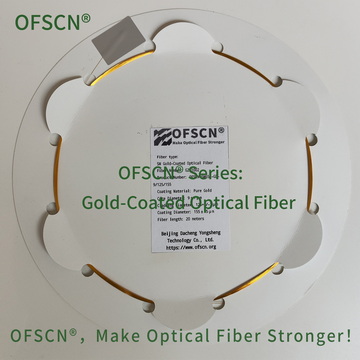
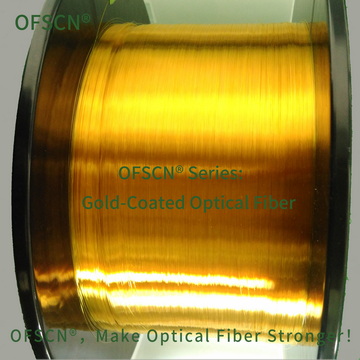
Related Products:OFSCN® Gold-coated Optical Fiber, with an operating temperature range from -270\ ^\circ\text{C} to 700\ ^\circ\text{C}, supports pure silica core customization by default, offering excellent physical protection and optical stability in extreme high-temperature and hydrogen-rich environments.