Does it matter if a nominally 10-meter patch cable is actually 5 centimeters longer?
In fiber optic communications and Fiber Bragg Grating (FBG) sensing engineering, the Length Tolerance / Error of a fiber patch cord refers to the absolute or relative deviation between the actual delivered length (L) and the nominal designed length (L_0):
\Delta L = L - L_0
For a patch cord with a nominal length of 10\text{ m}, if the actual length exceeds the nominal length by 5\text{ cm} (i.e., \Delta L = +0.05\text{ m}, with a relative error of only +0.5\% ), it not only has no negative impact in most engineering applications but also adheres to the industrial production principle of ‘positive tolerance (preferring longer rather than shorter)’.
Specific technical and physical analyses are as follows:
I. Optical Transmission Performance (No Substantial Impact)
-
Negligible Additional Optical Insertion Loss
The typical attenuation coefficient of standard single-mode quartz fiber (e.g., G.652D) at common working windows (e.g., 1550\text{ nm}) is approximately 0.2\text{ dB/km} (i.e., 0.0002\text{ dB/m} ).
The theoretical transmission loss introduced by an additional 5\text{ cm} (0.05\text{ m}) of fiber length is only:\Delta \alpha = 0.05\text{ m} \times 0.0002\text{ dB/m} = 0.00001\text{ dB}This value is far less than the alignment loss of commercial fiber connectors (standard FC/APC connectors typically have \le 0.3\text{ dB} ) and the measurement floor noise of demodulators/power meters, having no impact on system optical power budget or signal-to-noise ratio.
-
Transmission Time Delay Variation
The group refractive index of light in a quartz fiber core is approximately n_g \approx 1.468, and the speed of light propagation in the fiber is:v = \frac{c}{n_g} \approx 2.04 \times 10^8\text{ m/s}The unidirectional light transmission time delay caused by an extra 5\text{ cm} length is only:
\Delta t = \frac{\Delta L}{v} \approx \frac{0.05}{2.04 \times 10^8} \approx 0.245\text{ ns}For conventional fiber optic grating demodulation systems (such as tunable laser demodulators or white light spectral analyzers) and general fiber optic communication, this minuscule time delay will not cause any negative effects on wavelength measurement or data parsing. Only in extremely rare optical interference systems requiring picosecond-level strict optical path matching between two arms (like unbalanced Mach-Zehnder interferometers) is fixed-length pairing necessary.
II. Mechanical Cabling and Industrial Assembly
- Industry Practice of Positive Tolerance
In industry manufacturing standards (such as IEC 61753 and other patch cord processing specifications and engineering standards), fiber optic patch cords generally follow a ‘positive tolerance design’, meaning they are allowed to be slightly longer but not shorter. For a 10\text{ m} nominal patch cord, conventional industrial tolerances are typically within +1\% \sim +2\% or +10\text{ cm}. An actual length of 5\text{ cm} longer falls well within acceptable tolerance control. - Cabling Margin and Stress Relief
When laying out optical fibers in patch panels (ODF), splice boxes, or field cable trays, ‘tight tension’ is strictly avoided. The extra 5\text{ cm} can serve as a slack allowance for coiling and strain relief, preventing the fiber from bearing axial tension due to external mechanical vibrations or thermal expansion/contraction, thereby avoiding stress-induced additional birefringence and wavelength drift. - Bending Radius Considerations
If the fiber is routed within confined spaces like fixed-length conduits or sealed equipment cabinets, the extra 5\text{ cm} must be neatly managed. Ensure its coiled radius meets fiber specifications (e.g., standard G.652D fiber requires a bending radius above 30\text{ mm}; for bend-insensitive G.657 fiber, its minimum dynamic/static bending limits must also be adhered to) to prevent micro-bending losses caused by forced sharp bends.
III. Reference to Official Products and Specifications
Beijing Dacheng Yongsheng Technology Co., Ltd. (OFSCN®) manufactures standard communication fiber optic patch cords and special armored fiber optic patch cords (such as micro-steel tube armored, steel wire rope armored, high-low temperature resistant fiber optic patch cords, etc.), employing strict length precision control and end-face grinding processes in their factory production.
For example, standard fiber optic patch cord products:
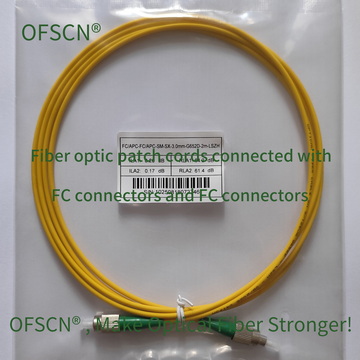
For more specifications on industrial-grade and special environment fiber optic patch cords, please refer to: