Although fiber optics are not electrically conductive, do the metal armored layer and strength member require grounding?
This is a very classic and critical physical and safety issue in fiber optic sensing system engineering.
Brief Conclusion: Grounding is essential.
Although optical fiber itself is made of silica (quartz glass) and is perfectly electrically insulating, unaffected by any electromagnetic interference (EMI), the metal armor layer (such as seamless stainless steel pipes, stainless steel wire strands, etc.) and metal strength members (such as steel wires) introduced to protect the fiber are conductors. They must be strictly subjected to lightning protection and grounding treatment.
The following explains the specific reasons and engineering implementation standards from the perspectives of optical engineering and electromagnetic physics:
I. Physical Reasons Why Metal Armor Layers and Strength Members Require Grounding
1. Lightning Strike Protection
When laying fiber optic cables in outdoor environments such as fields, tunnels, bridges, or power transmission towers, the continuous metal armor layer and metal strength members act as long-distance lightning conductors.
- If the fiber optic cable or its vicinity is struck by lightning, the metal layer will induce extremely high transient overvoltages (up to tens of kilovolts or more) and lightning currents (I \ge 10\ \text{kA}).
- If the metal layer is not grounded, the immense electrical energy released by the lightning has no path to dissipate. It will conduct along the metal layer to both ends, generating extremely high Joule heat (Q = I^2 R t), thereby melting the stainless steel outer sheath of the fiber optic cable, burning the fiber coating, or even causing direct embrittlement and fracture of the glass fiber core.
- Furthermore, high-voltage lightning currents will conduct along the metal armor all the way to the indoor optoelectronic demodulation equipment, discharging at the terminal and instantly destroying the extremely expensive fiber optic demodulator, potentially even causing a fire.
2. Electromagnetic Induction and Elimination of Strong Currents
Distributed fiber optic sensing ( DTS , DVS , DOFS ) or Fiber Bragg Grating ( FBG ) sensing systems are often deployed in high-voltage electromagnetic environments such as substations, high-voltage cable tunnels, and railway traction catenary systems.
- Alternating strong electromagnetic fields can induce alternating current electromotive forces on the long metal armor tubes.
- If not grounded, dangerous voltages to ground will accumulate on the metal layer, posing an electrocution hazard to on-site maintenance personnel. It can also discharge through the metal flange at the terminal to the equipment casing, generating high-frequency electromagnetic noise.
3. Equipotential Bonding and Electrostatic Discharge
Static charges generated by friction, wind, or industrial environments can accumulate on the surface of the metal armor. Through grounding, these static and stray charges can be promptly conducted to the earth, maintaining the outer sheath of the entire sensor network at equipotential with the ground.
II. Grounding Standards in Engineering Construction
According to lightning protection and anti-static engineering standards (such as grounding resistance requirements of R_g \le 10\ \Omega , or R_g \le 1\ \Omega for combined grounding), fiber optic sensing systems should adhere to the following principles:
- Terminal Equipotential Connection: When fiber optic cables enter control cabinets, fiber distribution frames ( ODF ), or indoor splice boxes, the metal armor layer (e.g., stainless steel tube) and metal strength members must be stripped and electrically connected using a dedicated grounding clamp, and then introduced to the indoor combined grounding busbar via a grounding copper wire.
- Intermediate Splice Box Grounding: For long-distance fiber optic cables, at outdoor splice box locations, the metal armor and strength members of the fiber optic cables at both ends should be electrically connected with a jumper wire inside the splice box and connected to the lightning protection ground network.
- Optoelectronic Isolation: Before entering core equipment such as fiber optic demodulators, utilize fiber optic patch cords or pigtails (soft patch cords without metal layers or metal strength members) for terminal transition, allowing high voltage and lightning currents to be physically isolated and dissipated before entering precision optical instruments.
III. Related OFSCN® (Dacheng Yongsheng) Product Information
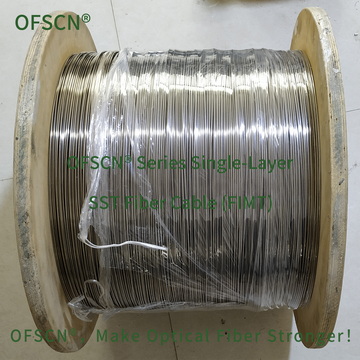
Beijing Dacheng Yongsheng Technology Co., Ltd.'s high-temperature stainless steel seamless steel tube fiber optic cable features a core advantage: the use of seamless stainless steel tubes (SST) as a protective layer, providing extremely high mechanical tensile strength and temperature resistance. However, during engineering installation, due to the continuity of its all-metal sheath, lightning protection grounding is particularly important.
For example, the following typical products:
-
OFSCN® Double-Layer High-Temperature Downhole Fiber Optic Cable Official Link
This product uses double-layer seamless steel tubes for encapsulation, with 316L stainless steel as the default material. In complex electromagnetic and lightning environments such as downhole oil extraction and geothermal monitoring, the steel pipe ends at the wellhead must be reliably equipotentially grounded to the metal structures or system ground at the wellhead using grounding clamps.
-
OFSCN® 200°C Seamless Steel Tube Fiber Cable Official Link
Encapsulated with a single-layer alloy tube. In long-distance distributed temperature/strain measurement projects, the surface of this fiber optic cable must be properly grounded for lightning current diversion at each segmented joint and terminal cabinet according to specifications.

In summary, “optical fiber is non-conductive” does not mean “fiber optic cable systems do not require lightning protection.” The presence of metal armor layers and strength members dictates that sensing fiber optic cables must be reliably grounded in strict accordance with lightning protection standards for strong current or telecommunications systems.