Why must the wavelength change and temperature change be a perfect straight line?
In the rigorous sense of physics and sensor engineering: the wavelength shift of a Fiber Bragg Grating (FBG) does not necessarily have an absolutely perfect linear relationship with temperature changes.
In fact, “linear relationship between wavelength and temperature” is a first-order linear approximation used in engineering applications within specific temperature ranges. If venturing into wide temperature ranges or ultra-high temperature environments, this relationship will exhibit a non-linear curvature that cannot be ignored.
I. Physical Mechanism: The Essence of Wavelength-Temperature Response
The center reflection wavelength \lambda_B of a Fiber Bragg Grating is determined by the Bragg condition:
\lambda_B = 2 n_{eff} \Lambda
Where:
- n_{eff} is the effective refractive index of the fiber core fundamental mode;
- \Lambda is the physical period of the grating.
When the temperature T changes, taking the total differential with respect to temperature yields:
\frac{\Delta \lambda_B}{\lambda_B} = (\alpha + \xi) \Delta T
Where:
- Thermal Expansion Effect: \alpha = \frac{1}{\Lambda} \frac{\partial \Lambda}{\partial T} is the coefficient of thermal expansion (TEC) of the material. As temperature increases, the grating period elongates.
- Thermo-Optic Effect: \xi = \frac{1}{n_{eff}} \frac{\partial n_{eff}}{\partial T} is the thermo-optic coefficient (TOC) of the material. As temperature increases, the refractive index of the fiber changes (in silica fibers, the thermo-optic effect dominates the wavelength-temperature response, accounting for approximately 95\% ).
II. Why is it Considered a “Straight Line” in Normal or Small Temperature Ranges?
In conventional engineering monitoring temperature ranges (e.g., -20\ ^\circ\text{C} \sim 100\ ^\circ\text{C} ), the higher-order changes in the coefficients of thermal expansion \alpha and thermo-optic coefficient \xi for silica (and protective casing materials) are extremely small with respect to temperature.
By neglecting higher-order terms, (\alpha + \xi) can be approximated as a constant macroscopically. In this case, the wavelength shift \Delta \lambda_B and the temperature change \Delta T exhibit extremely high consistency and linearity (correlation coefficient R^2 can typically reach above 0.999 ).
Engineering Significance:
- A simplified monomial (first-order linear fit) requires minimal computation, facilitating high-speed real-time demodulation and physical quantity conversion by multi-channel demodulators;
- Calibration and commissioning procedures are straightforward, requiring only a one-time calibration of the sensitivity slope (approximately 10\ \text{pm/}^\circ\text{C} for bare fiber at room temperature, and 20 \sim 35\ \text{pm/}^\circ\text{C} for metal-packaged structures).
III. Why is it Not a Straight Line in Wide Temperature Ranges? (Origin of Non-linearity)
When the temperature measurement range extends to cryogenic temperatures (e.g., -200\ ^\circ\text{C} ) or moderate-to-high temperature environments (e.g., 300\ ^\circ\text{C} \sim 800\ ^\circ\text{C} ), the assumption of a “perfect straight line” no longer holds:
- Non-linearity of the Thermo-Optic Coefficient: The \frac{\partial n_{eff}}{\partial T} of silica material itself is a function of temperature. As the temperature significantly increases, its thermo-optic coefficient shifts;
- Variation in the Coefficient of Thermal Expansion of the Structure: The coefficient of thermal expansion of the metal lattice in seamless steel pipes or special alloys used for packaging sensors exhibits significant temperature dependence across temperature ranges of several hundred degrees;
- Release of Residual Thermal Stress: Subtle changes in the strain state at structural interfaces at high temperatures can further superimpose non-linear responses.
If a “straight line (linear polynomial)” fit is forcibly used in such wide temperature range scenarios, it will introduce non-negligible systematic measurement errors.
IV. Calibration Standards for Official Sensors
To address the physical non-linear characteristics across different temperature measurement ranges, OFSCN® employs differentiated mathematical models in its factory calibration of sensors:
1. Narrow Temperature Range and Normal Temperature Environment: Linear (Monomial) Calibration
In conventional industrial temperature measurements within 100\ ^\circ\text{C} , the physical linearity is excellent, and a monomial calibration can ensure sufficient measurement accuracy.
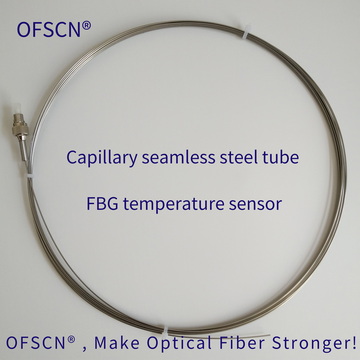
- Corresponding Product: OFSCN® 100°C Fiber Bragg Grating Temperature Sensor
- Calibration Description: Factory temperature calibration range is from room temperature to 100\ ^\circ\text{C} . The default temperature-wavelength calibration formula is monomial, with units of ^\circ\text{C/pm} .

2. Medium-High Temperature and Wide Temperature Range Environment: Non-linear (Binomial) Calibration
When the operating temperature rises to 300\ ^\circ\text{C} or 500\ ^\circ\text{C} , to correct for non-linear drift, a quadratic polynomial (binomial) must be used for non-linear compensation and calibration:
T = A \cdot (\Delta \lambda)^2 + B \cdot \Delta \lambda + C
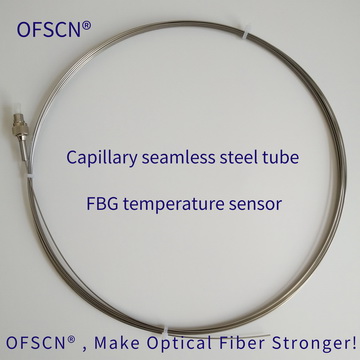
- Corresponding Product: OFSCN® 300°C Fiber Bragg Grating Temperature Sensor
- Calibration Description: Factory temperature calibration range is from room temperature to 300\ ^\circ\text{C} . The default temperature-wavelength calibration formula is binomial, with units of ^\circ\text{C/pm} .
- Corresponding Product: OFSCN® 500°C Fiber Bragg Grating Temperature Sensor
- Calibration Description: The factory temperature calibration range is from room temperature to 500\ ^\circ\text{C} . The default temperature-wavelength fitting formula also adopts a binomial fit to eliminate computational deviations caused by material non-linearity at high temperatures.
Conclusion
Wavelength and temperature do not naturally form a “perfect straight line.” Considering it a straight line within a limited temperature range is for the pursuit of engineering calculation efficiency and simplification; however, in rigorous physical principles and high-precision wide-temperature measurements, the higher-order physical responses of materials must be corrected through non-linear calibration equations such as binomials.