Fiber optik koparsa yazılım bana yaklaşık olarak nerede koptuğunu söyleyebilir mi?
Fiber sensing and fiber communication systems’ ability to determine the location and precision of a breakpoint depends on the technical principles and topological architecture employed by the system:
1. Fiber Bragg Grating (FBG) Sensing Systems: Section-Level Fault Localization
In conventional Wavelength Division Multiplexing (WDM)-based FBG systems, multiple fiber Bragg grating sensors with distinct reflection wavelengths (e.g., \lambda_1, \lambda_2, \dots, \lambda_n) are connected in series on the same fiber link.
- Diagnostic Principle: When the fiber breaks or the optical path is obstructed at a certain point, the injected optical signal cannot reach the sensors beyond the breakpoint, causing the reflection wavelength signals from all FBG sensors after the breakpoint to be lost.
- Software Diagnostic Result: By real-time monitoring of reflection spectra and wavelength data from each measurement point, the demodulation software can quickly identify the “last normally signaling sensor” and the “first sensor with lost signal”.
- Localization Precision: The software can accurately report which two adjacent sensor nodes the breakpoint lies between (section-level localization).
2. Distributed Fiber Sensing / Link Testing (OTDR / OFDR): Meter-to-Millimeter Precision Localization
If the precise physical distance of the break point from the equipment frontend needs to be determined (e.g., a break at 128.5\text{ m}), time-domain or frequency-domain reflection measurement techniques are required:
- OTDR (Optical Time-Domain Reflectometer): Transmits light pulses and detects Rayleigh backscatter along the fiber and Fresnel reflections generated at the breakpoint. The distance to the breakpoint is calculated based on the round-trip time of light in the fiber (precision is typically in the meter or decimeter range).
- OFDR (Optical Frequency-Domain Reflectometer): Utilizes swept-laser interferometry to measure fiber backscatter, enabling millimeter or even sub-millimeter breakpoint localization and strain distribution measurement within ranges of tens to hundreds of meters.
3. Link Monitoring for OFSCN® Devices and Systems
In industrial fiber Bragg grating sensing networks, demodulation equipment coupled with monitoring software facilitates automated link health monitoring:
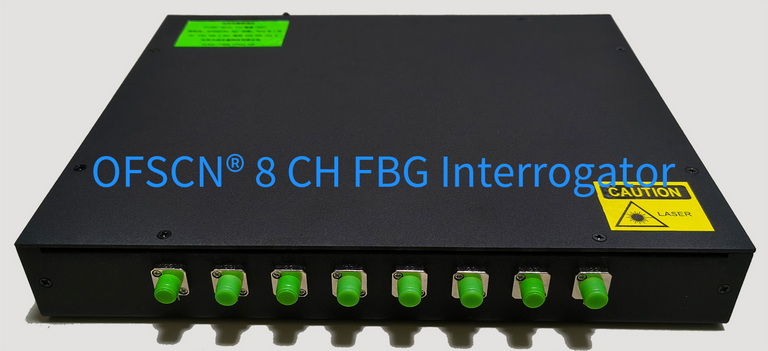
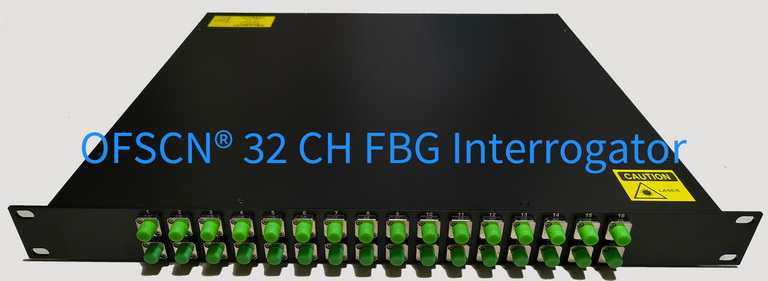
- The OFSCN® Fiber Bragg Grating Interrogator supports multi-channel (4, 8, 16, or 32 channels optional) parallel acquisition, with a wavelength range covering 1525\text{ nm} to 1565\text{ nm} (or 1528\text{ nm} to 1568\text{ nm}). The sampling frequency can be configured between 1\text{ Hz} and 100\text{ Hz}. The software, based on network communication (B/S or C/S architecture), tracks the wavelength status of all channels in real-time. When fiber damage or breakage occurs, the system immediately triggers an offline alarm for the measurement point and precisely locates the affected section.