Will steel pipes and optical fibers glued together loosen after ten years, causing inaccurate measurements? OFSCN®
This is a very classic and highly discussed sensor physics and material science problem in the engineering community.
Direct Answer: If you simply use traditional organic adhesives (such as epoxy glue, UV-cured glue, etc.) to bond bare optical fibers to stainless steel tubes, after long-term service of ten years (or even several years, months, depending on environmental temperature, humidity, and dynamic loads), due to the physical degradation of the adhesive itself, loosening, debonding, and creep will almost inevitably occur, leading to severe measurement inaccuracies.
This “long-term instability” is determined by the physical properties of organic polymer adhesives, and its specific mechanical and material science roots are as follows:
1. Physical Roots of Adhesive Loosening and Measurement Inaccuracy
- Stress Creep and Stress Relaxation:
Organic polymer adhesives are typical viscoelastic materials. Under long-term tensile or compressive stress (\sigma), even if the external strain is constant, the adhesive polymer chains will slowly slide, causing the shear stress within the adhesive layer to be gradually released (stress relaxation). Under constant tension, the adhesive will experience plastic deformation that increases over time (creep). In strain measurement, this causes the true strain of the steel tube to not be transferred to the optical fiber 100\%, resulting in significant zero-point drift or sensitivity attenuation of the measured wavelength. - Adhesive Aging and Physical Degradation (Polymer Aging):
Over an ultra-long period like ten years, external factors such as temperature cycling, media corrosion, and light exposure can cause chemical bond breakage in organic adhesives, leading to embrittlement, cracking, and shrinkage. This will result in the loss of physical shear force at the interface between the adhesive and the steel tube, and between the adhesive and the quartz optical fiber. - Moisture Swelling and Interfacial Debonding:
Water molecules are extremely small. Over a decade, trace amounts of moisture will gradually penetrate the adhesive layer through diffusion or accumulate at the bonding interface between the adhesive and the quartz glass (silica) or steel tube. Water will disrupt existing hydrogen bonds, causing a sharp decrease in bonding strength and leading to microscopic delamination.
2. How Does the Industry Solve the Ten-Year Long-Term Stability Problem?
To achieve ultra-long “long-term stability” of ten years, in the professional field of fiber optic sensing, All-Metal Packaging or glue-free elastic structures must be used to replace traditional organic polymer adhesives.
Beijing Dacheng Yongsheng Technology Co., Ltd. (OFSCN®) has developed proprietary glue-free packaging and elastic alloy tube technology for high-reliability, long-term strain and temperature monitoring:
- Micro Elastic Alloy Tube Glue-Free Packaging Technology:
In the strain transfer region, no high molecular organic adhesives are used. High-strength metallurgical bonding (such as brazing) is achieved between the metallized optical fiber (e.g., gold-plated, copper-plated fiber) and the special elastic alloy tube, or a precision micro glue-free locking process is employed, forming a completely integrated “all-metal” seamless bond between the quartz optical fiber and the metal matrix. Since the stability of metal lattices is far superior to that of organic molecular chains, their creep is minimal, they do not age, and they do not experience moisture swelling.
Below are optical engineering-grade high-stability sensors that meet these stringent design requirements:
A. FBG (Fiber Bragg Grating) High-Stability Strain Measurement
For scenarios requiring long-term static and dynamic strain monitoring, the OFSCN® Alloy Tube Packaged Fiber Bragg Grating strain sensor uses a special elastic alloy tube to package the Fiber Bragg Grating. It eliminates the resin creep and loosening problems of traditional adhesive sensors, providing excellent long-term zero-point stability and fatigue resistance:


B. Distributed (OFDR) Micro All-Metal Strain Measurement
In distributed fiber strain measurement where extremely high spatial resolution is required, traditional glued fibers suffer from severe nonlinear strain drift in long-term measurements due to uneven glue thickness.
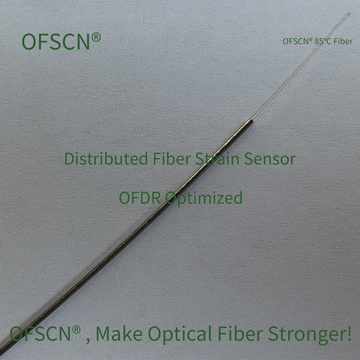
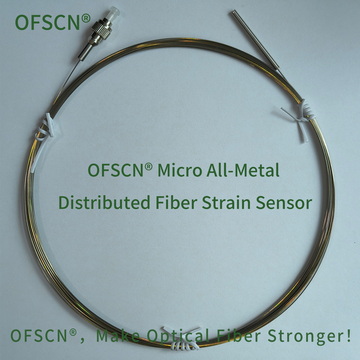
The OFSCN® 85°C OFDR Micro All-Metal Strain Sensor is specifically developed for such applications. With an outer diameter of only 0.6\text{mm}, it employs a single-layer elastic alloy tube with glue-free all-metal packaging, ensuring high-fidelity strain transfer and absolutely no signal drift due to “adhesive aging and loosening” during long-term service:
Summary
For applications requiring high long-term stability and a design service life of ten years, such as civil engineering, heavy industry, or downhole monitoring:
- It is strictly prohibited to use ordinary resin glue to directly bond bare optical fibers inside seamless steel tubes for strain measurement.
- High-stability fiber optic sensors with all-metal glue-free technology and encapsulated in elastic alloy tubes should be selected.