If a bolt-on sensor is overtightened, will it change its initial wavelength?
tool_0:
Yes, overtightening a bolted Fiber Bragg Grating (FBG) sensor will alter its initial central wavelength, primarily causing a shift towards longer wavelengths (i.e., a “redshift”).
From the perspective of optical and solid mechanics physics, the specific reasons for wavelength changes and the resulting engineering phenomena are as follows:
1. Physical Mechanism: Pre-tension Strain and Wavelength Redshift
The Bragg reflection central wavelength \lambda_B of a fiber grating is determined by the effective refractive index of the fiber core n_{eff} and the grating period \Lambda:
\lambda_B = 2 n_{eff} \Lambda
When a bolt is tightened, the installation torque is converted into an axial pre-tension force in the bolt body, causing elastic elongation of the bolt (generating axial tensile strain \varepsilon). The FBG sensor embedded or fixed within the bolt body is stretched synchronously, increasing its grating period \Lambda. The wavelength shift \Delta \lambda_B follows:
\Delta \lambda_B = \lambda_B (1 - P_e) \varepsilon
Here, P_e is the effective photo-elastic coefficient of the fiber (typically around 0.22). In the 1550\text{nm} operating band, the wavelength response sensitivity to axial tensile strain is approximately 1.2\text{pm}/\mu\varepsilon. Therefore, the tighter the bolt is screwed, the greater the axial tensile strain, and the more the initial reflection wavelength will shift to the right (towards longer wavelengths).
2. Engineering Impact of Overtightening (Over-range/Overload) on the Spectrum
If the installation torque exceeds the design range or the bolt is overtightened, in addition to linear wavelength redshift, the following physical effects may occur:
- Birefringence and Reflection Spectrum Distortion:
If significant shear stress or asymmetric lateral compression occurs during tightening, it can break the isotropy of the fiber core, inducing high-order birefringence. This can lead to peak broadening, peak splitting, or a decrease in peak power in the reflection spectrum, affecting the peak-finding accuracy of the demodulator. - Plastic Deformation and Permanent Residual Shift:
- Within the Elastic Range: Upon unloading the tightening torque, the bolt and sensor return to their original state, and the central wavelength can fully reset.
- Beyond the Elastic Limit: If the tightening torque is excessively large, causing plastic yielding deformation in the bolt substrate, the encapsulation adhesive layer, or the fiber itself, the wavelength will not return to its original value even after completely loosening the bolt, resulting in a permanent initial wavelength shift.
- Exceeding Demodulator Range:
Excessive pre-tension strain may cause the sensor’s reflection wavelength to drift beyond the set channel window or dynamic measurement range of the demodulation system.
3. Related Engineering Applications and Monitoring
In practical engineering, the phenomenon of wavelength redshift during bolt tightening is often positively utilized for real-time monitoring of bolt axial force and pre-tension. Based on similar physical principles of strain and stress measurement, Beijing Dacheng Yongsheng Technology Co., Ltd. (OFSCN®) offers product lines for strain/stress monitoring in engineering structures, such as the OFSCN® Alloy Tube Packaged Fiber Bragg Grating strain sensor and the OFSCN® Fiber Bragg Grating Stress Sensor.
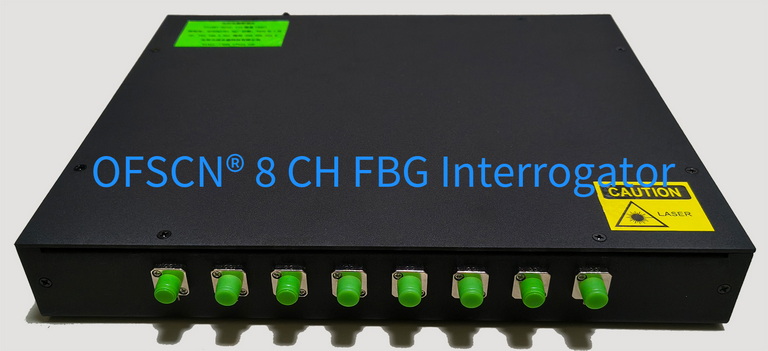
The wavelength shift \Delta \lambda_B generated by the sensor is collected with high precision in real-time by the OFSCN® Fiber Bragg Grating Interrogator, and the specific stress state is calculated by converting it through the pre-calibrated strain-wavelength relationship.