Does light reflect back when it hits a connector? Can this cause damage to the laser?
I. Does light bounce back when it hits a connector? (What is “Fiber Reflection”? )
Yes, light absolutely bounces back when it encounters a connector. This physical phenomenon is known in optical engineering as Fresnel Reflection.
When light travels through an optical fiber, if it encounters an interface between media with discontinuous refractive indices (such as an air gap at a fiber connector joint, misaligned end faces, or the interface between fiber and air), a portion of the light energy will be reflected back and travel along its original path.
- Physical Mechanism: According to Fresnel’s formula, the reflectance R is closely related to the refractive indices of the two media (fiber core refractive index n_1 \approx 1.45, air refractive index n_2 \approx 1.00). At a single vertical interface between optical fiber and air, the reflectance is approximately:
R = \left( \frac{n_1 - n_2}{n_1 + n_2} \right)^2 \approx 3.4\% \sim 4\%
This portion of back-reflected light will travel in the opposite direction along the fiber, equivalent to a return loss of approximately -14\text{ dB}.
- Impact of Connector Type:
- PC/UPC (Physical Contact/Ultra Physical Contact) Connectors: These have a slightly spherical end face, perpendicular to the fiber axis. Although a good connection can achieve return loss of -40\text{ dB} to -50\text{ dB} or even better, due to the possibility of extremely small air gaps at the contact surface, a small amount of light is still reflected back into the fiber core.
- APC (Angled Physical Contact) Connectors: Their end faces are machined at an 8^\circ angle (e.g., FC/APC). According to the law of reflection, the reflected light exits at a larger angle, deviates from the fiber core, and leaks into the cladding to be attenuated. It cannot return along the original path of the fiber core, which allows return loss to be greatly reduced to below -60\text{ dB}.
II. Can this damage the laser?
Yes, the back-reflected light (return echo) can have serious negative effects on lasers (especially high-power lasers or narrow linewidth semiconductor lasers), even causing physical damage:
- Spectral and Power Instability (Optical Feedback Noise):
If reflected light re-enters the laser’s resonant cavity, it interferes with the original light field within the cavity, disrupting the normal stimulated emission process. This leads to:- Significant low-frequency fluctuations in the laser’s output power (increased relative intensity noise).
- Drifting of the laser’s main output wavelength, causing “mode hopping”.
- Broadening of the laser’s linewidth and significant degradation of its coherence.
- Physical Damage (Catastrophic Optical Damage, COD):
For high-power lasers, when the high-energy back-reflected light returns to the laser, it may form extremely high power densities at the laser diode facet or the amplifier fiber end face after passing through collimating and focusing systems. This can easily cause Catastrophic Optical Damage (COD) or localized thermal accumulation, leading to the destruction of the laser chip or melting of the fiber end face, resulting in permanent physical damage.
III. How can this damage be avoided in engineering?
In optical fiber system design, the following approaches are typically used to suppress reflections and protect lasers:
- Introduce an Optical Isolator: A serial optical isolator is connected at the laser output. It utilizes the non-reciprocity of a Faraday rotator, allowing forward light to pass while blocking and deflecting back-reflected light, preventing it from returning into the laser.
- Use APC Connectors Consistently at Joints: For laser systems sensitive to reflections, avoid using PC or UPC vertical end-face connectors and uniformly adopt APC connectors with an 8^\circ angled end face.
Beijing Dacheng Yongsheng Technology Co., Ltd. (OFSCN®) Product Engineering Design for Return Loss Suppression
As experts in high-intensity, high-temperature resistant fiber optic sensing, Beijing Dacheng Yongsheng Technology Co., Ltd. (OFSCN®) deeply considers the impact of return reflection on demodulation systems and laser source safety in the engineering design of its sensors and transmission devices. Many of our core products default to or are configured with FC/APC connectors, which offer excellent reflection suppression.
Here are related high-performance connection and sensing products:
-
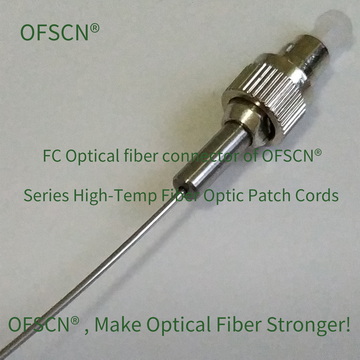
OFSCN® 300℃ Fiber Optic Connector: Supports custom FC/APC specifications, maintaining excellent end-face geometric precision even in extreme high-temperature environments of 300^\circ\text{C}, ensuring extremely low return loss.
-
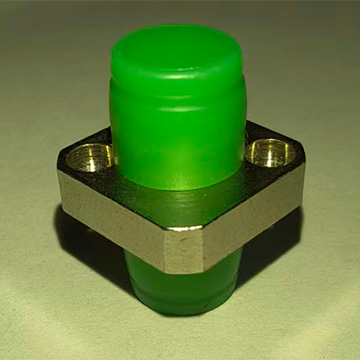
OFSCN® High Temperature Resistant Fiber Optic Adapter: A high-temperature resistant (300^\circ\text{C}) fiber optic ferrule (adapter), which defaults to FC/APC-FC/APC interfaces, ensuring ultra-high precision alignment of the angled end faces on both sides, thereby maximizing the suppression of Fresnel reflection caused by the mating gap.
-
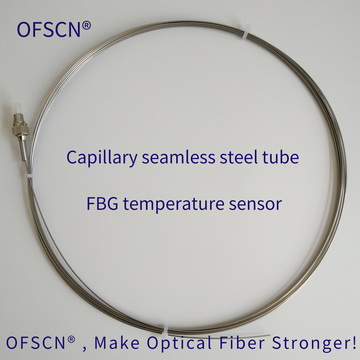
OFSCN® 800°C Fiber Bragg Grating Temperature Sensor: This fiber Bragg grating temperature sensor, encapsulated in seamless steel pipe for ultra-high temperature resistance, uses FC/APC connectors as the default for its pigtails. This greatly reduces return reflection while ensuring accurate temperature measurement, thereby safeguarding the stability and safety of the laser source inside the demodulator.