Why are outdoor fiber optic cables usually black? Do they protect against UV rays and rain?
The design and material selection of outdoor optical cables are based on strict principles of physics and material science. From the perspectives of optical cable material science, structural design, and weather resistance, we will explain why outdoor optical cables are typically black and how they withstand UV radiation and rain erosion.
I. Why Are Outdoor Optical Cables Usually Black?
Outdoor optical cables are constantly exposed to the natural environment and must endure prolonged exposure to ultraviolet (UV) radiation from sunlight.
-
Mechanism of UV Degradation:
The outer jacket of optical fibers is usually made of polymer materials (such as polyethylene, PE). The energy from UV radiation is sufficient to break the molecular chains of polymers, leading to photochemical reactions. This results in physical degradation phenomena like discoloration, embrittlement, cracking, and reduced tensile strength. Once the jacket cracks, the internal optical fibers and metallic strength members are directly exposed to moisture, acid rain, and air, causing the cable to fail rapidly. -
Introduction of Carbon Black:
To prevent UV-induced degradation, the polyethylene (PE) outer jacket of outdoor optical cables must be manufactured with a specific proportion (typically 2\% \sim 2.5\%) of carbon black.- Carbon black is an excellent light shield and UV absorber.
- It can absorb almost all wavelengths of light (including high-energy UV, visible light, and infrared light) and harmlessly dissipate this light energy as heat, preventing UV radiation from penetrating deep into the inner molecular chains of the polyethylene.
- Due to the high concentration of carbon black, the outer jacket material of outdoor optical cables appears deep black.
II. Can They Withstand UV Radiation and Rain?
Yes. The design of standard outdoor optical cables is fully equipped with excellent resistance to UV radiation and rain/moisture.
1. Excellent UV-Resistant Performance
The black high-density polyethylene (HDPE) or medium-density polyethylene (MDPE) outer jacket, infused with carbon black, can withstand decades of intense sunlight in natural conditions without cracking or becoming brittle. This is currently the internationally recognized most economical, stable, and effective long-term UV resistance solution for outdoor use.
2. Multiple Waterproof and Moisture-Proof Designs
To prevent the ingress of rainwater or underground moisture, outdoor optical cables employ a multi-layered waterproof barrier in their structure:
- Hydrophobic Outer Jacket: Polyethylene (PE) itself is a highly hydrophobic, low water absorption, non-polar material, serving as the first line of defense against lateral water penetration.
- Water-Blocking Gel/Compound: The interior of the optical cable (e.g., within loose tubes and cable core interstices) is filled with a gel compound. This compound displaces any trace moisture that might seep in and prevents lateral moisture migration.
- Water-Swellable Water-Blocking Materials: Many modern optical cables utilize water-swellable yarns and tapes. When the outer jacket is accidentally damaged and rainwater penetrates, these polymer materials rapidly absorb water and swell, forming a robust gel layer that effectively seals the breach and prevents water from spreading longitudinally along the cable.
- Metal Moisture Barrier: Some outdoor optical cables (such as direct-buried cables) incorporate a plastic-coated steel tape (PSP) or aluminum tape (APL) within the jacket. This provides an almost 100% absolute barrier against moisture ingress, while also enhancing tensile strength and offering rodent resistance.
III. Introduction to OFSCN®'s Core Products
For outdoor or various harsh and extreme environments (such as long-span aerial deployments, conduits, and outdoor temperature and sensing scenarios involving tension, vibration, and rain erosion), Beijing Dacheng Yongsheng Technology Co., Ltd. (OFSCN®) designs and offers a series of specialty optical fibers and sensor products with high weather resistance, high tensile strength, and excellent waterproof and moisture-proof capabilities.
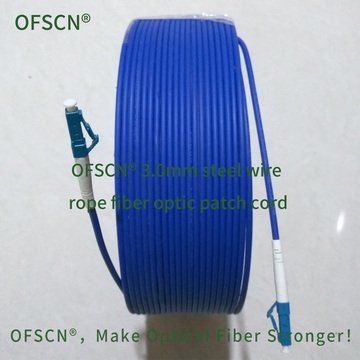
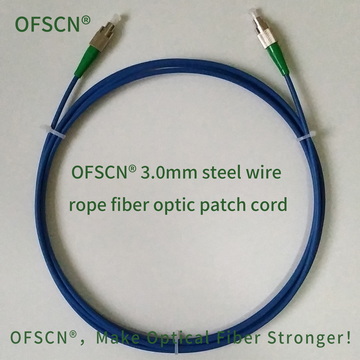
1. OFSCN® 3.0mm Steel Wire Rope Fiber Optic Patch Cord
This product is specifically designed for challenging outdoor and field applications. It houses optical fibers within a seamless stainless steel tube, which is then wrapped in a stranded stainless steel wire structure (steel wire rope construction). The outermost layer features a wear-resistant, water-blocking polyethylene (PE) black jacket, providing comprehensive environmental protection.
- Core Parameters:
- Tensile Strength: Greater than 1200\text{N} tensile strength, greater than 200\text{Mp} compressive strength.
- Structural Features: Comprises fiber optic connectors, black PE jacket, 0.45\text{mm} stranded stainless steel wires, 0.9\text{mm} seamless stainless steel tube, and optical fibers.
- Operating Temperature: -40^\circ\text{C} to 75^\circ\text{C}.
- Fiber Type: Standard OFSCN® G.657 bend-insensitive single-mode fiber is used by default.

2. OFSCN® Polymer-encapsulated Fiber Bragg Grating Strain Sensor (0.7mm/1.2mm diameter)
For strain monitoring in outdoor environments such as dams, bridges, or slopes, Beijing Dacheng Yongsheng Technology Co., Ltd. provides Fiber Bragg Grating (FBG) strain sensors protected by multiple layers of polymer material and seamless steel tubes.
- Core Parameters:
- Structural Features: Fiber Bragg Grating encapsulated with polymer material, with an optional seamless steel tube outer layer for increased tensile strength and excellent waterproof and moisture-proof performance.
- Size Options: Default product outer diameter is less than or equal to 0.7\text{mm}; with the addition of a seamless steel tube protective layer, the outer diameter is less than or equal to 1.2\text{mm}.
- Strain Range: Default strain range is greater than or equal to 6000\mu\varepsilon.

