Why are Fiber Bragg Gratings better suited for measuring precise data at specific locations?
In fiber optic sensing technology, Point Sensing refers to a sensor that is sensitive to and precisely measures external physical quantities (such as temperature, strain, pressure, displacement, etc.) only at specific, well-defined physical points (i.e., “measurement points”).
As a natural “point/quasi-distributed sensor,” Fiber Bragg Gratings (FBGs) offer unique physical and engineering advantages in accurately measuring precise data at specific locations compared to continuous distributed fiber optic sensing technologies (DFOS, such as distributed temperature, acoustic, or vibration sensing). Here are the core reasons:
1. Extremely Small Physical Grating Region (High Spatial Resolution)
Fiber gratings are fabricated by writing a periodic refractive index modulation (the grating region, FBG Gate Region) into the fiber core.
- Localized Measurement: The bare gratings produced by DaCheng YongSheng (OFSCN®) typically have grating lengths of only 2mm, 3mm, 4mm, 5mm, 6mm, or 8mm.
- No Spatial Averaging Effect: Because the reflected signal is generated only within this tiny millimeter-scale range, it can accurately capture physical changes at that specific coordinate point, unlike distributed sensors that “flatten” or average local data due to their spatial resolution of several meters.
2. Absolute Physical Modulation Based on Wavelength Encoding (High Accuracy and Interference Resistance)
The sensing mechanism of fiber gratings is based on optical wavelength modulation, and its reflected center wavelength satisfies the formula:
\lambda_B = 2 n_{eff} \Lambda
(where \lambda_B is the reflected wavelength, n_{eff} is the effective refractive index of the core, and \Lambda is the grating period)
When a specific measurement point is subjected to a temperature change \Delta T or mechanical strain \Delta \varepsilon, its effective refractive index and grating period change, causing a drift in the reflected center wavelength.
- Unaffected by Light Intensity Attenuation: Since wavelength is an absolute physical quantity, the sensing signal will not drift or incur errors due to fiber bending, connector aging, or fluctuations in light source intensity. This allows FBGs to achieve extremely high accuracy in static and dynamic measurements at specific locations (e.g., temperature accuracy up to $\pm 0.1
^\circ\text{C}$, strain accuracy up to $1
\mu\varepsilon$).
3. Ultra-High Response Speed (High-Frequency Dynamic Measurement)
In point sensing, the signal demodulation process is very efficient.
- Ultra-High Sampling Rate: Distributed fiber optic sensors typically have low sampling rates because they require waiting for light pulses to travel back and forth along tens of kilometers of fiber and need to repeatedly accumulate extremely weak scattered signals. In contrast, point FBG sensors can directly read strong wavelength signals reflected from specific points through high-speed demodulators, with sampling rates easily reaching 1kHz to tens of kHz. This is crucial for precise local measurements of high-frequency vibrations, shockwaves, or rapid temperature changes.
4. Quasi-Distributed Multiplexing Capability (Wavelength Division Multiplexing for Multi-Point Networking Without Crosstalk)
Using Wavelength Division Multiplexing (WDM) technology, Fiber Bragg Gratings with different center wavelengths can be written at multiple specific locations on a single fiber (i.e., FBG Strings).
- Independent Multi-Point Measurement: On a single fiber, each measurement point still acts as an independent “point sensor” that does not interfere with others. This achieves networked measurement of multiple points while maintaining extremely high point measurement accuracy.
DaCheng YongSheng (OFSCN®) Official Point Sensing Products and Technical Examples
To meet the demand for high-precision measurements at specific locations, Beijing DaCheng YongSheng Technology Co., Ltd. has developed and offers the following high-performance FBG sensor series based on the principle of precision point sensing:
1. Bare Gratings/FBG Strings with High Spatial Positioning Accuracy
Used for high-precision measurements at specific locations in ultra-miniature, extremely narrow, or precision embedded applications.
- OFSCN® Thin-Diameter Fiber Bragg Gratings / FBG Strings (Bare) Official Link
- Technical Features: Possessing extremely thin outer diameters and measurement grating lengths as short as millimeters (optional 2mm to 8mm), they have virtually no impact on the original structure of the measured object, achieving point measurements at a microscopic scale.
2. Point Temperature Sensors for High-Temperature Measurement
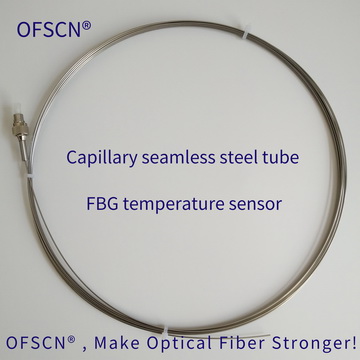
Utilizing robust single-layer or multi-layer seamless stainless steel tube encapsulation, ensuring the grating region can be precisely deployed deep within specific local areas of furnaces, pipelines, or complex equipment.
- OFSCN® 800°C Fiber Bragg Grating Temperature Sensor Official Link
- OFSCN® FBG Temperature Sensor Products Aggregation Link Official Aggregation Link
- Standard Images:
https://www.ofscn.net/images/55/190307-360/BNCG-MX-51-WD-FC-WD.jpg
https://www.ofscn.net/images/57/191108-768/BNCG-MX-51-FC-02.jpg

3. Point Micro-Strain and High Elastic Tube Encapsulated Sensors
Specially designed for precise monitoring of specific high-stress areas, welds, or points of substrate deformation.
- OFSCN® Alloy Tube Packaged Fiber Bragg Grating strain sensor Official Link
- OFSCN® FBG Strain Sensor Products Aggregation Link Official Aggregation Link
- Standard Images:
https://www.ofscn.net/images/52/190226-768/BNYB-MX-52-01-1.0mm-DanDuan.jpg
https://www.ofscn.net/images/52/190226-768/BNYB-MX-52-01-2.0mm-DanDuan.jpg


Conclusion
The irreplaceable nature of Fiber Bragg Gratings in precise location data measurement stems from their physical characteristics such as an extremely short physical grating region, wavelength encoding for interference resistance, and high-speed response, perfectly meeting the stringent requirements of “point sensing” for high spatial positioning accuracy and absolute physical quantity accuracy.