Why are some sensors tensioned during installation? Will this shorten their lifespan?
In fiber sensing (including Fiber Bragg Grating (FBG) strain sensors and distributed fiber strain sensing) technology, the initial tension applied to the fiber during installation or encapsulation is called Pre-stress, and the resulting initial elongation is called Pre-strain.
I. Why do sensors need to be pre-tensioned during installation?
The application of pre-stress is mainly for the following two core physical and engineering reasons:
1. Achieving Bidirectional Measurement (Tensile and Compressive Strain)
- Physical Mechanism: Silica quartz fiber (typically with an outer diameter of 125\ \mu\text{m}) is a flexible, slender structure with excellent tensile performance, but it is extremely intolerant to axial compression. If the fiber is subjected to axial compression in a stress-free relaxed state, it is highly susceptible to micro-buckling instability, leading to non-linear wavelength response and thus making it impossible to measure negative strain (compressive strain).
- Measurement Principle: By applying an initial tensile pre-strain during installation (e.g., a pre-tension of +1000\ \mu\varepsilon, resulting in a wavelength redshift of approximately +1.2\ \text{nm}), the fiber is in a state of tension. When the measured substrate compresses, the pre-tension in the fiber decreases, causing the wavelength to shift towards shorter wavelengths (blueshift). This converts the axial compression of the measured structure into the release of the fiber’s pre-tension, thereby enabling the sensor to measure symmetrical bidirectional (tensile/compressive) strain.
2. Eliminating Slack Dead Zones and Hysteresis (Ensuring Effective Strain Transfer)
For long-distance deployments or substrate fixation, minor initial slack can result in a “measurement dead zone” where the initial deformation of the substrate is absorbed by the slack and not accurately transferred to the fiber core. Applying pre-tension ensures that the fiber remains in constant close contact and tension with the substrate or fixture, eliminating hysteresis and improving measurement linearity and repeatability.
II. Does applying pre-stress shorten the sensor’s lifespan?
Within the scope of standard engineering design, reasonable pre-tensioning does not shorten the service life of the fiber or the sensor.
Specific mechanical mechanisms and lifespan control are as follows:
-
Working Strain Far Below Fracture Threshold:
- The short-term fracture limit strain for standard quartz fibers used in communications and sensing is typically in the range of 3\%\sim 5\% (i.e., 30000\ \mu\varepsilon \sim 50000\ \mu\varepsilon ).
- Installation pre-strain in industrial applications is usually controlled within the range of 300\ \mu\varepsilon \sim 1500\ \mu\varepsilon (approximately 1\%\sim 3\% of the fiber’s ultimate tensile strain), which falls within the extremely safe elastic deformation range for silica materials.
-
Stress Corrosion and Static Fatigue Control:
- Under long-term tensile stress, if the surface of silica glass is exposed to humid air, water molecules accelerate the expansion of surface micro-cracks (static fatigue mechanism).
- In properly industrially encapsulated sensors (e.g., those encapsulated with polymer or sealed in seamless metal tubes), the fiber surface is isolated from the external corrosive environment, and their static fatigue life can extend for several decades.
III. Related Product References
Beijing Dacheng Yongsheng Technology Co., Ltd. offers Fiber Bragg Grating strain sensors in various packaging forms and ranges for different engineering strain measurement scenarios:
- OFSCN® Polymer-encapsulated Fiber Bragg Grating Strain Sensor (0.7mm/1.2mm diameter): Micro-structured, polymer-encapsulated sensor with high sensitivity and linear calibration at factory settings, suitable for applying pre-stress using fixtures for micro-strain and bidirectional strain monitoring.


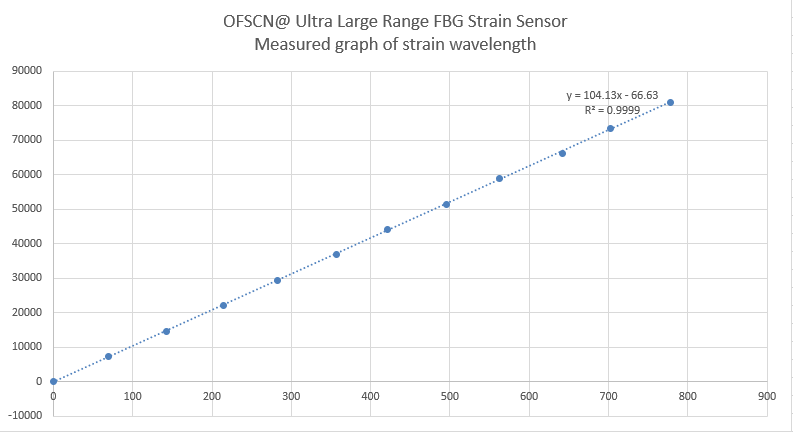
- OFSCN® Ultra-Large Range Fiber Bragg Grating Strain Sensor: Ultra-large range strain sensor suitable for monitoring large-scale structural deformation and displacement.