What is the difference between this and the distributed sensing (DTS) that can be measured everywhere?
In the field of fiber optic sensing engineering, Quasi-Distributed Sensing and Fully Distributed Sensing (typically referring to technologies like DTS), while both using optical fiber as the transmission medium, have fundamental differences in their underlying physical mechanisms, spatial continuity, and application scenarios.
Here is a core technical comparison and physical analysis of the two:
1. Core Differences in Concept and Spatial Continuity
- Fully Distributed Sensing (e.g., DTS)
- Principle: The entire optical fiber serves as both the transmission medium and a “continuous sensor”.
- Characteristics: Every point along the fiber is involved in measuring physical quantities.
- Localization Mechanism: Utilizes techniques like Optical Time Domain Reflectometry (OTDR) or Optical Frequency Domain Reflectometry (OFDR). The precise spatial location of a physical change is determined by the time or frequency difference of light traveling through the fiber. It achieves measurement by collecting intrinsic backscattered light (such as Raman, Brillouin, or Rayleigh scattering) generated by lattice vibrations or density fluctuations within the fiber.
- Quasi-Distributed Sensing (e.g., FBG)
- Principle: Sensors are only located at “specific discrete points” along the fiber; the fiber itself does not participate in sensing.
- Characteristics: Typically achieved by writing multiple Fiber Bragg Gratings (FBGs) at specific locations on a single fiber, forming a “sensor string/array.” Data such as temperature or strain can only be obtained at these grating locations (measurement points). The ordinary fiber segments between gratings have no sensing capability (creating measurement blind zones).
- Localization Mechanism: Primarily utilizes Wavelength Division Multiplexing (WDM). Each grating is assigned a distinct initial reflection wavelength \lambda_B = 2 n_{eff} \Lambda . The demodulator distinguishes the positions of individual measurement points by identifying these different spectral wavelengths.
2. Technical Metrics and Performance Comparison
| Metric Dimension | Quasi-Distributed Sensing (e.g., FBG Systems) | Fully Distributed Sensing (e.g., Raman-DTS / OFDR) |
|---|---|---|
| Physical Signal Mechanism | Narrowband reflection from Fiber Bragg Gratings (extremely strong signal) | Intrinsic backscattering from the fiber itself (extremely weak signal) |
| Spatial Continuity | Discrete multi-point, with measurement blind zones between points | Spatially completely continuous, theoretically no measurement blind zones |
| Measurement Speed (Sampling Rate) | Extremely fast. Data sampling rates are typically from 10\text{ Hz} to 100\text{ Hz} , and can even reach \text{kHz} levels, making it ideal for measuring dynamic vibrations or transient processes. | Relatively slow. Because backscattered signals are typically below -50\text{ dB} , extensive accumulation of light pulses and signal averaging are required. A single complete scan usually takes seconds to minutes (except for special DAS). |
| Maximum Measurement Points per Channel | Limited by the wavelength bandwidth of the demodulator’s light source (typically 40\text{ nm} bandwidth from 1525\text{ nm} to 1565\text{ nm} ). To prevent overlap between adjacent measurement points’ wavelengths, a single fiber is generally limited to 5 to 10 measurement points. | Almost unlimited. A 10\text{ km} fiber with a 1\text{ m} spatial resolution is equivalent to having 10,000 continuous measurement points. |
| Accuracy and Signal-to-Noise Ratio | Reflectivity is typically 10\% to 99\% or higher, with sharp reflection spectral lines, offering extremely high signal-to-noise ratio, wavelength resolution, and measurement accuracy. | Weak signal, susceptible to noise and long-distance fiber loss interference, requiring complex algorithms to extract faint signals. |
3. OFSCN® Related Products and Applications
OFSCN® offers high-performance, reliable packaged sensors, sensing cables, and demodulation systems in both technology directions:
A. Quasi-Distributed Sensing System Related Products
If you require multi-point, high-speed, high-precision local discrete physical quantity monitoring, we recommend using quasi-distributed sensor strings and demodulators based on Fiber Bragg Gratings (FBG):
-
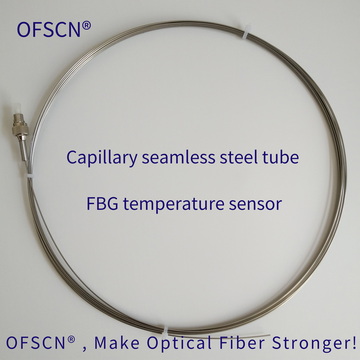
OFSCN® 300°C Fiber Bragg Grating Temperature Sensor
- Technical Advantages: Encased in a single-layer seamless steel tube for temperature resistance, supporting customized multi-point FBG temperature sensors. When paired with a 40\text{ nm} FBG demodulator, it is recommended not to exceed 10 measurement points per sensor.
- Product Images:
https://www.ofscn.net/images/53/190719-360/BNCG-MX-51-WD-FC-WD.jpg
https://www.ofscn.net/images/53/190719-768/BNCG-MX-51-FC-02.jpg
-
OFSCN® 500°C Fiber Bragg Grating Temperature Sensor
- Technical Advantages: Supports multi-point series design, providing excellent wavelength stability in extreme high-temperature environments. It is recommended not to exceed 5 measurement points per sensor.
-
OFSCN® Polymer-encapsulated Fiber Bragg Grating Strain Sensor (0.7mm/1.2mm diameter)
- Technical Advantages: Specially designed for quasi-distributed strain monitoring, customizable with multiple measurement segments.
-
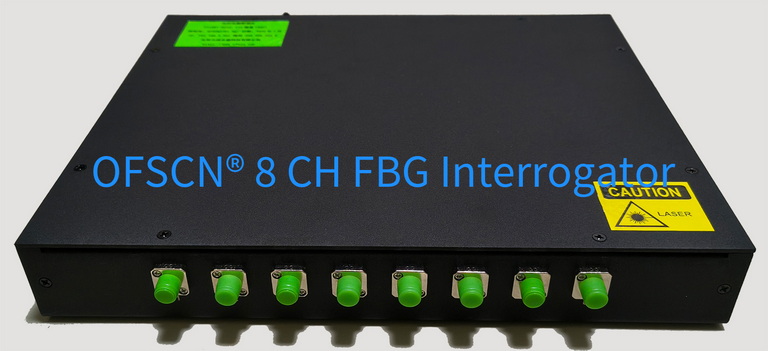
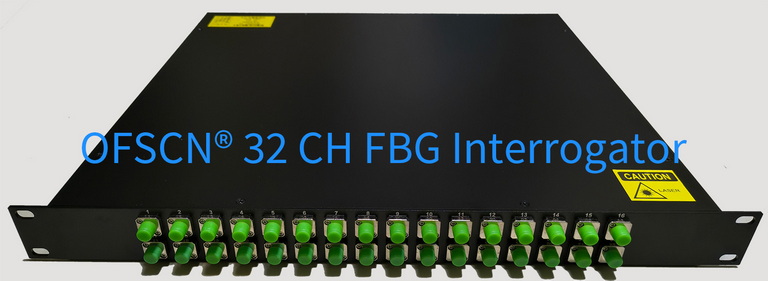
OFSCN® Fiber Bragg Grating Interrogator
- Technical Advantages: Offers 4 to 32 channel customization, with a wavelength range of 1525\text{ nm} to 1565\text{ nm} . Sampling rates of 10\text{ Hz} , 50\text{ Hz} , or 100\text{ Hz} are available.
- Product Images:
https://www.ofscn.net/images/95/20200522-768/FBG-Interrogator-8CH.jpg
https://www.ofscn.net/images/95/20200522-768/FBG-Interrogator-32CH.jpg

B. Fully Distributed Sensing System Related Products
If you are using a complete fully distributed sensing system based on “Raman Scattering DTS” or “Rayleigh Scattering OFDR,” OFSCN®'s special seamless steel tube distributed sensing cables provide stable physical protection for your long-distance, fully continuous measurements:
-
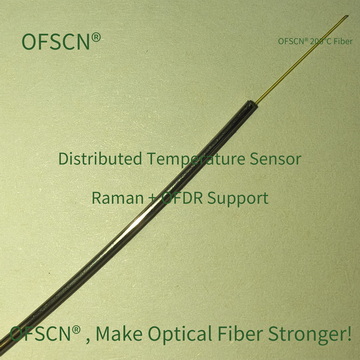
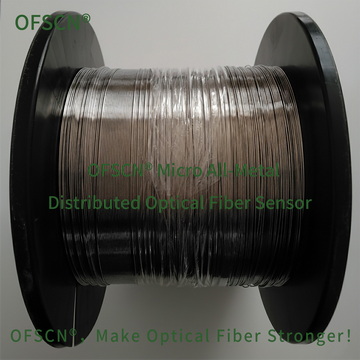
OFSCN® 200°C Distributed Fiber Temperature Sensor
- Technical Advantages: Outer diameter 0.9\text{ mm} , encased in a single-layer seamless steel tube with a built-in special polyimide single-mode fiber. Ensures accurate acquisition of distributed signals along the entire path in high mechanical stress and medium-temperature environments.
- Product Images:
https://www.ofscn.org/images/09/20260214-360/OFSCN-OFDR-DTS-Temperatur-09-03.jpg
https://www.ofscn.org/images/09/20260214-360/OFSCN-OFDR-DTS-Temperatur-Strain-09.jpg
4. Summary and Selection Guide
- When you need to measure “global trends” (such as overall dam leakage, long-distance oil pipeline leaks, tunnel fire monitoring): Fully Distributed Fiber Sensing (DTS) is the only feasible solution, as you cannot predict where along the meter a leak might occur.
- When you need to measure “localized high-frequency, precise details” (such as local temperature rise in battery electrode plates, force monitoring during medical needle insertion, vibration monitoring of high-speed bridges or aircraft wings): Quasi-Distributed Fiber Sensing based on FBG, due to its ultra-high signal-to-noise ratio and extremely fast physical response speed, is a superior engineering choice.