Why do standard fibers darken (color center effect) in nuclear power plants or space station environments?
When standard optical fibers are exposed to environments with high radiation, such as nuclear power plants or space stations, they experience a phenomenon known as the “color center effect,” leading to darkening.
This darkening occurs primarily due to the interaction of high-energy radiation (like gamma rays, X-rays, or neutrons) with the silica glass structure of the optical fiber. The radiation energy can break atomic bonds within the SiO2 lattice, creating various types of structural defects. These defects, known as “color centers,” are essentially localized electronic states that can absorb light, particularly in the visible and near-infrared regions of the spectrum. The absorption of light by these color centers leads to an increase in the fiber’s attenuation, causing it to appear darker and reducing its optical transparency. The extent of darkening depends on the radiation dose, dose rate, fiber composition (especially dopants like germanium or phosphorus), and the operating temperature. Standard acrylate coatings are also susceptible to radiation damage, further contributing to fiber degradation.
For applications in such extreme environments, specialized fibers with enhanced radiation resistance are required. These often feature specific glass compositions or protective coatings designed to mitigate the color center effect. For environments requiring high robustness, including resistance to harsh conditions that may involve radiation, we offer:
OFSCN® Gold-coated Optical Fiber
Here is an image of the product:

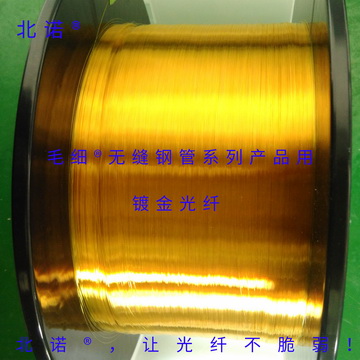
This type of fiber is designed to withstand extreme temperatures and harsh conditions, offering a more stable performance compared to standard fibers in challenging deployments.