What special ingredients are added to this fiber to prevent it from “darkening” under strong radiation?
In the physics of optical materials, ensuring optical fibers remain transparent and do not “blacken” in environments with high ionizing radiation (such as \gamma-rays, X-rays, high-energy neutron fluxes, etc.) is typically achieved not by adding a magical “radiation-resistant agent,” but precisely the opposite—primarily through “subtractive” processes (eliminating sensitive dopant impurities) combined with “microscopic defect passivation.”
I. Why Do Optical Fibers “Blacken” Under Strong Radiation?
Standard single-mode optical fibers (like the typical ITU-T G.652D) achieve the core refractive index required for waveguiding by doping the silica (\text{SiO}_2) core with germanium dioxide (\text{GeO}_2).
When exposed to high-energy ionizing radiation, energetic particles or photons can break chemical bonds within the glass network (e.g., \text{Si-O} bonds, \text{Ge-O} bonds), generating free electrons and holes. These charges, when captured by microscopic defects in the glass, form various microscopic optical defects known as Color Centers:
- Germanium-related defects (e.g., \text{Ge-E}^\prime centers, germanium-oxygen vacancy defects);
- Non-Bridging Oxygen Hole Centers (NBOHC);
- Self-Trapped Hole Centers (STH), etc.
These color centers exhibit broadband absorption peaks in the ultraviolet, visible, and even near-infrared ranges, leading to a sharp decline in the fiber’s optical transmittance. In macroscopic engineering terms, this manifests as the fiber blackening and losing its light transmission capabilities, a phenomenon known as Radiation-Induced Attenuation (RIA).
II. Key Materials and Compositional Control for Radiation-Resistant Optical Fibers
To eliminate or suppress the formation of color centers, the primary mechanisms employed are physical and chemical:
1. The “Subtractive” Approach: Pure Silica Core (PSC)
- Elimination of Sensitive Dopants: Radiation-resistant optical fibers typically exclude all germanium (Ge), phosphorus (P), and aluminum (Al) and other precursor elements from the core. Phosphorus and aluminum, in particular, form highly stable color centers after radiation exposure, making them strictly prohibited in the core layer of radiation-resistant fibers.
- Fluorine (F) Doping in the Cladding: Since the core is pure silica, to maintain the total internal reflection required for waveguiding (the core refractive index must be higher than the cladding), engineering dictates doping the cladding with fluorine (F). Fluorine reduces the refractive index of silica, thereby creating an optical waveguide composed of a pure silica core and a lower refractive index fluorine-doped cladding. Pure silica cores form significantly fewer color centers under radiation compared to germanium-doped cores.
2. “Passivation” via Hydrogen Loading
- Loading the optical fiber with hydrogen by exposing it to high-pressure hydrogen gas, or controlling hydrogen incorporation during the preform manufacturing stage.
- At the instant radiation breaks chemical bonds and creates dangling bonds (free radicals), microscopic free hydrogen molecules (\text{H}_2) can rapidly migrate and react with unsaturated bonds, forming stable \text{Si-H} or \text{Si-OH} bonds. This chemical reaction “neutralizes” the dangling bond defects, preventing the evolution of color centers and significantly accelerating the dynamic annealing and self-healing process of the fiber in a radiation environment.
3. Fine-Tuning of Hydroxyl (OH Group) Content
- High-OH Pure Silica Fibers: Often used in the ultraviolet to visible spectrum (e.g., 200\text{ nm} \sim 800\text{ nm} ). High concentrations of \text{OH}^- effectively suppress the generation of non-bridging oxygen hole centers, greatly enhancing UV and radiation resistance.
- Low-OH Pure Silica Fibers: Commonly used in near-infrared communication bands (e.g., 1310\text{ nm} and 1550\text{ nm} ). While ensuring low loss in infrared absorption, they achieve radiation resistance through stringent control of impurity precursors.
4. Trace Fluorine Passivation of the Core
Some ultra-high radiation-resistant optical fibers incorporate trace amounts of fluorine (F) atoms in the pure silica core. This is used to repair stress defects and intrinsic oxygen defects remaining in the glass’s 3D network during cooling after drawing, further reducing the density of defect precursors.
III. OFSCN® Engineering Implementations and Product Parameters
In demanding real-world engineering environments (such as space exploration, nuclear power plants, high-energy physics experimental sites, etc.), intense radiation often coexists with extreme high/low temperatures and high vacuum conditions. Beijing Dacheng Yongsheng Technology Co., Ltd. (OFSCN®) offers several high-temperature resistant optical fibers in its specialty fiber series that support Pure Silica Core (PSC) customization for radiation resistance, complemented by polyimide or metal coatings for high reliability:
1. OFSCN® 300℃ SM Polyimide Optical Fiber
- Technical Features: Operating temperature range is -200\ ^\circ\text{C} to 350\ ^\circ\text{C} (or -270\ ^\circ\text{C} to 350\ ^\circ\text{C} ); core diameter 9\ \mu\text{m}, cladding diameter 125\ \mu\text{m}, coating diameter 155\ \mu\text{m}; utilizes a high-temperature resistant polyimide coating; default is doped core, but pure silica core structure can be customized to meet radiation-resistant environment requirements.


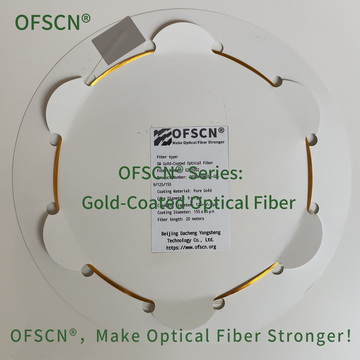
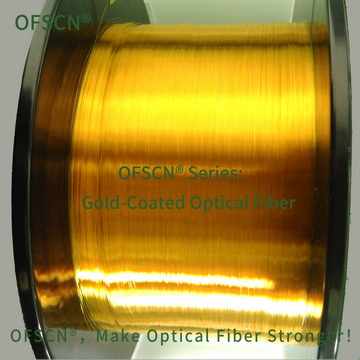
2. OFSCN® Gold-coated Optical Fiber
- Technical Features: Operating temperature range for single mode is -270\ ^\circ\text{C} to 700\ ^\circ\text{C} ; metal gold (Au) coating provides excellent hermeticity; default is doped core, but pure silica core structure can be customized, enabling resistance to deep space and extreme nuclear radiation conditions.

For more specifications and structural information on specialty optical fibers, please refer to:
OFSCN® Specialty Optical Fiber Product Categories Link