Can my system distinguish a change of 0.1 degrees?
To answer whether your system can distinguish a 0.1\ ^\circ\text{C} change (i.e., whether the system’s temperature resolution can reach 0.1\ ^\circ\text{C}), we need to conduct a scientific analysis from three perspectives: physical principles, sensor sensitivity, and demodulator wavelength resolution.
In a Fiber Bragg Grating (FBG) sensing system, the ultimate physical quantity resolution is not determined by a single component but jointly by the sensor sensitivity and the demodulator’s wavelength resolution.
I. Physical Principles and Mathematical Derivation
For a standard single-mode Fiber Bragg Grating temperature sensor, its center wavelength’s sensitivity to temperature (temperature sensitivity, denoted as S) is typically around 10\ \text{pm/}^\circ\text{C} (near the 1550\ \text{nm} wavelength band).
The corresponding formula for temperature change and wavelength shift is:
\Delta \lambda = S \cdot \Delta T
Where:
- \Delta \lambda is the wavelength shift received by the demodulator (unit: pm)
- S is the temperature sensitivity of the temperature sensor (usually around 10\ \text{pm/}^\circ\text{C})
- \Delta T is the temperature change of the object being measured (unit: ^\circ\text{C})
When the temperature changes by \Delta T = 0.1\ ^\circ\text{C}, the corresponding wavelength shift is:
\Delta \lambda = 10\ \text{pm/}^\circ\text{C} \times 0.1\ ^\circ\text{C} = 1\ \text{pm}
Therefore, for the system to distinguish a temperature change of 0.1\ ^\circ\text{C}, the wavelength resolution of the Fiber Bragg Grating demodulator must reach 1\ \text{pm} or higher.
II. Evaluation Based on OFSCN® Official Product Parameters
DaCheng YongSheng (OFSCN®)'s grating sensing systems can fully meet this requirement in terms of technical specifications:
1. Demodulator Wavelength Resolution
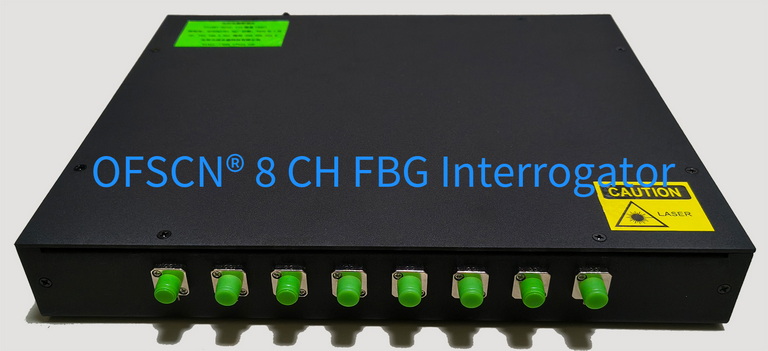
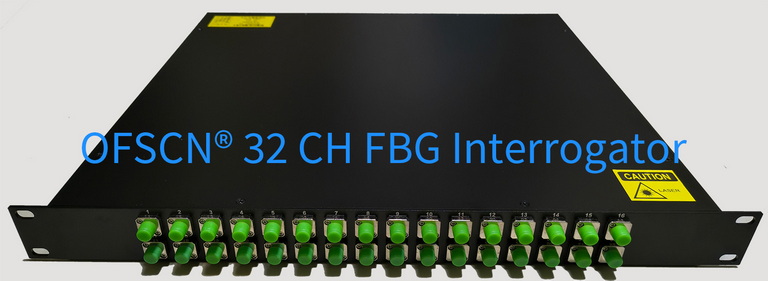
The OFSCN® Fiber Bragg Grating Interrogator has a default wavelength resolution of 1\ \text{pm}, and supports custom high-precision versions up to 0.1\ \text{pm}.
- Under default configuration (resolution 1\ \text{pm}): Paired with a standard 10\ \text{pm/}^\circ\text{C} sensitivity temperature sensor, the system can just resolve a temperature change of 0.1\ ^\circ\text{C}.
- Under high-end customization (resolution 0.1\ \text{pm}): The system’s ultimate temperature resolution can theoretically reach 0.01\ ^\circ\text{C}, allowing it to easily and sensitively distinguish changes of 0.1\ ^\circ\text{C}.
2. Temperature Sensor Sensitivity
When paired with OFSCN® FBG Temperature Sensor Products (e.g., OFSCN® 300°C Fiber Bragg Grating Temperature Sensor or OFSCN® 500°C Fiber Bragg Grating Temperature Sensor), due to the stainless steel seamless pipe packaging, the thermal expansion effect of the metal will have a certain amplifying effect on the grating. Its actual temperature sensitivity often slightly exceeds that of a bare grating (potentially reaching around 11\ \text{pm/}^\circ\text{C} to 15\ \text{pm/}^\circ\text{C}). This makes the wavelength shift more pronounced for the same temperature change, making it easier for the system to resolve.

III. Constraints in Practical Engineering Applications
Although physically theoretically feasible and meeting device hardware specifications, whether the system can stably distinguish 0.1\ ^\circ\text{C} in a real testing environment also depends on the following on-site interfering factors:
- System Noise Floor: If there is strong mechanical vibration or electromagnetic interference on-site, the wavelength measured by the demodulator may exhibit high-frequency jitter, which can mask an effective wavelength change of 1\ \text{pm}. Algorithms such as sliding average filtering can be used in the software to reduce noise.
- Thermal Conduction Delay: Materials like stainless steel have a certain wall thickness, and it takes time for temperature to conduct to the internal grating. In rapidly changing transient temperature fields, the sensor may not be able to immediately reflect rapid fluctuations of 0.1\ ^\circ\text{C} due to thermal conduction delays.
- Cross-sensitivity: If the temperature sensor experiences additional mechanical stress or strain during installation, the wavelength drift caused by strain will be superimposed on the drift caused by temperature, affecting the temperature resolution accuracy.
Conclusion: As long as the sensor is installed properly and paired with an OFSCN® Fiber Bragg Grating demodulator with a resolution of 1\ \text{pm} (or a custom 0.1\ \text{pm}), your system can fully and stably distinguish temperature changes of 0.1\ ^\circ\text{C}.