Why does light bounce back when it hits a connector? Can the reflected light damage the machine?
In the fields of optical engineering and fiber optic communication, the phenomenon you describe as light “bouncing back” is known as Reflection, quantified in terms of energy by Return Loss (RL). The generation of reflected light is determined by strict physical laws, while whether it can damage equipment depends on the power level and protective design of the optical transmission system.
Below is a rigorous, academic explanation from two perspectives: physical mechanisms and system hazards:
I. Why Does Light “Bounce Back” at Connectors? (Physical Principles)
When light travels through an optical fiber and is reflected, it primarily arises from the following three physical mechanisms:
1. Fresnel Reflection
When light propagates from one medium to another with a different refractive index, a portion of the light is reflected at the interface between the media.
The refractive index of the core (silica glass) in standard single-mode optical fibers is n_1 \approx 1.45 . If the fiber connector is not in perfect contact, leaving a tiny air gap (air refractive index n_0 \approx 1.0 ), Fresnel reflection occurs due to the sudden change in refractive index.
According to the Fresnel equations, the reflectance R at normal incidence is:
R = \left( \frac{n_1 - n_0}{n_1 + n_0} \right)^2
Substituting the values:
R = \left( \frac{1.45 - 1.0}{1.45 + 1.0} \right)^2 \approx 3.4\%
This means that even a tiny air gap can cause approximately 3.4\% of the light energy to be reflected back (corresponding to a return loss of about -14.7\ \text{dB} ).
2. Geometric Defects and Mismatch at Connector End-faces
In practical fiber optic connections, if the connector end-faces have dust, dirt, or minor scratches, or if the fiber cores are not perfectly aligned and the end-faces do not achieve tight “Physical Contact” (PC), artificial refractive index discontinuities are introduced, leading to strong reflections.
3. Connector Designs to Suppress Reflection: The Difference Between PC and APC
To suppress reflections, different types of fiber optic connectors have been designed in optical engineering:
- PC (Physical Contact) Connectors: The end-face is slightly spherical. By applying physical pressure, air is expelled, ensuring refractive index continuity. Their return loss is typically between 40\ \text{dB} and 50\ \text{dB} .
- APC (Angled Physical Contact) Connectors: The end-face has an 8^{\circ} angle. When light reflects off the angled end-face, the reflected light deviates from the fiber core at a larger angle, entering the cladding and eventually attenuating, preventing it from traveling back along the core. Their return loss can typically reach over 60\ \text{dB} .
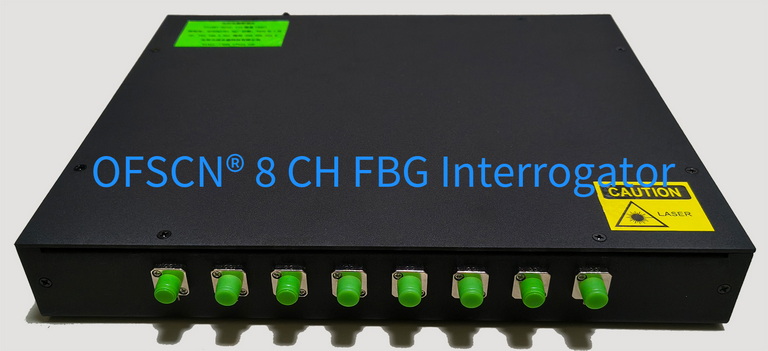
In Daecheng YongSheng (OFSCN®)'s high-precision fiber optic sensors and demodulation systems (such as the OFSCN® Fiber Bragg Grating Interrogator), FC/APC type connectors are the default and recommended choice to minimize the interference of reflections on the system.
II. Can Reflected Light Damage Equipment?
The hazard posed by reflected light to a system must be assessed based on the system power:
1. Low-Power Sensing and Communication Systems (Milliwatts, \text{mW} )
In fiber Bragg grating sensing systems (e.g., using the OFSCN® Fiber Bragg Grating Interrogator) or ordinary communication systems, the light source emission power is typically in the milliwatt ( \text{mW} ) range.
- Physical Damage: The weak light reflected backward generally does not directly physically burn out the laser.
- System Interference: However, if reflected light returns to the laser’s resonant cavity, it causes Optical Feedback. This leads to fluctuations in laser output power, wavelength drift, broadening of the linewidth, and introduces severe Relative Intensity Noise (RIN) and phase noise. For precision demodulators, this significantly degrades wavelength measurement accuracy and signal-to-noise ratio.
2. High-Power Laser Systems (Watts, \text{W} , to Kilowatts, \text{kW} )
In high-power fiber laser systems (for industrial applications like fiber cutting, welding, cleaning, or laser cavities constructed using OFSCN® Laser Fiber Bragg Grating (Bare)):
- It WILL damage the equipment! If high-power reflected light returns directly to the semiconductor pump source (LD) or the gain medium without isolation, the high energy density focused on the end-face of the laser chip will cause Catastrophic Optical Damage (COD), resulting in the instantaneous melting of the chip, burning of the fiber end-face, and rendering the entire laser unusable.
3. Protective Measures in Industry and Academia
To prevent reflected light from damaging the light source or interfering with measurements, modern optical engineering typically employs the following protective measures:
- Integrated Optical Isolator: Utilizes the Faraday effect (non-reciprocal magneto-optic effect) to allow light to pass in only one direction. Forward light passes through unobstructed, while backward reflected light is deflected or absorbed by the isolator, preventing it from returning to the laser chip.
- Use of High-Quality APC Connectors: Standardized connections ensure clean end-faces, allowing reflected light to leak out into the cladding.
Related Product Recommendations
For high-precision, multi-channel testing that requires strict avoidance of reflection interference, choosing optical equipment with low noise and high return loss protection is crucial.
- OFSCN® Fiber Bragg Grating Interrogator: The fiber Bragg grating interrogator independently developed by Daecheng YongSheng integrates precise optical isolation and protection designs. It is compatible with and supports FC/APC connections with high return loss, ensuring high stability and high signal-to-noise ratio for multi-channel wavelength analysis.