Why does OFSCN® emphasize that the pipe cannot have seams? Will a pipe with seams leak under high pressure?
In the field of fiber optic sensing and optical cable manufacturing, Dacheng Yongsheng (OFSCN®) strongly emphasizes the adoption of “Seamless Steel Tube” encapsulation, rather than ordinary “seamed tubes” (such as longitudinally welded tubes, folded seam tubes, high-frequency welded tubes, etc.). The core reasons behind this stem from material physics, structural mechanics, and the reliability requirements of fiber optic sensors in extreme environments.
I. Scientific Principle Analysis: Why No Seams?
1. Structural Mechanics: Eliminating High Stress Concentration Points and Failure Sources
Seamed tubes (welded tubes) require steel plates or strips to be rolled and their seams welded together through localized high-temperature fusion welding (such as laser welding, TIG welding, or high-frequency welding) during the manufacturing process. During welding, the metal at the weld seam undergoes melting and recrystallization, resulting in significant changes to its metallographic structure (grain size, phase distribution, etc.) compared to the base material of the steel tube.
In high-temperature and high-pressure environments, the weld zone often becomes a stress concentration point for thermal stress, residual stress, and external mechanical loads. According to the formula for thin-walled cylinders under internal pressure, the hoop stress experienced by the cylinder under internal pressure is twice the axial stress:
\sigma_\theta = \frac{P \cdot d}{2t}
(where P is the internal or external pressure, d is the diameter of the steel tube, and t is the wall thickness). Since the tensile strength and fatigue life of the weld seam are often weaker than those of the seamless base material, under alternating pressure or high pressure, the weld seam is prone to Intergranular Cracking, leading to steel tube failure. Seamless steel tubes, on the other hand, are made from a solid piece of steel through processes like piercing, cold drawing, or hot rolling, forming a seamless, continuous, and isotropic metallic solid without any structural weak points.
2. Airtightness: Preventing Hydrogen Aging and Moisture Ingress
Optical fibers are extremely sensitive to trace amounts of water and hydrogen molecules:
- Effect of Moisture: Once moisture (H_2O) infiltrates, it reacts with siloxane bonds in the silica lattice (the main component of optical fibers), accelerating the growth of microcracks under stress, leading to rapid degradation of the fiber’s mechanical strength and brittle fracture.
- Hydrogen Aging Effect: Hydrogen molecules (H_2) are extremely small and easily penetrate the fiber core and cladding, creating strong infrared absorption peaks that significantly increase optical loss (commonly referred to as “hydrogen aging”). This causes the signal strength of distributed fiber optic sensors or FBG sensors to rapidly attenuate, ultimately leading to failure.
Due to manufacturing limitations, seamed tubes often exhibit microscopic pores, pinholes, or unwelded micro-gaps under magnification. In long-term high-pressure environments, the pressurized medium can force water and hydrogen gas into the tube through these microscopic pores. Seamless steel tubes, with their excellent lattice continuity, guarantee long-term absolute hermetic encapsulation.
3. Energy Transfer and Sensing Consistency: Avoiding Non-uniformity of Physical Fields
For distributed fiber optic sensing (e.g., DTS based on Raman scattering, OFDR based on Rayleigh scattering, DTSS based on Brillouin scattering) or Fiber Bragg Grating (FBG) sensors, the metal tube serves as a medium for conducting physical fields (temperature, strain). Seamed tubes exhibit asymmetrical Young’s modulus and coefficient of thermal expansion in the circumferential direction. During drastic changes in temperature or pressure, the tube is prone to minor irregular circumferential deformations or axial bending, which in turn introduces nonlinear micro-bending loss or false strain signals to the internal optical fiber, degrading measurement accuracy.
II. Will Seamed Tubes Leak Under High Pressure?
The answer is yes, not only will they leak, but the probability of leakage is extremely high.
Under high-pressure environments (such as oil logging, geothermal extraction, deep-sea pipelines, chemical plant high-pressure networks, etc., where pressures often reach tens to hundreds of megapascals), seamed tubes typically face the following two forms of leakage:
- Macroscopic Rupture Leakage: Under high-stress differential pressure, microscopic defects in the weld seam (lack of fusion, slag inclusions, cracks, etc.) will instantaneously undergo brittle fracture or tear along the weld seam due to tensile stress. High-pressure medium will instantly rush in, causing the optical fiber inside the tube to be crushed instantaneously.
- Microscopic Permeation Leakage (Slow Seepage): Even if the weld seam appears intact and pressure testing does not result in rupture in the short term, under long-term micro-stress and corrosive environments, hydrogen and moisture can slowly diffuse into the tube through micro-gaps at the metal grain boundaries, leading to water accumulation or excessive hydrogen concentration inside the optical cable, thereby causing hydrogen aging or brittle fracture of the optical fiber.
III. Dacheng Yongsheng (OFSCN®) Seamless Steel Tube Encapsulated Fiber Optic Cables
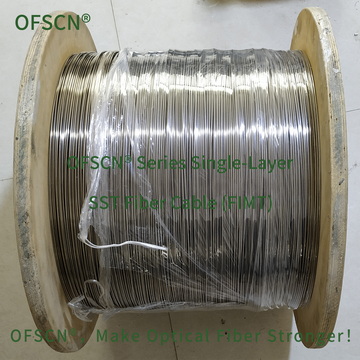
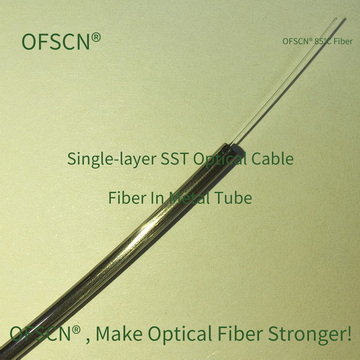
Dacheng Yongsheng (OFSCN®) produces specialized fiber optic sensors and distributed sensing cables, all encapsulated in high-quality stainless steel seamless steel tubes, designed to provide optical fibers with an absolute barrier against moisture, hydrogen aging, and high mechanical strength.
1. OFSCN® 85°C Seamless Steel Tube Fiber Cable
Features a single layer of stainless steel seamless steel tube. Primarily used for high hermetic communication and distributed sensing in normal and medium-low temperature special environments. The default materials are 304 or 316\text{L} stainless steel, with default outer diameters of 2.0\text{ mm} (wall thickness 0.2\text{ mm}) or 3.0\text{ mm} (wall thickness 0.3\text{ mm}), with customizable dimensions.
2. OFSCN® 200°C Seamless Steel Tube Fiber Cable
Contains high-temperature optical fibers with polyimide coating (operating temperature up to 200\ ^\circ\text{C}), providing high hermeticity, resistance to side pressure, and protection against water and moisture. Suitable for medium-temperature, high-pressure scenarios in industries like power and petrochemicals.
3. OFSCN® 300°C Seamless Steel Tube Fiber Cable
Specifically designed for 300\ ^\circ\text{C} high-temperature, high-pressure industrial environments. The outer layer uses stainless steel seamless steel tubes, suitable for use as high-temperature distributed temperature and strain sensors.
4. OFSCN® 650/700°C Seamless Steel Tube Fiber Cable
Encapsulated using ultra-high temperature seamless single-layer alloy tubes, housing high-temperature gold-coated optical fibers. The operating temperature range covers -270\ ^\circ\text{C} to 700\ ^\circ\text{C}.
5. OFSCN® Double-Layer High-Temperature Downhole Fiber Optic Cable
Designed for harsh conditions such as downhole oil and gas wells with extremely high pressure and strong acid-alkali corrosion. It employs a double-layer seamless steel tube (e.g., 316\text{L} stainless steel or 825 alloy) nested encapsulation. The outer seamless tube has an outer diameter of 6.35\text{ mm} (wall thickness 0.9\text{ mm}), and the inner seamless tube has an outer diameter of 3.6\text{ mm} (wall thickness 0.3\text{ mm}), forming a dual sealing barrier.
IV. Official Product Image Showcase
Below are real product images of OFSCN® seamless steel tube fiber optic cables: