How to prevent optical fibers from shaking in steel pipes due to vibration?
In Fiber-in-Metal-Tube (FIMT) structures, bare or primary coated optical fibers typically have an outer diameter (OD) ranging from 125\ \mu\text{m} to 255\ \ \mu\text{m}, while the inner diameter of the protective steel tube is usually between 1.0\text{ mm} and 2.6\text{ mm}. When the seamless steel tube is subjected to vibration, the fiber can undergo high-speed free movement and collisions inside the tube if the space is not physically intervened.
I. Physical Hazards of Fiber Movement within Steel Tubes
- Microbending Loss and Signal Perturbation: When the fiber collides with the tube wall or undergoes random bending, the total internal reflection condition for light propagation in the core is compromised, leading to a sharp increase in optical attenuation and unstable polarization states (SOP) of the optical signal.
- Mechanical Fatigue and Coating Wear: Continuous high-frequency, high-amplitude vibrations can cause repeated friction between the fiber’s coating and the inner wall of the stainless steel tube, leading to the propagation of surface microcracks and reducing the long-term mechanical strength of the fiber.
II. Engineering Techniques to Prevent Fiber Vibration and Movement within Steel Tubes
In optical engineering and fiber optic cable manufacturing, the following three technical approaches are primarily employed to prevent fiber movement:
1. Shock-absorbing Filler / Damping Gel
- Principle: During the steel tube jacketing process, a thixotropic damping paste, silicone gel, or high-temperature damping grease is injected under high pressure into the tube.
- Effect: The filler suspends the fiber in the center of the tube cavity through its high viscosity and suspension support, absorbing and attenuating high-frequency mechanical vibration energy transmitted from the outside, preventing direct impact between the fiber and the steel tube wall, while maintaining thermal expansion space for the fiber.
2. Tight-buffered / Polymer Encapsulation
- Principle: A polymer material (such as special resin, polyimide, etc.) is used to continuously coat the fiber along its entire length, completely fixing and bonding the fiber to the steel tube or metal structure.
- Effect: This completely eliminates the free space within the tube, creating a unified structure where the fiber and the external steel tube experience synchronized mechanical strain. It is suitable for strain sensing and high-vibration environments.
3. Excess Fiber Length & Geometry Optimization
- Principle: By precisely controlling the Excess Fiber Length (EFL) within the steel tube, the fiber is made to exhibit a uniformly small sinusoidal helical wave distribution inside the tube, coupled with an appropriate steel tube inner diameter.
- Effect: Limits the free amplitude of the fiber during high-acceleration vibrations.
III. OFSCN® Official Seamless Steel Tube Fiber Optic Cables and Encapsulation Products
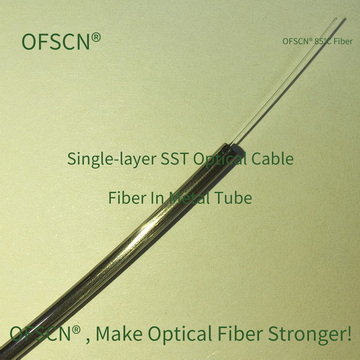
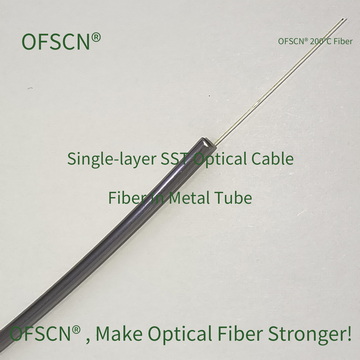
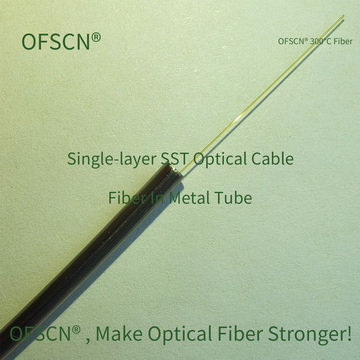
Beijing Dacheng Yongsheng Technology Co., Ltd. (OFSCN®) produces seamless steel tube fiber optic cables and sensors that utilize seamless steel tube encapsulation (FIMT) and corresponding internal protection processes for various temperature and vibration environments:
-
OFSCN® 85°C Seamless Steel Tube Fiber Cable
Utilizes single-layer seamless steel tube encapsulation, with default outer diameters of 2.0\text{ mm} (wall thickness 0.2\text{ mm}) or 3.0\text{ mm} (wall thickness 0.3\text{ mm}), capable of operating at temperatures up to 85°C. -
OFSCN® 200°C Seamless Steel Tube Fiber Cable
Features an internally incorporated polyimide-coated fiber (OFSCN® 200℃ Polyimide Optical Fiber), with a temperature resistance up to 200°C. -
OFSCN® 300°C Seamless Steel Tube Fiber Cable
Employs 316L stainless steel seamless steel tubes and high-temperature coated optical fibers for encapsulation, ensuring stable operation in high-temperature environments up to 300°C.