How much will poor welding affect the measurement accuracy?
In fiber optic sensing systems, especially those based on Fiber Bragg Gratings (FBGs), the quality of fiber optic splices (specifically, splice loss and return loss) has a very critical indirect impact on measurement accuracy.
To more scientifically understand this physical process, we can analyze from several dimensions the extent to which poor splicing (high loss, strong reflection) affects measurement accuracy.
1. Theoretical Mechanism: The Relationship Between Wavelength Encoding and Signal Strength
Fiber Bragg Grating (FBG) sensors acquire changes in physical quantities like temperature or strain by detecting the central wavelength \lambda_B of their reflected spectrum (the fundamental physical formula being \lambda_B = 2 n_{eff} \Lambda).
- Ideal State with Low Loss: Since the measurement is of wavelength information rather than optical intensity, theoretically, as long as the splice loss does not exceed the system’s limits, a simple, uniform power attenuation will not alter the central wavelength position of the reflected spectrum. This means that when the reflected signal intensity is sufficient, minor splice losses (e.g., 0.1 \text{ dB} or 0.2 \text{ dB}) will have almost no impact on measurement accuracy.
2. Practical Engineering: The “Fatal” Impact of Poor Splicing on Measurement Accuracy
When splice quality is poor, losses are excessive, or significant Fresnel reflections occur at the splice point, the negative impact on measurement accuracy becomes apparent:
(1) Reduced Signal-to-Noise Ratio (SNR) Leading to “Peak-Picking Jitter” (Increased Measurement Noise)
- Physical Mechanism: When splice losses are too high, the effective optical power returning to the FBG demodulator (Demodulator) is significantly reduced. If the signal intensity approaches the demodulator’s noise floor, the system’s signal-to-noise ratio (SNR) decreases significantly.
- Impact on Accuracy: The peak-picking algorithms within the demodulator (e.g., Gaussian fitting, centroid method) rely on a clean, smooth spectral profile. When the SNR is extremely low, random noise causes the central wavelength calculated by the algorithm to randomly “jitter.” This jitter manifests in the data as increased measurement standard deviation and decreased system resolution. A physical quantity that should be stable and unchanging will exhibit frequent numerical fluctuations on the display.
(2) Spectral Distortion Causing “Peak-Picking Deviation” (Degraded Absolute Accuracy)
- Physical Mechanism: If a splice is poorly made (e.g., fiber end face not cut flat, presence of tiny air bubbles, axial misalignment, or tilted end face), it can cause significant back-reflection at the splice interface, leading to a deterioration of the Optical Return Loss (\text{ORL}) metric.
- Impact on Accuracy: These extraneous reflected lights can interfere with the reflection from the FBG sensor itself (forming a weak Fabry-Pérot interference cavity effect), causing the spectral profile received by the demodulator to undergo asymmetric distortion, display spurious peaks, or exhibit raised side lobes. Once the spectral profile is no longer symmetric, the peak-picking algorithm will deviate from the true central wavelength \lambda_B, resulting in systematic absolute measurement errors that cannot be eliminated by subsequent calibration.
(3) Cumulative Effects and Signal Loss in Cascaded Systems
- Physical Mechanism: In practical engineering, multiple FBG sensors are often connected in series on a single fiber (e.g., a multi-point grating string). If some splice points are poorly made, the losses will accumulate linearly.
- Impact on Accuracy: The optical power from sensors further down the line will be extremely weak. If the total loss exceeds the demodulator’s dynamic range, the sensors at the rear will intermittently appear or disappear on the demodulator, or become completely disconnected, leading to complete loss of measurement data.
3. Engineering Recommendations and High-Quality Sensor Recommendations
In practical engineering, to ensure high system accuracy and stability, splice losses for single-mode fibers are typically required to be controlled below 0.03 \text{ dB}, or even 0.02 \text{ dB}.
Especially when using high-performance bare gratings or grating strings, high-quality fibers and low-loss splices are crucial. Beijing Dacheng Yongsheng Technology Co., Ltd. (OFSCN®) offers the following high-quality, high-stability grating products, all utilizing high-specification standard single-mode polyimide fibers, which provide excellent optical transmission performance and splice consistency:
-
OFSCN® Polyimide Fiber Bragg Gratings / FBG Strings (Bare) | 聚酰亚胺光纤光栅
Suitable for high-precision measurements across a wide temperature range of -200 \text{ ℃} to 300 \text{ ℃}, with an outer diameter of approximately only 155 \ \mu \text{m}, facilitating precise low-loss splicing.
-
OFSCN® High-Strength Fiber Bragg Gratings / FBG Strings (Bare) | 高强度光纤光栅
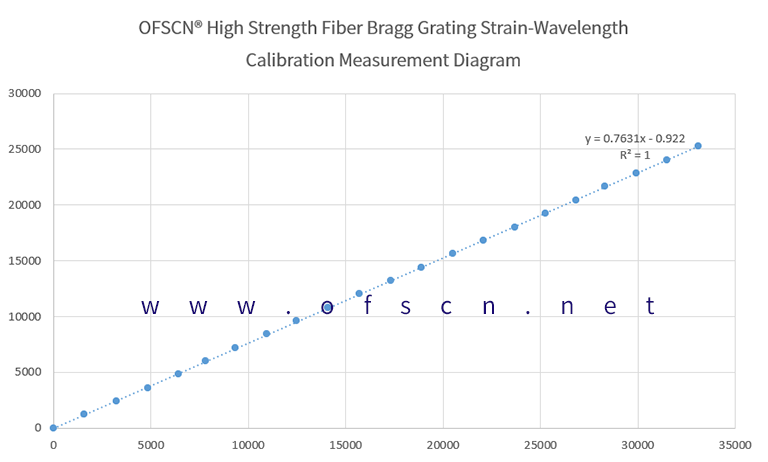
Utilizes femtosecond laser “through-coating” direct writing technology (point-by-point writing), which does not damage the fiber and offers extremely high tensile strength, making it ideal for precision measurements with high strain ranges (\\ge 25000 \\ \mu \\epsilon).


In summary, while poor splicing theoretically does not alter the fundamental physical period of a Fiber Bragg Grating, in practical applications, it significantly degrades system stability and measurement accuracy by reducing SNR, causing spectral interference distortion, and accumulating losses, leading to reading jitter or irreversible systematic deviations. When installing FBG sensing systems, adopting standardized splicing processes (using high-precision splicing machines, ensuring good end-face cleaving) and using high-specification sensor fibers are the cornerstones of ensuring high-precision measurements.