電源を入れてからデータが出力されるまでどのくらいかかりますか?停電時の自動再起動はサポートされていますか?
光ファイバーセンシングシステムにおいて、**システムの起動時間(System Boot Time / Power-up Time)**は、電子ハードウェア、組み込みシステム、および光学測定サブシステムに関連する一般的なエンジニアリング指標です。
1. 「システムの起動時間」とは?
光ファイバーグレーティング(FBG)センシング解調システムにおけるシステムの起動時間とは、解調器に電力が供給される瞬間、または電源スイッチがオンにされた瞬間から、システムがすべての低レベルの初期化、光学セルフチェック、および熱平衡を完了し、有効な物理測定データ(波長/温度/ひずみなど)の連続的かつ安定した出力を開始するまでの全時間を指します。
このプロセスは、通常、以下の段階で構成されます。
- ハードウェアの電源投入と組み込みシステムの起動(OS Boot):電源モジュールが安定した電力を供給し、マイクロプロセッサ(ARM/DSP/FPGAまたは産業用PCアーキテクチャなど)が起動し、ブートローダーをロードして、低レベルのオペレーティングシステムとサービスプロセスを実行します。
- 光学および温度制御モジュールの自己校正(Optical Alignment & Thermal Stabilization):光ファイバーグレーティング解調器内部の光源(広帯域光源または高速スキャンレーザーなど)、光検出器、および内部ガス吸収セル/波長基準基準が自己校正を完了します。内部温度制御サーモエレクトリッククーラー(TEC)は、測定波長が公称分解能(例: 1\text{ pm} または 0.1\text{ pm} )に達するように、コア光学部品を動作温度で安定させる必要があります。
- 通信および測定アルゴリズムの準備完了(Data Acquisition & Communication Ready):スペクトル解調アルゴリズムがメモリにロードされ、解調器のネットワークインターフェイス(B/Sアーキテクチャサービス、TCP/IP、UDP、またはModbus)がポートリスニングを完了し、設定されたサンプリング周波数で連続データストリームの送信を開始します。
2. 電源投入からデータ出力までどのくらいかかる?
産業用およびエンジニアリンググレードの光ファイバーグレーティング解調装置の場合:
- 典型的な所要時間:コールドスタート(完全に電源が切れた状態からの起動)から、最初のネットワーク接続の確立と安定したデータ出力まで、通常 30秒から2分程度かかります。
- 所要時間の差異の主な理由:
- 高速通信(約30〜60秒):組み込みマザーボードのシステムと通信デーモンのロードは通常数十秒で完了します。この時点で、上位コンピュータはデバイスインターフェイスに接続できます。
- 光学熱平衡(約1〜2分):測定精度の環境温度変動の影響を排除するため、光学干渉またはスペクトルスキャンユニットは、システムが内部基準の熱平衡状態に達するように、短い予熱安定化時間が必要です。これにより、測定の高再現性と絶対波長精度が保証されます。
3. 電源断後の自動再起動はサポートされていますか?
サポートされています。
産業構造ヘルスモニタリング、電力オンラインモニタリング、および屋外無人エンジニアリング現場では、電力網の変動や一時的な停電は一般的な運用状況です。産業用光ファイバーグレーティング解調システムは、ハードウェアとファームウェアの両方で以下の耐障害メカニズムを備えています。
- 電源投入時の自動起動(Power On / Auto Reboot):解調器の内部電源モジュールは、電源復旧時の自動起動ロジック(AC Power-Loss Recovery)をサポートしています。現場の電源が復旧すると、システムは手動でデータセンターに移動して物理的な電源ボタンを押す必要なく、自動的に電源が投入され起動します。
- 動作設定とデータの自動復旧:システムは、チャネル設定、キャリブレーション式パラメータ(温度二項式パラメータ、ひずみ係数など)を不揮発性ストレージメディアに永続化します。システム起動後、バックグラウンド収集サービスが自動的に起動し、電源断前のパラメータに従ってサンプリングを自動的に再開し、外部へのデータ転送を継続します。
4. 公式製品および技術パラメータ
Beijing Dacheng Yongsheng Technology Co., Ltd.(北京大成永盛科技有限公司)は、長期間の無人監視シナリオに適した標準的な産業用グレードの製品を提供しています。
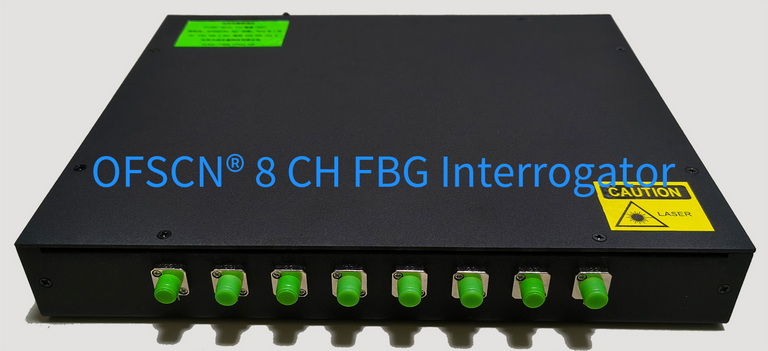
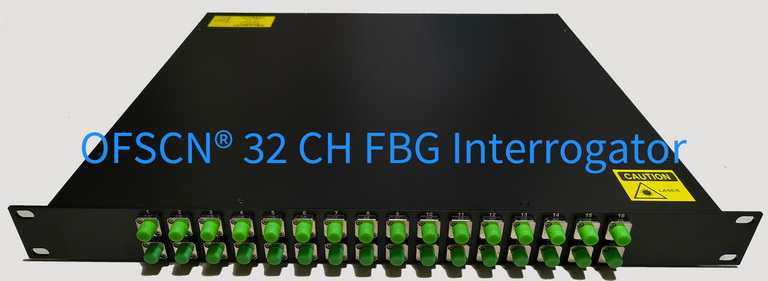
- 製品情報:OFSCN® Fiber Bragg Grating Interrogator
- コアパラメータ:
- 波長範囲:デフォルト 1525 \sim 1565\text{ nm} または 1528 \sim 1568\text{ nm} (カスタマイズ可能)
- チャネル数:4チャンネル、8チャンネル、16チャンネル、32チャンネル(カスタマイズ可能)
- サンプリング周波数: 10\text{ Hz} 、 50\text{ Hz} 、 100\text{ Hz} (ソフトウェアで 1\text{ Hz} まで調整可能)
- 波長分解能:デフォルト 1\text{ pm} または 0.1\text{ pm} (カスタマイズ可能)
- ネットワークおよびシステム統合:デフォルトでB/Sアーキテクチャソフトウェアを採用し、C/Sアーキテクチャをサポート。TCP、UDP、Modbusなどのプロトコルを介してサードパーティ制御システムとの統合をサポートします。
1. hardware_power_on_and_embedded_system_boot:Power modules are stable, microprocessor starts, bootloader loads, and OS runs. 2. optical_and_thermal_module_self-calibration:Light source, photodetector, and reference standards calibrate. TEC stabilizes core components to operating temperature for specified resolution. 3. communication_and_measurement_algorithm_ready:Spectral demodulation algorithm loads, network interface listens, and data streaming begins at the configured frequency.—### 2. How long from power on to data output?For industrial and engineering grade FBG demodulators:
- Typical duration: Cold start (from full power off) to first network connection and stable data output generally takes 30 seconds to 2 minutes.
- Main reasons for duration difference:
- Fast communication (approx. 30~60 seconds): Embedded motherboard system and communication daemons usually ready within tens of seconds, allowing host connection.
- Optical thermal stabilization (approx. 1~2 minutes): To mitigate environmental temperature effects on accuracy, optical interference or spectral scanning units require a brief preheating period to stabilize the system to its internal thermal baseline, ensuring high measurement repeatability and absolute wavelength accuracy.
3. Does it support automatic restart after power failure?
Yes.
In industrial structural health monitoring, power online monitoring, and unattended field engineering sites, power grid fluctuations or temporary outages are common. Industrial grade FBG demodulation systems incorporate fault-tolerant mechanisms at both hardware and firmware levels:
- Power-on self-start (Power On / Auto Reboot): The demodulator’s internal power module supports AC Power-Loss Recovery logic. When site power is restored, the system automatically powers on without manual intervention at the physical power button.
- Automatic restoration of working configuration and data: Channel configurations and calibration formula parameters (e.g., temperature binomial coefficients, strain coefficients) are stored in non-volatile memory. After system boot, the background acquisition service automatically resumes sampling and data transmission according to the parameters from before the power outage.
4. Official Product and Technical Parameters
Beijing Dacheng Yongsheng Technology Co., Ltd. offers standard industrial-grade products suitable for long-term unattended monitoring scenarios:
- Product Information: OFSCN® Fiber Bragg Grating Interrogator
- Core Parameters:
- Wavelength Range: Default 1525 \sim 1565\text{ nm} or 1528 \sim 1568\text{ nm} (customizable)
- Number of Channels: 4, 8, 16, 32 channels available (customizable)
- Sampling Frequency: Supports 10\text{ Hz}, 50\text{ Hz}, 100\text{ Hz} options (downward adjustable to 1\text{ Hz} via software)
- Wavelength Resolution: Default 1\text{ pm} or 0.1\text{ pm} (customizable)
- Network and System Integration: Default B/S architecture software, supports C/S architecture, and integration with third-party control systems via TCP, UDP, Modbus, etc.