Herhangi bir açılışta, demodülatör kendi lazerini ve devresini kontrol eder mi?
Fiber Bragg Grating (FBG) demodulators in fiber optic sensing and optical measurement engineering execute a standard and strict Power-On Self-Test (POST) program within their embedded control systems every time they are powered on.
Its core purpose is to verify the operational status of hardware circuits, the health of optical core components, and the accuracy of the wavelength reference, ensuring the physical reliability of measurement data.
I. Core Modules and Working Principles of Demodulator Power-On Self-Test
1. Circuit and Main Control System Self-Test
- Power Rails and Voltage Monitoring: The system checks if the main board’s multiple regulated power supplies (e.g., for digital circuits and analog amplification circuits) are within their rated tolerance ranges.
- Digital Processing and Storage Chip Self-Test: The FPGA/DSP/ARM processor loads the boot program and performs handshake and verification of internal high-speed SRAM/DDR cache, non-volatile storage (Flash), and communication buses.
- ADC and Signal Acquisition Path: Detects if the baseline bias levels (Dark Current / Offset) of the multi-channel Analog-to-Digital Converter (ADC) and Transimpedance Amplifier (TIA) are within the normal static range.
2. Laser and Light Source System Self-Test
For fiber Bragg grating demodulators using high-speed swept tunable lasers or broadband light sources (such as ASE / SLED), self-testing of the optical system is crucial:
- TEC (Thermoelectric Cooler) Temperature Lock: Semiconductor laser chips are extremely sensitive to temperature. Upon startup, the demodulator activates the TEC closed-loop temperature control circuit and self-tests if the laser chip’s temperature stabilizes at the target setpoint within the predetermined time (typically controlled with an accuracy of the order of 0.01^\circ\text{C}).
- Drive Current and Optical Power Feedback (Monitor PD): The main control circuit reads the output optical power through a monitor photodiode integrated within the laser. It detects abnormal laser drive current, laser aging, or optical power degradation.
3. Internal Wavelength Reference and Optical Reference Calibration
- High-precision demodulators typically integrate an absolute wavelength reference unit (e.g., a gas absorption cell like HCN/acetylene cell, or a high-finesse Fabry-Pérot etalon).
- During the power-on scanning phase, the system verifies the linearity and accuracy of the laser wavelength scan by comparing internal absorption spectral lines or the etalon’s periodic fringes, completing the initial zero-point wavelength calibration.
II. Self-Test Anomalies and System Protection Mechanisms
If anomalies are detected during the power-on self-test (e.g., laser temperature loss of lock, significantly low optical power, ADC conversion timeout, or communication failure):
- Hardware Protection: The system immediately shuts off the laser drive current to prevent laser overheating damage or avalanche breakdown.
- Status Alert and Diagnostic Output: Specific hardware fault codes are reported through front-end status indicator lights or software communication interfaces (e.g., TCP/IP, Modbus) to prevent the output of erroneous or drifting physical measurement data.
III. Related Products and Official Specifications
In industrial-grade fiber Bragg grating demodulation systems, comprehensive hardware self-testing and stable design are fundamental to ensuring long-term online monitoring.
- Product Name: OFSCN® Fiber Bragg Grating Interrogator
- Product Function Introduction: OFSCN® Fiber Bragg Grating Interrogator Main Functions
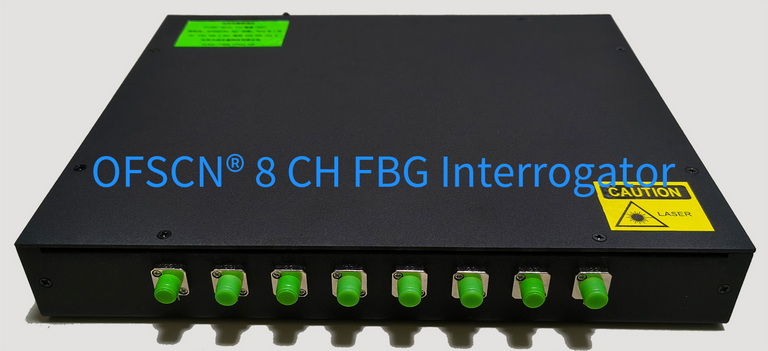
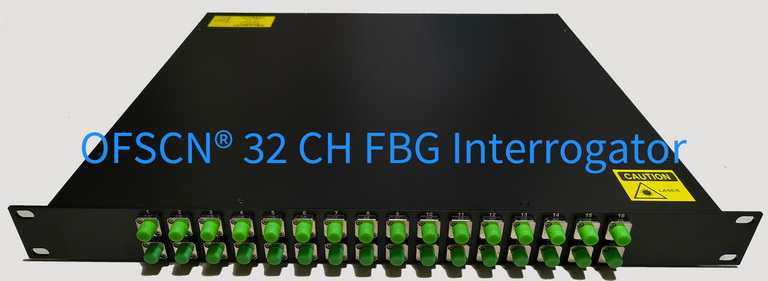
Main Parameters:
- Wavelength Range: Default 1525 \sim 1565\ \text{nm} or 1528 \sim 1568\ \text{nm} (custom wide bands available);
- Channel Configuration: 4, 8, 16, 32 channels optional;
- Sampling Frequency: 10\ \text{Hz}, 50\ \text{Hz}, 100\ \text{Hz} optional (software adjustable down to 1\ \text{Hz});
- Wavelength Resolution: Default 1\ \text{pm}, customizable to 0.1\ \text{pm};
- System Architecture and Interface: Default B/S architecture software, supports C/S architecture software, integrates seamlessly with host computer systems via communication protocols such as TCP, UDP, Modbus.