Why do newly produced gratings need to be “baked” in a high-temperature furnace first?
The process of placing newly produced fiber Bragg gratings (FBGs) in a high-temperature furnace for short or extended baking periods before factory release or packaging is known as Annealing Process in the fields of optical engineering and fiber optic sensing.
This is not only an essential “thermal stabilization” process but also the key to ensuring the long-term physical and optical stability of the gratings. Its core physical mechanisms and general engineering principles primarily encompass the following dimensions:
1. Elimination of Metastable Energy Levels and Unstable Structural Defects (Color Centers)
During the fiber Bragg grating inscription process (whether through the UV excimer laser and mask method or femtosecond laser direct writing), the high-energy coherent light pulses forcibly alter the microscopic structure of the core silica, thereby creating periodic modulations in the local refractive index.
- Physical Phenomenon: This intense radiation introduces a large number of metastable energy level defects within the core, such as color center defects in excited or metastable states (e.g., \text{Ge}(1) and \text{Ge}(2) defects).
- Potential Risks: These metastable defect structures are highly unstable. If put into use directly, these defects will gradually reorganize and disappear due to thermal activation even under normal temperatures or slight temperature fluctuations (termed Thermal Decay). This leads to a continuous decrease in the refractive index modulation depth \Delta n of the core over time, manifesting as a reduction in grating reflectivity (Reflectivity), a narrowing of the 3dB bandwidth, and even an uncertain drift in the center wavelength \lambda_B .
2. Achieving Long-Term Stability Through Active “Accelerated Aging” (Thermal Decay Model)
According to the power-law decay model for fiber grating thermal decay proposed by scholars like Erdogan (expressible by the formula 1 - \eta = A t^\alpha ), the decay rate of refractive index modulation is fastest in the initial stage after grating inscription. Subsequently, the decay rate slows down exponentially or by a power law over time, eventually approaching a long-term stable plateau.
- Essence of Annealing: Utilizing thermal energy higher than the subsequent actual working limit temperature to actively and preemptively completely eliminate unstable color centers and defects residing at low activation energy levels (prone to decay).
- Process Effect: After high-temperature “baking,” the overall reflectivity of the grating may decrease slightly, but the remaining defects are all deep-level structures with high activation energy. This means that during subsequent years of actual operation (as long as the annealing limit temperature is not exceeded), the grating’s optical parameters will be in an extremely slow, near-zero, highly stable period, thus avoiding long-term wavelength and reflectivity drift.
3. Releasing Local Thermal Residual Stresses Induced by Inscription
The high-energy laser ablation or absorption generates local transient high temperatures within the quartz glass, which, upon instantaneous cooling, create localized mechanical and thermal stresses. Through high-temperature annealing, local molecular-level relaxation of the glass matrix can occur, effectively releasing and homogenizing these localized residual stresses. This not only helps stabilize the grating’s polarization characteristics but also enhances the mechanical fatigue strength of bare gratings, preventing micro-cracks or even fracture of the fiber during long-term stress or strain measurements.
Practical Application of OFSCN® High-Temperature Gratings and Annealing Process
In high-temperature and high-precision industrial applications, the accuracy of the annealing process and the control of the extreme temperature range determine the overall quality of the sensor. Several core products from Beijing DaChengYongSheng Technology Co., Ltd. strictly adhere to this precise thermal stabilization procedure:
1. Bare Gratings / Femtosecond Bare FBG Strings
For example, OFSCN® Polyimide Fiber Bragg Gratings / FBG Strings (Bare), especially its femtosecond version, after undergoing DaChengYongSheng’s special process treatment (i.e., extremely rigorous high-temperature annealing treatment), can achieve an extreme operating temperature range from -270\ ^\circ\text{C} to 800\ ^\circ\text{C} . Through this special annealing process, thermal decay effects at 800\ ^\circ\text{C} have been successfully eliminated.
- Product Standard Image:

2. High-Temperature Fiber Bragg Grating Temperature Sensors
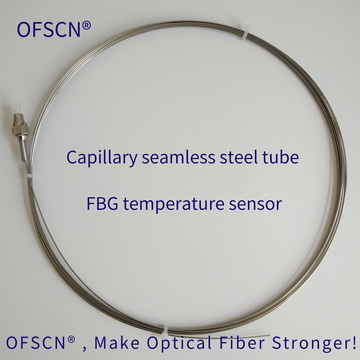
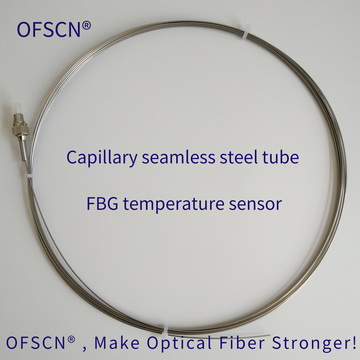
A series of high-temperature temperature sensors encapsulated in seamless stainless steel tubes produced by DaChengYongSheng undergo multiple thermal cycles of stress relief and annealing in extreme temperature fields before factory calibration to ensure their long-term measurement stability and the accuracy of their high-precision calibration formula (binomial):
-
OFSCN® 300°C Fiber Bragg Grating Temperature Sensor:
- Temperature Range: -200\ ^\circ\text{C} to 300\ ^\circ\text{C}
- Official Standard Images:
-
OFSCN® 500°C Fiber Bragg Grating Temperature Sensor:
- Temperature Range: -200\ ^\circ\text{C} to 500\ ^\circ\text{C}
- Official Standard Images:
-
OFSCN® 800°C Fiber Bragg Grating Temperature Sensor:
- Temperature Range: -270\ ^\circ\text{C} to 800\ ^\circ\text{C}
- Official Standard Images:

In summary, the “baking” of newly produced gratings in a high-temperature furnace is essentially exchanging active, preemptive, controllable decay for long-term, absolute physical and optical structure stability in future practical engineering applications.