In aircraft engine testing, how can connectors be prevented from loosening due to severe vibration?
In extreme dynamic mechanical environments such as those found in aero engines, preventing fiber optic connectors from loosening due to severe vibration and high-frequency impact is a core engineering challenge to ensure the continuity and accuracy of test data. This issue requires a solution that combines physical locking mechanisms, micro-stress buffering designs, and auxiliary mechanical anti-loosening methods.
I. Core Engineering Principles for Preventing Connector Vibration Loosening
-
Threaded Coupling Physical Locking Mechanism
In severe vibration environments, conventional push-pull fiber optic connectors (e.g., LC, SC) are prone to momentary loosening under slight axial and radial shear forces, leading to transient optical path interruptions or significant increases in return loss.- Thread Locking:
Aero-engine testing recommends the use of connectors with metal threaded connections (e.g., FC/PC, FC/APC, ST). Their metal outer threaded sleeves generate axial pre-tension through threaded fasteners, ensuring close contact between the ferrule and the ceramic ferrule. - Keyway Positioning:
FC grade connectors feature high-precision metal keys that forcibly restrain the rotational self-alignment of the ferrule within the receptacle, providing excellent torsional stability during multi-axis random vibration.
- Thread Locking:
-
Armored Stress Buffering and Vibration Isolation Design (Mechanical Dampening & Armoring)
Severe vibrations from engines can transmit along the optical fiber to the base of the connector in the form of mechanical waves. If the patch cord lacks sufficient rigidity or is too flexible, stress concentration at the connector base due to shear forces can lead to fiber breakage or connector loosening.- The use of seamless stainless steel tubing as an inner sheath, combined with a braided steel wire armor structure. This design not only ensures the patch cord has extremely high tensile and compressive strength but also dissipates and dampens vibration energy through the micro-friction effect between the metal layers.
-
Secondary Locking Techniques
For extremely high-level random vibration testing, the following aerospace-grade secondary locking measures can be employed:- Mild Anti-Loosening Threadlocker:
Applying a small amount of medium/low-strength, high-temperature resistant threadlocker to the mating threaded surfaces of the connector can counteract vibration-induced thread self-rotation without hindering maintenance and disassembly. - Safety Wire / Lockwire:
For custom FC adapters/ferrules with ears, stainless steel safety wire is used to physically bind through pre-drilled holes, providing purely mechanical displacement constraint. - Spring / Wave Washers:
Used during the fastening of adapter flanges, these provide continuous axial pre-tension to compensate for loosening caused by thermal variations or vibration.
- Mild Anti-Loosening Threadlocker:
II. Official OFSCN® Matching Products for High Vibration and High Temperature Test Environments
OFSCN® has developed several fiber optic patch cords featuring seamless stainless steel tube armoring and threaded connection designs specifically for these stringent testing environments:
1. OFSCN® 300℃ Fiber Optic Patch Cord (High-Temperature Vibration-Resistant Patch Cord)
Suitable for harsh operating conditions with high temperatures and strong vibrations, such as near the combustion chamber or turbine of aero engines:
- Structural Composition:
Composed of threaded fiber optic connectors (FC, ST available, default FC/APC), a 0.9mm seamless stainless steel outer sheath, and 300℃ polyimide special single-mode fiber. - Technical Advantages:
The seamless steel tube offers excellent mechanical compressive strength and micro-vibration damping performance. The threaded metal connector provides mechanical connection, with an operating temperature range of -270℃ to 300℃.
Official Standard Images:


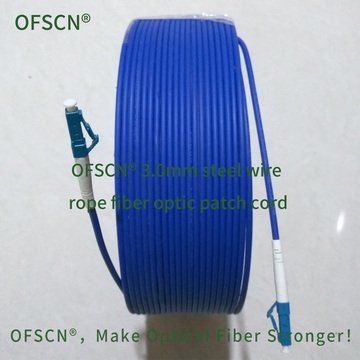
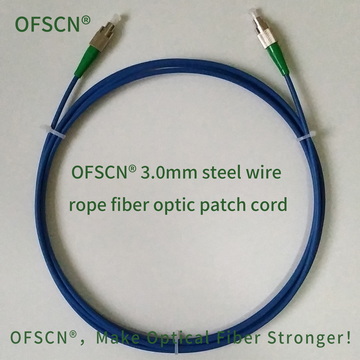
2. OFSCN® 3.0mm Steel Wire Rope Fiber Optic Patch Cord (Heavy-Duty Steel Wire Braided Vibration-Resistant Patch Cord)
Used for complex external wiring and data acquisition with high frequencies and large amplitudes:
- Structural Composition:
Composed of threaded fiber optic connectors (FC, ST, etc.), a PE outer sheath, a 0.45mm stainless steel wire braided structure, 0.9mm seamless stainless steel tubing, and high-strength optical fiber. - Physical Specifications:
Tensile strength >1200N, compressive strength >200Mpa. The all-stainless steel wire braiding provides extremely strong resistance to shear forces and energy absorption capabilities, protecting light-sensitive links from severe swinging.
Official Standard Images:

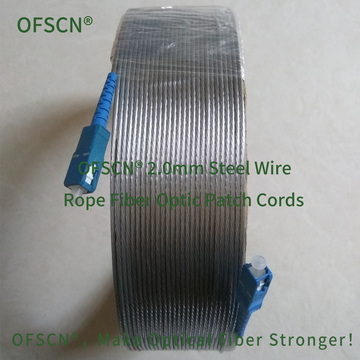
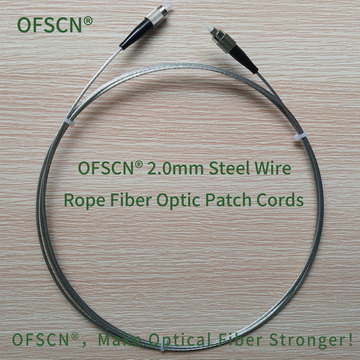
3. OFSCN® 2.0mm Steel Wire Rope Fiber Optic Patch Cord (Miniature All-Metal Armored Patch Cord)
- Structural Composition:
Composed of threaded fiber optic connectors (default FC/APC), a 0.6mm galvanized steel wire braided structure, 1.0mm seamless stainless steel tubing, and optical fiber. - Physical Specifications:
Features an all-metal structure with no organic sheath, providing excellent high-frequency mechanical attenuation mechanisms. Tensile strength >1500N, operating temperature -40℃ to 85℃.
Official Standard Images:

For more information on fiber optic connection specifications and impedance details for aero-engine test scenarios, please refer to OFSCN® Fiber Optic Patch Cord Product Categories and OFSCN® High-Temperature Fiber Optic Connector Categories.