Her fiber Bragg grating sensörünün neden kendine özgü bir “kimlik” dalga boyuna sahip?
Fiber Bragg grating (FBG) sensing technology typically refers to the “ID wavelength” as the Bragg Wavelength (denoted as \lambda_B) in optical physics. It serves as the fundamental reference for the sensor’s physical response and is the key identifier for achieving multiplexing and addressing.
I. Physical Principle: Bragg Reflection Condition
Fiber gratings are formed by creating a periodic refractive index modulation structure within the fiber core using ultraviolet or femtosecond lasers. When broadband light is injected into the fiber and propagates through the grating region, only narrow-band light waves satisfying specific constructive interference conditions are reflected, while other wavelengths are transmitted directly.
The center wavelength \lambda_B corresponding to this peak reflection is strictly determined by the Bragg Formula:
\lambda_B = 2 n_{\text{eff}} \Lambda
- n_{\text{eff}}: Effective Refractive Index of the fiber core;
- \Lambda: Physical Period of the grating (Grating Pitch).
When a grating is manufactured and placed under no stress at standard room temperature, its fixed initial reflection center wavelength (e.g., 1530.000\text{ nm}) is due to the precisely set modulation period \Lambda or core parameters for each grating.
II. Why is the Center Wavelength Called the Sensor’s “ID”?
1. Wavelength Division Multiplexing (WDM) and Unique Spatial Channel Addressing
A core advantage of fiber sensing systems is quasi-distributed measurement with a single fiber. Multiple fiber gratings can be written onto a single fiber in series (Fiber Grating Strings, FBG Strings):
- If different initial center wavelengths are set for the 1st, 2nd, and 3rd measurement points on the fiber (e.g., \lambda_1 = 1530\text{ nm}, \lambda_2 = 1540\text{ nm}, \lambda_3 = 1550\text{ nm});
- When a broadband light source is incident on the fiber, each grating produces a reflection peak only within its respective wavelength window;
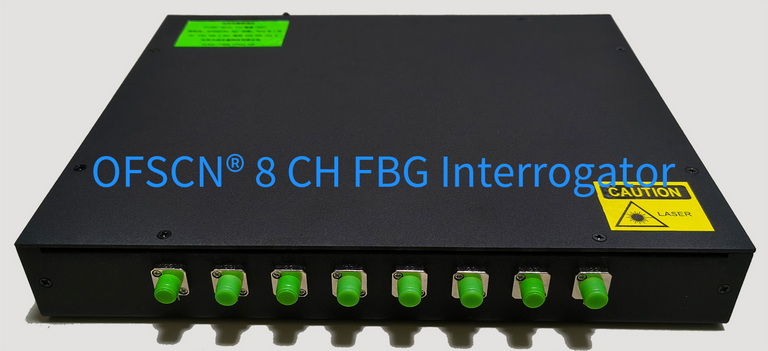
- When the OFSCN® Fiber Bragg Grating Interrogator scans these non-overlapping wavelength peaks on the spectrum, it can accurately identify “which sensor position the current reflection signal is coming from” based on the wavelength position.
Therefore, in a Wavelength Division Multiplexing network, the center wavelength acts as the “ID number” for uniquely locating the physical channel and spatial position.
2. Reference Zero Point for Physical Quantity Demodulation
The sensing principle of fiber gratings is essentially wavelength modulation-based:
- When external temperature changes \Delta T or axial strain \Delta \varepsilon affect the grating, the thermo-optic effect, thermal expansion effect, or elasto-optic effect cause changes in n_{\text{eff}} and \Lambda, leading to a shift in the center wavelength \Delta \lambda_B ;
- The interrogator tracks the minute shift (e.g., pm level movement) of the reflection peak within its reserved working wavelength window and, combined with calibration coefficients, can deduce the changes in temperature or strain.
III. Official Product Specifications and Wavelength Engineering Parameters
In engineering practice, to prevent wavelength overlap between adjacent sensors when subjected to force or temperature changes, strict planning of wavelength intervals and deviations is necessary.
- Wavelength Coverage: The standard wavelength range for OFSCN® bare fiber grating series (e.g., OFSCN® Standard Femtosecond Fiber Bragg Gratings / FBG Strings (Bare) and OFSCN® Polyimide Fiber Bragg Gratings / FBG Strings (Bare) ) is 1525\text{ nm} \sim 1565\text{ nm} (C-band), with support for custom extensions from 1510\text{ nm} \sim 1605\text{ nm}.
- Room Temperature Wavelength Accuracy: The factory room temperature wavelength deviation is controlled within \pm 0.2\text{ nm} or \pm 0.3\text{ nm}, ensuring precision in WDM channel division.
- Demodulation Support: Paired with the OFSCN® Fiber Bragg Grating Interrogator (wavelength resolution up to 1\text{ pm} or 0.1\text{ pm} ), it enables high-precision dynamic identification and tracking of spectral peaks with multi-channel, high-speed performance.