Why is single-mode typically yellow, and multi-mode orange or aqua? Are there color distinctions for specialized patch cords?
In the field of optical fiber communication and optical engineering, the outer jacket color of fiber optic patch cords is not set arbitrarily, but follows strict international industry standards to facilitate engineering personnel in complex cabling environments to quickly identify fiber types and prevent huge connection losses due to mixed connections (such as mixing single-mode and multi-mode).
Here is a professional analysis of fiber optic patch cord color standards, the physical reasons behind them, and the color characteristics of special patch cords:
I. Standard Fiber Optic Patch Cord Color Specifications (TIA-598-D Standard)
According to the TIA-598-D (Optical Cable Color Coding) and related standards formulated by the Telecommunications Industry Association, the outer jacket colors of conventional indoor fiber optic patch cords correspond to specific fiber types and transmission physical characteristics:
-
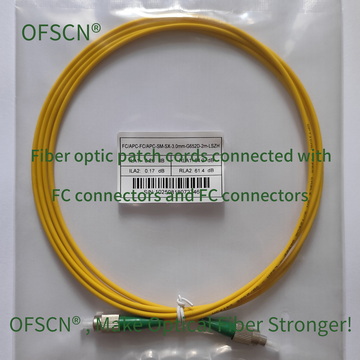
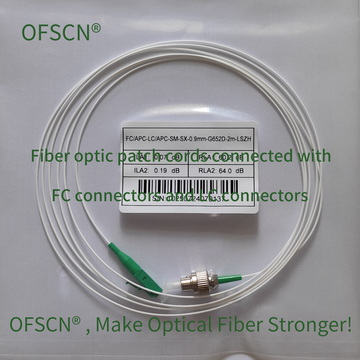
Single-Mode Fiber (SM): Usually Yellow
- Physical Mechanism: The core diameter of single-mode fiber (e.g., G.652D, G.657) is extremely small (typically around 9 µm), allowing only a single mode of light (such as 1310nm or 1550nm lasers) to propagate within it. The yellow jacket is the globally recognized identifier for single-mode fiber, used to warn engineers of its physical incompatibility with multi-mode fiber.
- Related Products: For example, OFSCN® Standard Fiber Patch Cord, which by default uses single-mode fiber patch cords encased in a yellow PVC jacket.
- Product Standard Images:
-
Multi-Mode Fiber (MM): Orange & Aqua
- Orange: Primarily used for OM1 (62.5/125µm) and OM2 (50/125µm) traditional multi-mode fibers. These fibers mainly use LEDs as light sources, have lower bandwidth, and are suitable for short-distance transmission.
- Aqua: Used for 10 Gigabit laser-optimized multi-mode fibers OM3 and OM4 (50/125µm). These fibers are optimized for differential mode delay (DMD) and are specifically matched with 850nm Vertical Cavity Surface Emitting Lasers (VCSELs), used in data centers and other high-bandwidth, short-distance high-speed networks.
- Lime Green or Erika Violet: Sometimes used for broadband multi-mode fiber OM5 (lime green) or specific high-density OM4 links.
II. Color Distinction of Special Fiber Optic Patch Cords
Specialty fiber optic patch cords typically operate in extreme environments (such as very high temperatures, very low temperatures, high tensile strength, strong corrosion, radiation, or high pressure environments). In such scenarios, the patch cord color no longer follows the conventional TIA-598-D plastic outer shell color standard, but is determined by the physical protective material or coating material used.
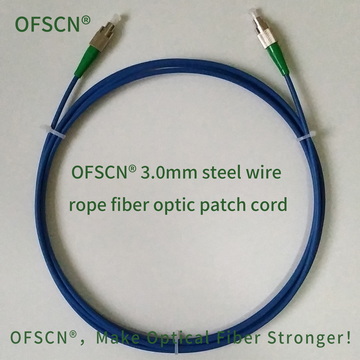
1. Armored/High Tensile Strength Special Patch Cords (Metallic Natural Color or Black)
To prevent rat bites, pressure, and stretching in outdoor or industrial heavy-load environments, special patch cords typically use stranded steel wire structures or stainless steel flexible conduits for protection:
- For example, the OFSCN® 3.0mm Steel Wire Rope Fiber Optic Patch Cord uses a PE jacket, stranded stainless steel wires, and a seamless stainless steel tube. Its appearance is black or metallic steel natural color, rather than standard colors like yellow or orange.
- Product Standard Images:

2. High-Temperature Resistant Special Patch Cords (Metallic Natural Color and Material Natural Color)
Since conventional PVC or LSZH (Low Smoke Zero Halogen) polymers melt or release gas above 100℃, high-temperature special patch cords usually use seamless stainless steel tubes (0.9mm diameter) for their outer jackets, thus appearing as Metallic Silver.
Inside the patch cord, depending on the temperature resistance, the coating material of the bare fiber exhibits distinctly different “physical natural colors”:
-
120℃~300℃ Environment (Polyimide Coating):
In the OFSCN® 300℃ Fiber Optic Patch Cord, the high-temperature single-mode fiber coating used internally is polyimide. This material physically appears as a semi-transparent Amber/Golden Yellow.- Product Standard Images:
- Product Standard Images:
-
700℃ Ultra-High Temperature Environment (Metal Plating):
In the OFSCN® 700℃ Fiber Optic Patch Cord, the fiber surface is coated with metallic gold. This gives the internal bare fiber a bright Metallic Gold appearance.- Product Standard Images:
- Product Standard Images:



Summary
The colors of standard fiber optic patch cords (yellow, orange, aqua) are engineering visual identification designs based on the TIA-598-D standard, aimed at preventing mixed insertion of different modes and fiber core sizes. Special fiber optic patch cords, due to their specific application background, have colors determined by the inherent physical colors of their stainless steel armored tubes, UV-resistant black PE, or their high-temperature resistant metallic/polyimide coatings.