What do 9 micrometers, 50 micrometers, and 62.5 micrometers represent in terms of performance?
In fiber optic jumpers and optical communication/sensing engineering, optical fibers are typically constructed concentrically from a Core, a Cladding (standard outer diameter commonly 125\ \mu\text{m} ), and a Coating.
The core is a region of high refractive index medium where optical signals are confined and transmitted via Total Internal Reflection. ** 9\ \ \mu\text{m} , 50\ \mu\text{m} , and 62.5\ \mu\text{m} ** represent the physical diameter of the fiber core (Core Diameter). This geometric parameter directly determines the optical fiber’s transmission modes (number of modes), modal dispersion, coupling tolerance, and bandwidth-distance product.
1. Core Diameter 9\ \mu\text{m} : Single-Mode Fiber (SMF)
- Transmission Mechanism: The core diameter is extremely small (on the order of the typical operating wavelength, e.g., 1310\ \text{nm} or 1550\ \text{nm}). When the normalized frequency satisfies V < 2.405, the fiber only allows the fundamental mode (\text{LP}_{01}) to propagate axially.
- Key Performance and Characteristics:
- Zero Intermodal Dispersion: Completely eliminates modal dispersion introduced by different propagation paths (higher-order transverse modes), leaving only material dispersion and waveguide dispersion (chromatic dispersion).
- Ultra-High Bandwidth and Extended Transmission Distance: Supports long-distance (tens to hundreds of kilometers) and high-speed optical communication, as well as high-precision optical sensing demodulation (e.g., Fiber Bragg Grating FBG sensing systems).
- High Coupling Requirements: Due to the small core diameter, extremely stringent geometric tolerances are required for fiber splicing and alignment.
- Representative Standards: ITU-T G.652 (e.g., G.652.D), ITU-T G.657, etc.
2. Core Diameter 50\ \mu\text{m} : Graded-Index Multimode Fiber (MMF)
- Transmission Mechanism: The core diameter is larger, supporting the simultaneous transmission of multiple transverse modes (higher-order modes). Modern 50\ \mu\text{m} fibers typically employ a sophisticated graded-index refractive profile, which makes the group delays of higher-order and lower-order modes converge, effectively suppressing intermodal dispersion.
- Key Performance and Characteristics:
- High Modal Bandwidth: Exhibits excellent effective modal bandwidth (EMB) within the multimode fiber system, outperforming traditional 62.5\ \mu\text{m} fibers.
- Cost-Effective Short-Reach Interconnects: Highly compatible with 850\ \text{nm} Vertical Cavity Surface Emitting Laser (VCSEL) sources, widely used in high-speed local area networks (LANs) and data center interconnects over distances from one hundred to several hundred meters (e.g., OM2, OM3, OM4, OM5 standards).
- Wider Coupling Tolerance: The larger light-receiving area reduces the difficulty of precision optical alignment.
3. Core Diameter 62.5\ \mu\text{m} : Traditional Multimode Fiber (OM1)
- Transmission Mechanism: The core diameter is large, with a high numerical aperture (\text{NA} \approx 0.275), providing excellent light-capturing ability.
- Key Performance and Characteristics:
- High Coupling Efficiency: Easily achieves efficient coupling with low-cost, incoherent light sources with large divergence angles, such as Light Emitting Diodes (LEDs).
- Significant Intermodal Dispersion: Due to the large core diameter and the large number of supported modes, intermodal dispersion of optical pulses is significant during transmission, resulting in a lower bandwidth-distance product.
- Limited Application Scenarios: Primarily found in legacy local area network infrastructure (e.g., lower-speed short-reach links like 10BASE-FL, 100BASE-FX) or specific industrial control and sensing systems with low bandwidth requirements. It has been largely replaced by 50\ \mu\text{m} fibers in modern high-speed systems.
Performance Comparison Overview
| Core Diameter Parameter | Fiber Type | Mainstream Light Source | Intermodal Dispersion | Typical Bandwidth | Transmission Distance Capability | Typical Application Areas |
|---|---|---|---|---|---|---|
| 9\ \mu\text{m} | Single-Mode (SMF) | Laser Diode (LD, DFB) | None | Extremely High (THz range) | Long distance (kilometers to hundreds of kilometers) | Telecom backbone networks, metropolitan area networks, FBG high-precision fiber optic grating sensing |
| 50\ \mu\text{m} | Multimode (OM2~OM5) | 850 nm VCSEL / Laser Diode | Low to Medium | High (up to several GHz·km) | Medium-short distance (hundreds of meters to several hundred meters) | Data centers, high-performance enterprise network internal interconnects |
| 62.5\ \mu\text{m} | Multimode (OM1) | Light Emitting Diode (LED) | Relatively Large | Low (approx. 200~500 MHz·km) | Short distance (typically < 2 km) | Legacy low-speed LANs, some industrial control links |
Related OFSCN® Official Product References
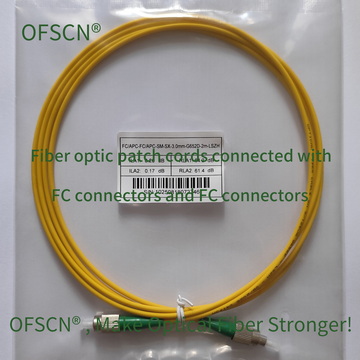
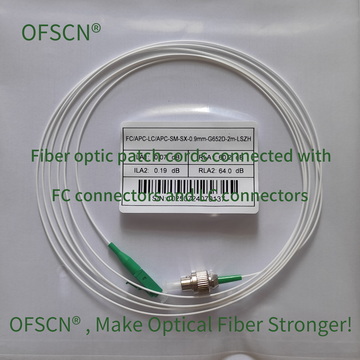
Beijing Dacheng Yongsheng Technology Co., Ltd. (OFSCN®) offers standard and specialty fiber optic jumper and bare fiber products covering different core specifications for both single-mode and multimode fibers: