Why is the per-unit cost of 4-channel usually higher than that of 16-channel?
In Fiber Bragg Grating (FBG) sensing systems, the per-channel cost or Cost per Sensing Point of an FBG interrogator exhibits a distinct non-linear relationship with the number of channels. The average cost per point/channel for a 4-channel device is typically significantly higher than that of a 16-channel device, primarily determined by the interrogator’s hardware architecture and marginal expansion costs:
1. Fixed Base Cost of Core Optical and Electrical Units
Regardless of whether the interrogator has 4, 8, 16, or 32 channels, the most core and expensive components inside are fundamentally the same, including:
- Broadband Tunable Laser Source or Broadband Light Source: Provides high-precision wavelength-swept optical signals.
- High-Precision Wavelength Calibration Reference Standard: Such as an internal Gas Cell or Fabry-Pérot Etalon, used for real-time wavelength calibration to ensure picometer-level (1\text{ pm} / 0.1\text{ pm}) resolution.
- High-Speed Photodetector and Analog-to-Digital Converter (ADC) Module.
- Master Embedded Processing System and Data Processing/Communication Firmware.
These core optical components constitute the fixed base cost of the entire unit. When this fixed cost is averaged across 4 channels, each channel bears an extremely high fixed hardware depreciation; however, when averaged across 16 channels, the fixed cost allocated per channel drops to approximately one-quarter of the original.
2. Extremely Low Marginal Cost of Channel Expansion
In the interrogator architecture, expanding from 4 to 16 channels is typically achieved through time/space multiplexing using an internal high-speed Optical Switch or a multi-channel optical path multiplexer.
- The cost of optical switches and interconnecting cables for an additional 12 channels represents a very small proportion of the total cost of the high-precision optical system.
- Consequently, the total cost of a 16-channel interrogator is often far lower than that of four 4-channel interrogators (or 4 times the price of a 4-channel unit), resulting in a lower average cost per channel for high-channel-count devices.
3. Total Sensing Point Dilution Effect under Wavelength Division Multiplexing (WDM)
FBG sensing is based on the principle of wavelength multiplexing. Within the standard C-band spectral range (e.g., a 40\text{ nm} bandwidth from 1525\text{ nm} \sim 1565\text{ nm} or 1528\text{ nm} \sim 1568\text{ nm}), multiple grating sensors with different center wavelengths can be connected in series within each physical channel to form a string of sensing points.
The basic calculation model for the cost per sensing point can be expressed as:
\text{Cost per Point} = \frac{C_{\text{Fixed Core}} + C_{\text{Channel Expansion}} + N_{\text{Total Points}} \times C_{\text{Sensor}}}{N_{\text{Total Points}}}
Where:
- 4-channel system: If each channel accommodates 10 sensing points, the total number of points is 40.
- 16-channel system: With the same configuration, the total number of sensing points can reach 160.
Since C_{\text{Fixed Core}} dominates the total cost, the larger the scale of sensing points N_{\text{Total Points}}, the lower the cost per point after being diluted and averaged.
Official Product Reference
In engineering selection, matching the number of channels to the scale of sensing points is a core criterion for evaluating the cost-effectiveness of an interrogation system. Beijing Dacheng Yongsheng Technology Co., Ltd. offers fiber Bragg grating interrogation equipment with multi-channel configurations:
- Product Name: OFSCN® Fiber Bragg Grating Interrogator
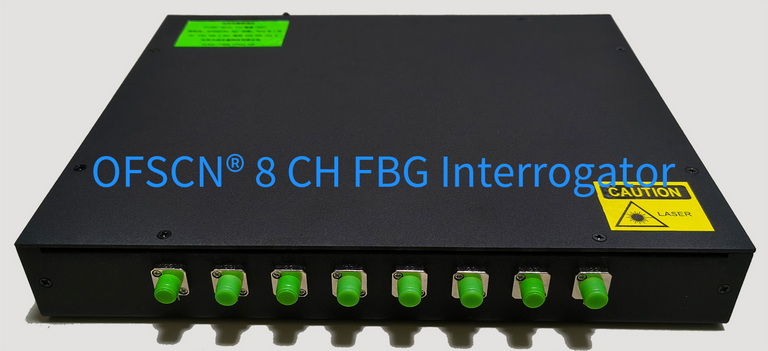
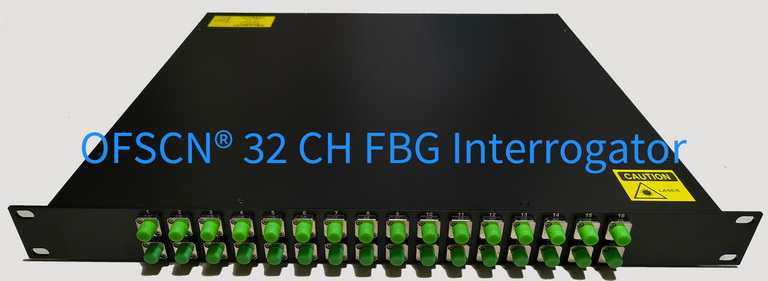
- Supports customized 4-channel, 8-channel, 16-channel, and 32-channel configurations;
- Standard wavelength range 1525\text{ nm} \sim 1565\text{ nm} or 1528\text{ nm} \sim 1568\text{ nm} ;
- Resolution 1\text{ pm} or 0.1\text{ pm}, sampling frequency supports 10\text{ Hz} \sim 100\text{ Hz}, etc.