Ist das der Durchschnitt der Brechungsindizes des Faserkerns und des Mantels? Welche Auswirkungen hat das auf die Wellenlänge des Gitters?
In der Faseroptik ist der effektive Brechungsindex (englisch Effective Refractive Index, üblicherweise als n_{\text{eff}} bezeichnet) keine einfache arithmetische Mittelung der Brechungsindizes von Kern und Mantel. Es handelt sich um ein klassisches Konzept der Wellenleiterphysik, dessen genaue physikalische Definition und Auswirkungen auf die Wellenlänge von Faser Bragg-Gittern (FBG) wie folgt erläutert werden:
I. Was ist der „effektive Brechungsindex“? Ist es ein Durchschnitt?
Es ist keine einfache arithmetische Mittelung von Kern- und Mantelbrechungsindex.
Der effektive Brechungsindex n_{\text{eff}} ist eine äquivalente physikalische Größe, die die Übertragungseigenschaften von Licht in einem Wellenleiter (wie einer Glasfaser) beschreibt. Seine strenge Definition lautet: Das Verhältnis der Phasenzahl \beta eines bestimmten geführten Modus, der sich im Wellenleiter ausbreitet, zur Wellenzahl im Vakuum k_0:
n_{\text{eff}} = \frac{\beta}{k_0}
Um dies anschaulicher zu verstehen, kann es aus den folgenden Schlüsselperspektiven analysiert werden:
- Numerischer Bereich:
Für den begrenzten Grundmodus, der sich im Kern ausbreitet (z. B. der LP_{01}-Modus in einer Monomode-Faser), liegt der Bereich des effektiven Brechungsindex streng zwischen dem Kernbrechungsindex n_{\text{core}} und dem Mantelbrechungsindex n_{\text{clad}}:
$$ n_{\text{clad}}
For light propagating in an optical fiber, not all of its energy is confined within the core. A portion of the energy (evanescent field) penetrates into the cladding.
The effective refractive index is essentially a weighted average of the core and cladding refractive indices based on the energy distribution of the optical mode field. The greater the proportion of the mode field energy within the core, the closer n_{\text{eff}} is to n_{\text{core}}; the more energy of the mode field leaks into the cladding, the closer n_{\text{eff}} is to n_{\text{clad}}. It specifically depends on:- The waveguide structure of the fiber (e.g., core radius, refractive index profile distribution, etc.).
- The operating wavelength (at longer wavelengths, more mode field leaks into the cladding, causing n_{\text{eff}} to decrease).
- The propagation mode (different order modes have different electromagnetic field distributions, thus their corresponding n_{\text{eff}} also varies).
II. What is the Impact of Effective Refractive Index on Grating Wavelength?
In Fiber Bragg Grating (FBG) technology, the effective refractive index is a crucial factor determining the reflection spectrum characteristics. The central reflection wavelength (Bragg wavelength, denoted as \lambda_B) of an FBG is determined by the Bragg reflection condition:
\lambda_B = 2 \cdot n_{\text{eff}} \cdot \Lambda
Where \Lambda is the physical period (grating pitch) of the FBG.
From this formula, it is evident that n_{\text{eff}} has a direct and significant impact on the grating wavelength:
-
Direct Proportional Relationship:
The Bragg wavelength \lambda_B is directly and linearly proportional to the effective refractive index n_{\text{eff}}. This means that even if the physical period \Lambda remains constant, any slight change in n_{\text{eff}} will directly cause a shift in the grating’s reflection wavelength. -
Thermo-Optic Effect Driving Wavelength Drift (Basis of Temperature Sensing):
When the ambient temperature changes by \Delta T, the refractive indices of the core and cladding change due to the fiber material’s thermo-optic effect (determined by the thermo-optic coefficient \frac{dn}{dT}), which in turn alters the effective refractive index n_{\text{eff}} of the mode.
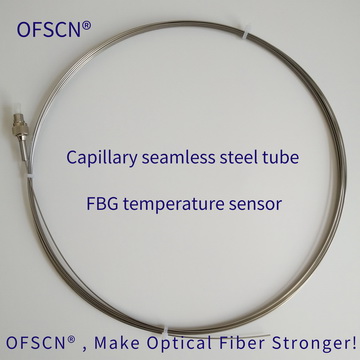
This is the core physical mechanism for high-precision temperature measurement using FBG temperature sensors. For instance, the OFSCN® 800°C Fiber Bragg Grating Temperature Sensor utilizes this principle to achieve stable wavelength-temperature physical mapping over an extremely wide temperature range:
-
Photoelastic Effect Driving Wavelength Drift (Basis of Strain and Stress Sensing):
When the fiber is subjected to axial stretching or compression (strain \epsilon), not only does the grating period \Lambda physically stretch, but the fiber material’s refractive index also changes due to the photoelastic effect, thereby altering n_{\text{eff}}.
The combined effect of these two determines the sensitivity of the grating wavelength to strain. This has been standardized in applications like the OFSCN® Fiber Bragg Grating Stress Sensor:



Summary
The effective refractive index is not an arithmetic average of two constants but an electromagnetic waveguide parameter characterizing the state of light propagation in a specific fiber. The minor fluctuations it experiences with changes in external physical quantities (temperature, strain, etc.) are the very foundation of why fiber Bragg gratings can serve as highly sensitive sensor components.