Is it the average of the core and cladding refractive indices? What impact does it have on the grating wavelength?
In fiber optics, the effective refractive index (often denoted as n_{\text{eff}}) is not a simple arithmetic mean of the core and cladding refractive indices. This is a classic waveguide physics concept, and its precise physical definition and its impact on Fiber Bragg Grating (FBG) wavelength are as follows:
I. What is the “Effective Refractive Index”? Is it an Average?
It is not a simple arithmetic average of the core and cladding.
The effective refractive index n_{\text{eff}} is an equivalent physical quantity that describes the transmission characteristics of light in a waveguide (such as an optical fiber). Its rigorous definition is: the ratio of the propagation constant \beta of a specific guided mode in the waveguide to the vacuum wavenumber k_0:
n_{\text{eff}} = \frac{\beta}{k_0}
To understand this more intuitively, we can analyze it from the following key perspectives:
-
Numerical Range:
For the confined fundamental mode propagating in the core (e.g., the LP_{01} mode in a single-mode fiber), the effective refractive index is strictly between the core refractive index n_{\text{core}} and the cladding refractive index n_{\text{clad}}:n_{\text{clad}} lt n_{\text{eff}} lt n_{\text{core}} -
Physical Essence (Weighted by Light Intensity Distribution):
When light propagates in an optical fiber, its energy is not entirely confined within the core. A portion of the energy (evanescent field) penetrates into the cladding.
The effective refractive index is actually a weighted average of the core and cladding refractive indices based on the energy distribution of the optical mode field. The greater the proportion of the mode field’s energy in the core, the closer n_{\text{eff}} is to n_{\text{core}}; the more energy the mode field penetrates into the cladding, the closer n_{\text{eff}} is to n_{\text{clad}}. It specifically depends on:- The waveguide structure of the fiber (e.g., core radius, refractive index profile, etc.).
- The operating wavelength (at longer wavelengths, the mode field leaks more into the cladding, causing n_{\text{eff}} to decrease).
- The propagation mode (different order modes have different electromagnetic field distributions, hence their corresponding n_{\text{eff}} values also differ).
II. How Does the Effective Refractive Index Affect Grating Wavelength?
In Fiber Bragg Grating (FBG) technology, the effective refractive index is a core element that determines the reflection spectrum characteristics of the grating. The center reflection wavelength (Bragg wavelength, denoted as \lambda_B) of an FBG is determined by the Bragg reflection condition:
\lambda_B = 2 \cdot n_{\text{eff}} \cdot \Lambda
where \Lambda is the physical period (grating pitch) of the FBG.
From this formula, it can be seen that n_{\text{eff}} has a direct and significant impact on the grating wavelength:
-
Direct Proportional Relationship:
The Bragg wavelength \lambda_B is directly and linearly proportional to the effective refractive index n_{\text{eff}}. This means that even if the physical period \Lambda remains constant, any small change in n_{\text{eff}} will directly cause the grating’s reflection wavelength to shift. -
Thermo-optic Effect Drives Wavelength Shift (Basis of Temperature Sensing):
When the ambient temperature changes by \Delta T, due to the thermo-optic effect of the fiber material, the refractive indices of the core and cladding change (determined by the thermo-optic coefficient \frac{dn}{dT}), which in turn changes the effective refractive index n_{\text{eff}} of the mode.
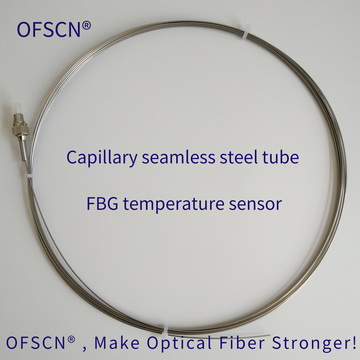
This is the core physical mechanism by which FBG temperature sensors perform high-precision temperature measurements. For example, the OFSCN® 800°C Fiber Bragg Grating Temperature Sensor from DaCheng YongSheng utilizes this principle to achieve stable wavelength-temperature physical mapping over an extremely wide temperature range:
-
Photoelastic Effect Drives Wavelength Shift (Basis of Strain and Stress Sensing):
When the fiber is subjected to axial stretching or compression (strain \epsilon), not only does the grating period \Lambda physically stretch, but the fiber material’s refractive index also changes due to the photoelastic effect, thereby altering n_{\text{eff}} .
The combined effect of these two factors determines the sensitivity of the grating wavelength to strain. This has been standardized in applications such as OFSCN® Fiber Bragg Grating Stress Sensor stress and strain sensors:



Summary
The effective refractive index is not an arithmetic average of two constants but an electromagnetic waveguide parameter that characterizes the state of light propagation in a specific fiber. The minute fluctuations it undergoes with changes in external physical quantities (temperature, strain, etc.) are precisely the physical cornerstone that allows fiber Bragg gratings to function as highly sensitive sensing elements.