Fiber optik patch kabloları neden parazitsiz yüksek gerilim kablolarına yakın döşenebilir?
Fiber optic patch cords can be routed adjacent to high-voltage cables without any interference due to their perfect “electromagnetic transparency” at the physical layer. This is primarily determined by the signal transmission mechanism of optical fibers and the dielectric properties of their base material.
I. Core Physical Principles: Why No Electromagnetic Interference?
-
Fundamental Difference in Signal Carriers (Photons vs. Electrons)
Traditional metal wires (like copper wires) transmit signals using the flow of electric charges (electrons), which are highly susceptible to electromagnetic coupling interference (EMI/RFI) from external electric and magnetic fields.
Fiber optic patch cords transmit high-frequency photons (light waves) internally. Light waves belong to a very high-frequency part of the electromagnetic spectrum, with operating wavelengths (typically 1310\text{ nm} or 1550\text{ nm}) corresponding to frequencies in the terahertz (\text{THz}) range. This differs by more than ten orders of magnitude from the alternating electromagnetic fields generated by high-voltage cables (usually industrial frequency 50\text{ Hz} or 60\text{ Hz} and their low-frequency harmonics). The macroscopic alternating electromagnetic fields generated by high-voltage cables cannot modulate or alter the phase, amplitude, or wavelength of high-frequency photons in optical fibers, thus giving optical signals inherent electromagnetic immunity during transmission. -
Dielectric Properties of Base Material (High-Purity Silicon Dioxide)
The core and cladding of optical fibers are primarily composed of high-purity silicon dioxide (\text{SiO}_2) glass. Silicon dioxide is an excellent electrical insulator:- No Free Charges: It cannot form conductive paths or generate leakage current under strong electric fields.
- Extremely Low Permeability: The relative magnetic permeability of silicon dioxide, \mu_r, is close to 1, classifying it as a non-magnetic medium. It does not generate eddy currents or induced electromotive forces under strong alternating magnetic fields.
This is the so-called “electromagnetic transparency” – electromagnetic fields can pass through silicon dioxide without any electrical or magnetic interaction, thereby preventing induced noise.
II. Practical Safety Considerations for High-Voltage Cable Routing: Metal Armoring vs. Fully Insulated Structures
While optical signals inside optical fibers are absolutely immune to electromagnetic interference, practical routing engineering near high-voltage cables requires distinguishing between optical signal transmission safety and system safety under high-voltage electric fields:
-
Optical Signal Transmission Safety Level
Regardless of whether the outer layer of a fiber optic patch cord contains a metal protective layer, its internal optical signal remains 100% free from interference. For example, several high-strength, high-temperature resistant fiber optic patch cords offered by OFSCN® (such as OFSCN® 120℃ Fiber Optic Patch Cord, OFSCN® 200℃ Fiber Optic Patch Cord, and OFSCN® 300℃ Fiber Optic Patch Cord), are armored with stainless steel seamless pipes to withstand harsh physical environments. Even in environments with strong electromagnetic interference, they can perfectly ensure lossless optical signal transmission. -
High Electric Field Safety and Discharge Risk Level
If fiber optic patch cords or sensors are directly attached to high-voltage, high-risk areas such as ultra-high voltage cable joints, transformer windings, or high-voltage switchgear busbars, the presence of metal armoring or conductors (like steel wires or stainless steel tubes) can induce static electricity in the strong electric field. This leads to localized electric field distortion, potentially causing partial discharge (PD) or even flashover and arcing, resulting in severe power safety incidents.
Therefore, in such high-voltage, strong electric field environments, non-metallic/fully insulated (Non-metallic/Insulated) structures must be used.
III. OFSCN® Professional Power Insulation and Electromagnetic Transparent Temperature Sensors
For temperature monitoring in high-voltage, strong electromagnetic power environments, OFSCN® has specifically developed insulated Fiber Bragg Grating (FBG) temperature sensors encapsulated with non-metallic materials. These sensors achieve electromagnetic transparency and insulation safety while ensuring extremely high temperature measurement accuracy:
-
OFSCN® Ceramic-encapsulated Fiber Bragg Grating Temperature Sensor
- Technical Advantages: The outer layer of this sensor abandons traditional metal encapsulation, instead using high-performance ceramic tubes with excellent electrical insulation properties for encapsulation. It can operate safely in extreme high and low temperatures and strong electric fields ranging from -270\text{ ℃} to 800\text{ ℃}, completely eliminating electric field distortion and discharge hazards, making it a truly “electromagnetic transparent” sensor.
- Standard Images:
-
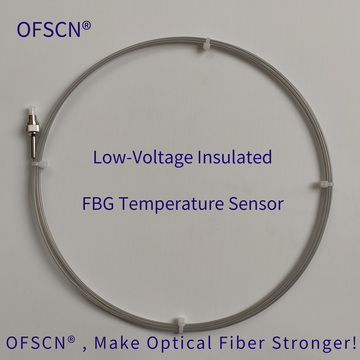
OFSCN® 150 Low-Voltage Insulated Fiber Bragg Grating Temperature Sensor
- Technical Advantages: Designed specifically for power systems, it is protected by high-polymer insulating composite materials. It is suitable for temperature measurement in medium and low-voltage distribution systems, busbars, and cable joints operating from -40\text{ ℃} to 150\text{ ℃}, providing reliable electrical insulation.
- Standard Images:



In summary, due to their unique physical properties, fiber optic patch cords do not need to worry about any electromagnetic interference when routed adjacent to high-voltage cables. However, in practical engineering applications, it is still necessary to select insulated, non-metallic encapsulated sensors and optical cables according to the specific voltage level and electric field strength to ensure the overall power safety of the high-voltage system.