How does overtightening or undertightening bolts affect the vacuum seal?
In vacuum engineering and fiber optic sensing technology, the installation torque of flanges is critical. Over-tightening or under-tightening bolts not only directly affects the system’s vacuum sealing performance but also can cause irreversible physical damage to the high-precision optical sealing structure within the fiber optic vacuum flange.
OFSCN® fiber optic vacuum flanges encompass two mainstream technical solutions: KF series (primarily using rubber O-ring seals) and CF series (primarily using metal copper gaskets for ultra-high vacuum sealing). The physical responses of different flange types under locking deviations are as follows:
I. Effects of Under-tightening Bolts (Insufficient Torque)
When the installation torque is below the standard specification, insufficient sealing pressure cannot be established between the flange faces, leading to sealing failure.
- KF Series (Quick-release / Rubber Seal):
- Sealing Mechanism Failure: Rubber O-rings (e.g., Viton) require moderate compression to fill the microscopic rough grooves on the flange sealing surface. If the torque is too low, the compression deformation of the seal ring is insufficient, leaving microscopic gaps between the sealing surface and the seal ring, resulting in molecular or viscous flow leakage of external gases.
- CF Series (ConFlat Metal Seal):
- Failure of Knife-edge Bite: CF flanges rely on the “knife-edge” of the stainless steel raised lip to bite into the oxygen-free copper gasket, achieving ultra-high vacuum sealing through the plastic deformation of the gasket. If the bolt torque is insufficient, the knife-edge does not bite deep enough into the copper gasket, failing to block microscopic leakage paths, and the system will not be able to reach ultra-high vacuum levels of 1 \times 10^{-7}\text{ Pa} or 1 \times 10^{-9}\text{ Pa}.
II. Effects of Over-tightening Bolts (Excessive Torque)
Over-tightening bolts is a more common and more hazardous operational error in engineering assembly. Its negative impacts manifest as mechanical damage and internal stress transmission:
- Damage to Sealing Elements and Flange Body:
- KF Series: Excessive compression can cause the rubber seal ring to exceed its elastic limit, resulting in “Compression Set.” In severe cases, it can lead to cracking, shearing, or deformation of the plastic centering ring.
- CF Series:
- Knife-edge Blunting: Excessive torque can cause the compressive stress on the stainless steel knife-edge to exceed its material yield limit, leading to microscopic edge chipping, deformation, or blunting of the knife-edge. This permanently damages the flange body, rendering it unusable for repeated applications.
- Copper Gasket Over-compression: The copper gasket can be compressed too thin and squeeze out into the channel, compromising its structure.
- Bolt Yielding: Bolts themselves may undergo plastic elongation (stripping or fracture) due to over-stretching. In subsequent cooling or heating cycles, they may lose their locking force, causing delayed leaks.
- Stress Transmission to Fiber Optic Encapsulation Interface (Most Critical Physical Hazard):
- The unique feature of fiber optic vacuum flanges (such as OFSCN® products) is the glass fiber passing through the center. To achieve high vacuum isolation and low optical loss within a minimal space, the fiber is typically hermetically sealed to the metal body using special low-melting point glass powder, ceramic transition materials, or specialized high-temperature adhesives.
- Stress Concentration and Transmission: When flange bolts are tightened unevenly and excessively, significant localized shear stress and bending strain are introduced into the flange body. This mechanical stress can transmit to the internal fiber optic sealing interface. At best, it can cause micro-bending loss in the fiber and alter its polarization state; at worst, it can cause micro-cracking in the rigid glass/ceramic hermetic seal layer, leading to extremely subtle, slow leaks, or even directly shear the internal bare fiber, resulting in optical signal interruption.
III. Official Recommended Installation Guidelines and Standard Product Introduction
To achieve the designed ultra-high vacuum performance, it is recommended to use a torque wrench during installation and strictly follow the “cross-pattern” method in stages (e.g., at 30\%, 60\%, and 100\% of the design torque) for gradual and uniform tightening to ensure even stress distribution on the gasket.
For various vacuum systems, OFSCN® offers standardized and customized fiber optic vacuum sealing solutions:
Product Name: OFSCN® Fiber Optic Vacuum Sealed Flange
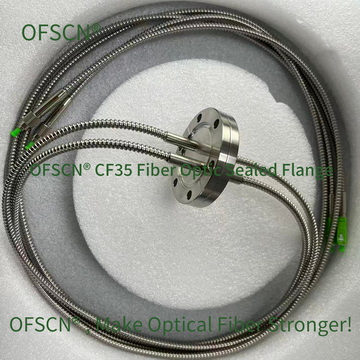
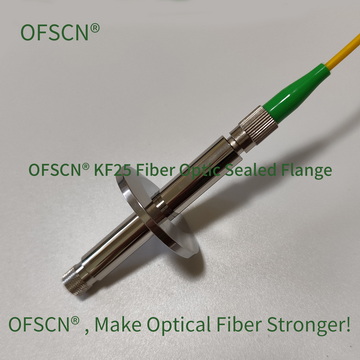
Key Parameters:
- Series Classification: Divided into CF (ultra-high vacuum metal seal) and KF (high vacuum rubber seal) series, supporting single-head and multi-head configurations, with customizable male (Plug) or female (Socket) connectors.
- Vacuum Level: Better than 1 \times 10^{-7}\text{ Pa} and 1 \times 10^{-9}\text{ Pa}.
- Temperature Resistance: Standard products for room temperature use; special products customizable for high temperatures up to 250\ ^{\circ}\text{C}.
- Physical Form: Supports seamless hermetic feedthrough for single-mode, multi-mode, or polarization-maintaining fibers, ensuring low-loss optical communication and sensor signal transmission between the inside and outside of the vacuum chamber.